

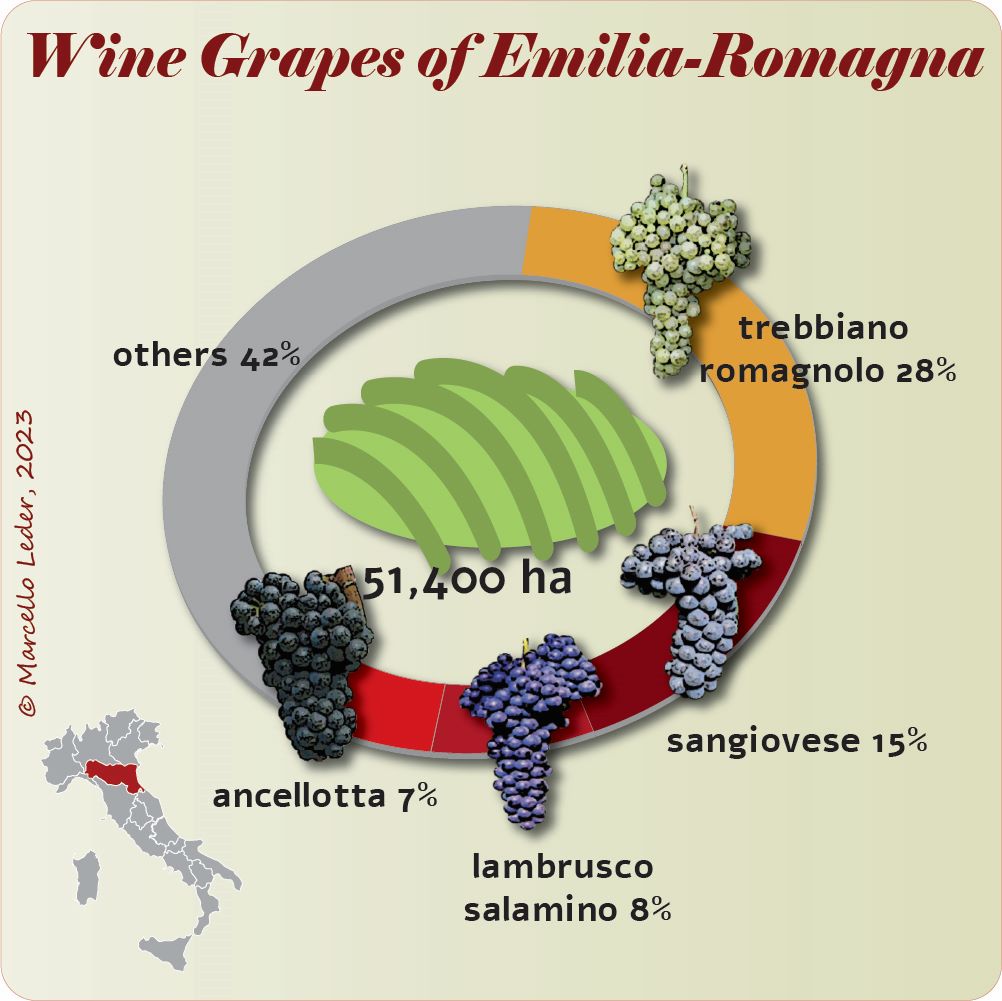
Emilia and Romagna, though administratively united and sharing similar traditions, exhibit significant differences in their viticultural practices and grape varieties.
Wine grapes of Emilia
Emilia’s 28,000 hectares of vineyards are predominantly located in the plains (71%), with 25% in the hills and 4% in mountainous areas. The region produces approximately 6.7 million hectoliters of wine annually, with black grape varieties constituting 70% of the total, predominantly local and indigenous over international varieties. Sangiovese is particularly widespread in the province of Bologna.
International grape varieties cover less than 5% of Emilia’s vineyard area. In a region where red wines predominate, international varieties are mostly white, including Sauvignon blanc, followed by Chardonnay and Pinot Bianco, mainly found in the provinces of Reggio Emilia and Bologna, as well as Cabernet Sauvignon. These are mostly cultivated in the hills, where they can express their character, producing firm and well-structured wines.
In the Piacenza province of Emilia, the most common grape varieties are black grapes, Barbera and Croatina, defining the Gutturnio DOC and, to some extent, Bonarda. White grape varieties include Malvasia di Candia aromatica and Moscato bianco, along with the indigenous Ortrugo. International varieties like Chardonnay, Pinot Bianco, and Pinot Grigio, Riesling Italico, and Müller-Thurgau are also cultivated. The Parma province is distinguished by a prevalence of white over red wine grapes, with no significant difference in grape varieties cultivated. The provinces of Reggio-Emilia and Modena are known for cultivating Lambrusco in varieties such as Lambrusco Salamino, Lambrusco Maestri, Lambrusco Marani, Lambrusco Montericco, and Ancellotta. Lambrusco di Sorbara and Lambrusco Grasparossa are more prevalent in Modena. In the Bologna province, Montù and Pignoletto, both white grapes, are widespread with the Reno DOC and Colli Bolognesi Classico Pignoletto DOCG. The Ferrara province features the black grape Fortana (also known as Uva d’Oro) with the Bosco Eliceo DOC appellation as its reference.
Romagna’s Wine Grapes
Romagna’s 23,000 hectares of vineyards are primarily in the plains (76%), with 23% in the hills and 1% in mountainous areas. The region produces over 3 million hectoliters of wine annually, 70% of which is white. The landscape of national grape varieties is dominated by Trebbiano Romagnolo, especially cultivated in the fertile, flat areas along the Via Emilia, where vineyards ensure high productivity.
International grape varieties constitute a small fraction of Romagna’s vineyard area. Among white grapes, Chardonnay (about 1.7% of the total vineyard area), Pinot Bianco (1%), and Sauvignon blanc (0.5%) are the most cultivated, while among black grapes, Merlot (3%) and Cabernet Sauvignon (1.5%) are prevalent. These newer varieties are mainly grown in the hilly areas, more suitable for quality viticulture, to produce varietal wines or blends.
In Romagna, Sangiovese is the most important black grape variety, significantly outpacing Trebbiano Romagnolo, the most widespread white grape in the region. The white Pagadebit and Albana, the latter giving rise to the Albana di Romagna DOCG, are cultivated around Faenza. The key viticultural areas include the hills around Faenza, the hilly zone of Forlì, and the hills surrounding Cesena and Rimini, reflecting the distinct viticultural identities of Emilia and Romagna within their shared regional boundary.