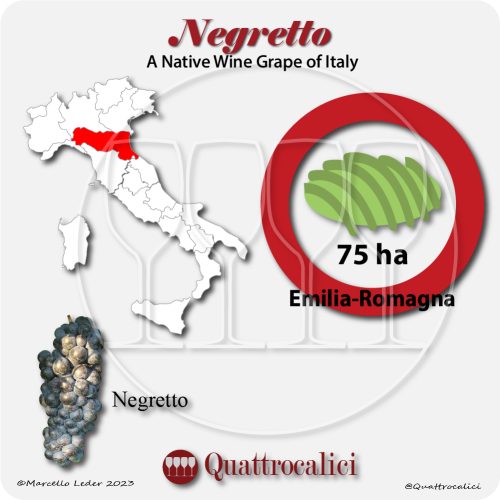


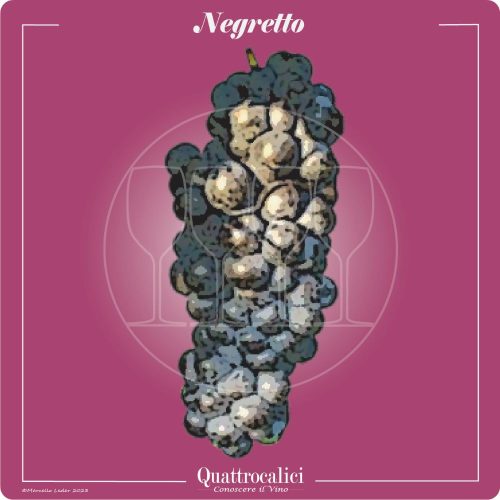
Negretto is one of the lesser-known indigenous grape varieties of Emilia-Romagna, the only Italian region where it is planted. Historically, the name “Negretto,” along with others of this kind, was used to denote grapes with particularly dark berries. During the post-phylloxera reconstruction period, Negretto was widely used due to its rustic nature and, in particular, its tolerance to diseases. In the early 1900s, Negretto was still extensively cultivated in the Colli Bolognesi area, with estimates suggesting that out of 20,000 hectares of vineyards, over half were planted with Negretto. However, this grape was not particularly suited for single-varietal wines and was primarily used as a blending grape for its rich color. In recent years, it was nearly extinct, but thanks to the efforts of a few dedicated winemakers, some interesting biotypes have been preserved.
The Negretto grape has a good and consistent yield and prefers clayey and less fertile soils. Recommended training systems include GDC (Geneva Double Curtain) or spur-pruned cordon, with short pruning. It is a grape that is highly sensitive to frost and Botrytis. Wines produced from pure Negretto, though rare, exhibit an intense color and a moderately complex aromatic profile, rich in spicy notes, fruity aromas of red berries and black cherry, along with herbal hints. On the palate, the wine is somewhat astringent, slightly bitter, with medium acidity and body.