The Best Tool to Learn about Italian Wine

italian wine regions - quattrocalici

Wine in Emilia-Romagna

local grapes, wine, and food

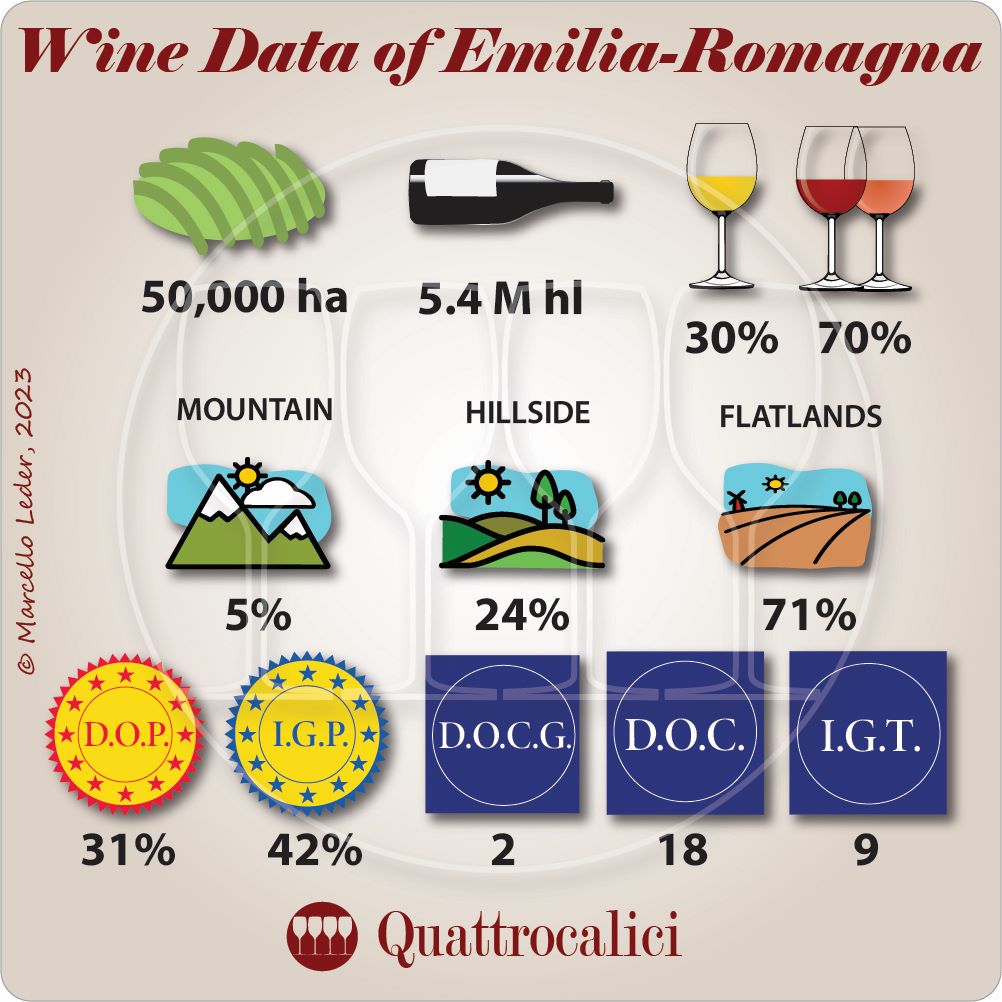
Wine data of Italy's region Emilia-Romagna

Emilia-Romagna stands as one of the largest wine-producing Italian regions by area, with approximately 60,000 hectares under vine. The region’s landscape is roughly 50% flat, 25% hilly, and 25% mountainous, with elevations exceeding 2,000 meters above sea level in the Tuscan-Emilian Apennines. As such, the distribution of vineyards is approximately 75% in the plains, 20% in hilly areas, and 5% in mountainous zones (between 400 and 600 meters above sea level). The climate, and thus the pedoclimatic characteristics of the territory, give rise to various wine zones, progressing from west to east towards the milder zones of the Romagna Riviera. The region is divided into two distinct geographical and cultural areas: Emilia, in the western part of the region, and Romagna, in the eastern part, along the Adriatic coastline. These two areas are distinguished not only by their different culinary traditions but also by the grape varieties cultivated and, consequently, the wines produced. Emilia is the undisputed home of “Lambruschi,” sparkling red wines, while in Romagna, the focus shifts predominantly to still wines produced from Sangiovese, Albana, and Pignoletto grapes. This diversity underscores the region’s rich viticultural heritage, offering a wide range of wines that reflect the unique characteristics of their respective territories.

Wine figures of Emilia-Romagna

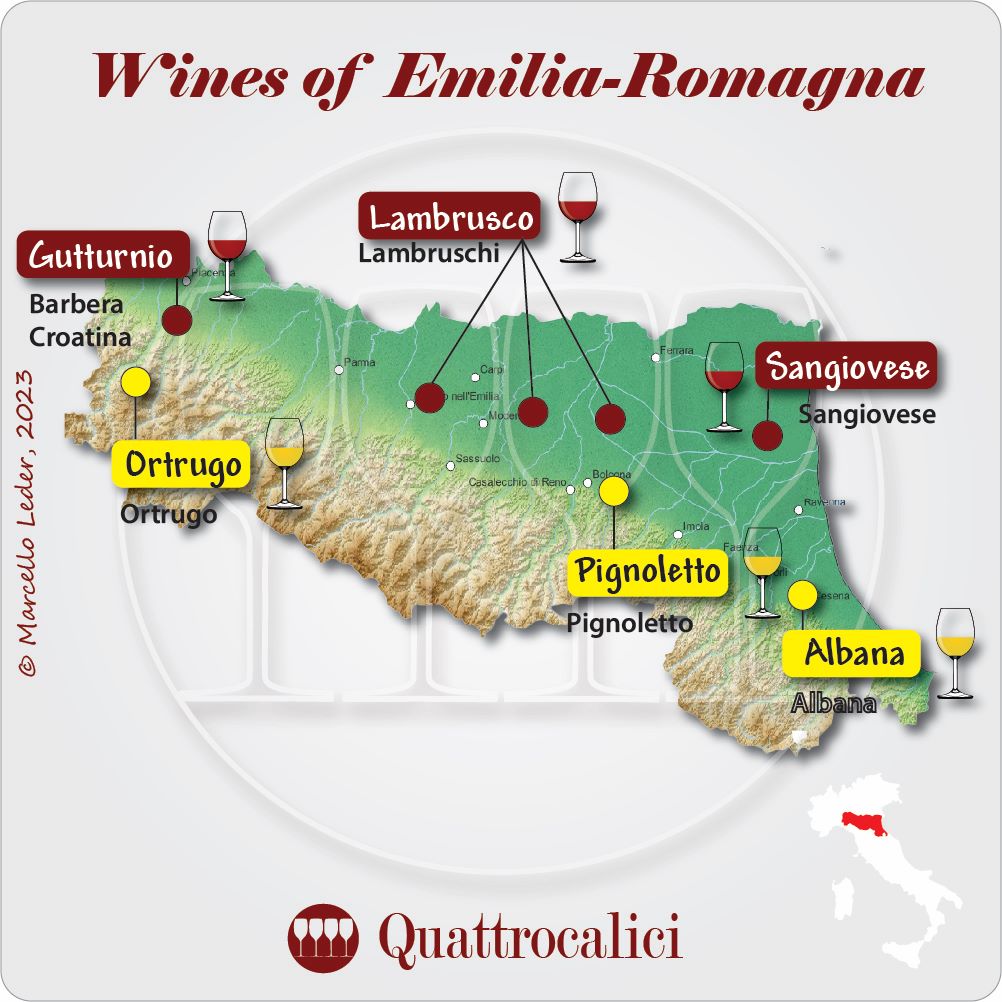
Wines of Italy's region Emilia-Romagna

Viticolture in Emilia-Romagna

The viticulture of Emilia-Romagna, a region located in the heart of Italy, is distinguished by its significant climatic and pedological diversity, which greatly influences the viticultural and agronomic techniques employed, as well as the vine training systems used. The most widespread vine training systems in Emilia-Romagna include:

Guyot: This pruning system is very common in the hilly areas, where both white and red grape varieties require more sun exposure and good aeration. It allows for targeted production management and qualitative control of the bunches.

Cordon Training: Suitable for varieties that respond well to short pruning, this system is often used in the flat and hilly areas to facilitate the mechanization of viticultural operations.

Pergola and Tendone: While less common, these systems are still found, especially in more traditional areas or for specific grape varieties that benefit from increased sun protection. These systems help achieve good production while maintaining a favorable microclimate around the vine.

The choice of training system and viticultural techniques in Emilia-Romagna is strongly influenced by zoning, which considers factors such as microclimate, soil, exposure, and altitude. For instance, in the hilly areas where the risk of spring frosts is lower and solar exposure is optimal, training systems that enhance the exposure of the bunches are preferred. In the coastal and flat areas, where humidity can be higher, foliage management techniques and training systems tend to aim for greater canopy aeration. This nuanced approach to vineyard management reflects the region’s commitment to producing high-quality wines that express the unique characteristics of their terroir.

History of Winemaking in Emilia-Romagna

La storia della vite e del vino in Emilia-Romagna risale all’epoca preromana ed è legata alla sua uva più famosa, il Lambrusco, citata già da Plinio il Vecchio nella sua Naturalis Historia, dove ne descrive le proprietà mediche e le caratteristiche. Sembra che il nome Lambrusco derivi da Vitis Labrusca, antica specie di vite selvatica di cui non ci sono notizie certe relativamente all’uso per la produzione di vino. Nel VII secolo a.C. le scoperte archeologiche svolte in queste zone hanno consentito di stabilire con certezza che a quei tempi gli abitanti di queste terre si dedicavano alla viticoltura. L’introduzione dalla Dalmazia della varietà Refosco Terrano, conosciuto in Emilia-Romagna con il nome di Cagnina, risale al V secolo d.C. L’ordine dei Benedettini ha dato in seguito grande contributo alla viticoltura della regione, soprattutto nei pressi di Ferrara, dove prenderà origine la viticoltura di Bosco Eliceo. Anche in epoche successive si fa riferimento alle varietà presenti nel territorio dell’Emilia-Romagna, in particolare ai Lambruschi. Alla fine del 1800 l’arrivo della fillossera segnerà un arresto della viticoltura. Nel delta del Po, nei pressi dell’odierno territorio della DOC Bosco Eliceo, i vigneti di uva Fortana furono risparmiati da questo parassita e, ancora oggi, molte viti sono innestate su piede franco e non su varietà di origine americana. Il Lambrusco deve alle cooperative di produttori nella prima metà del ‘900 il suo grande sviluppo, soprattutto in termini quantitativi. La diffusione di questo vino lo fa conoscere in tutto il mondo, ma ha anche generato la convinzione che con quest’uva si producono solamente vini ordinari, cosa smentita da molti esempi di grande qualità presenti nella zona. Negli ultimi anni la viticoltura in Emilia-Romagna ha seguito due strade parallele: la rivalutazione dei vitigni autoctoni regionali e l’introduzione piuttosto massiccia dei vitigni cosiddetti “internazionali”, spesso utilizzati insieme alle varietà locali.

Wine in Emilia Romagna
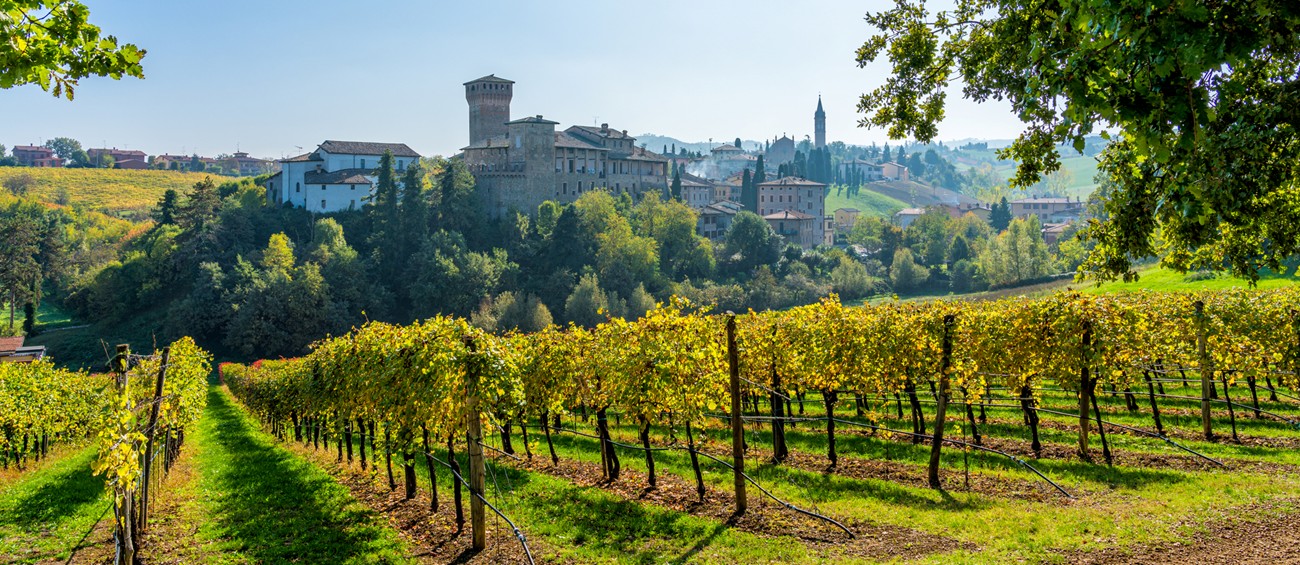
Vineyards in Levizzano Rangone (Modena) Image: Depositphotos.com

Wine grapes of Emilia-Romagna

The history of viticulture and wine in Emilia-Romagna dates back to pre-Roman times and is closely linked to its most famous grape, Lambrusco, which was already mentioned by Pliny the Elder in his “Naturalis Historia,” where he described its medicinal properties and characteristics. It appears that the name Lambrusco derives from “Vitis Labrusca,” an ancient species of wild vine, though there is no certain evidence of its use in wine production. Archaeological discoveries made in the 7th century B.C. have confirmed that the inhabitants of these lands were engaged in viticulture at that time. The introduction of the Refosco Terrano variety from Dalmatia, known in Emilia-Romagna as Cagnina, dates back to the 5th century A.D.

The Benedictine order later made a significant contribution to the region’s viticulture, especially near Ferrara, where the viticulture of Bosco Eliceo originated. Even in later periods, references to the varieties present in the Emilia-Romagna territory, especially the Lambruschi, continue. The arrival of phylloxera at the end of the 19th century marked a halt in viticulture. In the Po Delta, near the current Bosco Eliceo DOC territory, the Fortana grape vineyards were spared by this parasite, and even today, many vines are grafted onto native rootstocks rather than those of American origin.

The Lambrusco owes its significant development, especially in quantitative terms, to the producers’ cooperatives in the first half of the 20th century. The spread of this wine made it known worldwide, but it also led to the belief that only ordinary wines are produced from this grape, a notion contradicted by many examples of high-quality wines in the area. In recent years, viticulture in Emilia-Romagna has followed two parallel paths: the revaluation of regional indigenous grape varieties and the rather massive introduction of so-called “international” grape varieties, often used together with local varieties. This dual approach has fostered a dynamic and innovative viticultural environment, enhancing the region’s rich wine heritage while embracing modern trends and techniques.

Wine appellations of Emilia-Romagna

Wine Appellations of Emilia

In Emilia, there is a distinctive focus on quality wine production, underscored by the presence of a single DOCG (Denominazione di Origine Controllata e Garantita), the Colli Bolognesi Classico Pignoletto DOCG, which highlights the region’s commitment to producing exceptional wines. The area around Piacenza is characterized by the Gutturnio DOC, where Barbera and Croatina, and to some extent Bonarda, are the primary grapes, showcasing the region’s rich viticultural diversity. The Parma area, with the Colli di Parma DOC, is distinguished by a predominance of white wines over reds, indicating a unique viticultural identity within Emilia.

The regions of Reggio-Emilia and Modena are celebrated for their cultivation of Lambrusco, giving rise to esteemed denominations such as Lambrusco di Sorbara DOC, Lambrusco Grasparossa di Castelvetro DOC, and Lambrusco Salamino di Santa Croce DOC. This underscores the importance of Lambrusco as a flagship variety for Emilia. In the Bologna area, Montù and Pignoletto, both white grape varieties, are prevalent, with the Reno DOC denomination being the area’s most renowned appellation. The province of Bologna also boasts the Colli d’Imola DOC, further enriching the region’s wine landscape.

Reggio Emilia contributes with the Colli di Scandiano e Canossa DOC and the Reggiano DOC, while the province of Piacenza is known for the Colli Piacentini DOC and the Ortrugo dei Colli Piacentini DOC, which is centered around the eponymous white grape variety. In the Ferrara area, the Fortana grape (also known as Uva d’Oro) is prominent, with Bosco Eliceo DOC being the key denomination. The Colli di Faenza DOC marks the transition to Romagna, stretching into the provinces of Ravenna and Forlì-Cesena, bridging the viticultural traditions of Emilia and Romagna.

Wine Appellations of Romagna

Transitioning to Romagna, the region also boasts a single DOCG, the Romagna Albana DOCG, highlighting the area’s focus on producing high-quality wines. Key DOCs include Romagna DOC and Colli della Romagna Centrale DOC, with Sangiovese emerging as the most significant grape variety, surpassing in quantity the Trebbiano Romagnolo (the most widespread white grape variety in Romagna), Pagadebit, and Albana. The latter gives rise to the Romagna Albana DOCG, particularly in the Faenza area. The most crucial viticultural zones in Romagna are the hills around Faenza, with the Colli di Faenza DOC, the hilly area of Forlì, and the hills surrounding Cesena and Rimini (Colli di Rimini DOC), showcasing the region’s diverse and rich wine-producing heritage.

Wine areas of Emilia-Romagna

In Emilia, the western part of the region, sparkling wines from various Lambrusco varieties play a pivotal role. Conversely, in Romagna, the eastern part, the focus shifts towards the production of both dry and sweet wines, encompassing white varieties like Albana, Pignoletto, Trebbiano Romagnolo, and Pagadebit (Bombino Bianco), as well as reds, primarily from Sangiovese grapes. The most widespread international varieties in Emilia-Romagna include Chardonnay, Sauvignon Blanc, Cabernet Sauvignon, and Merlot, showcasing the region’s versatility and openness to global viticulture trends.

Emilia and the Lambruscos

Key varieties of this family include Lambrusco di Sorbara, Lambrusco Grasparossa, and Lambrusco Salamino, complemented by Lambrusco Marani and Lambrusco Maestri. Lambrusco vineyards start from the province of Parma and dominate those of Reggio Emilia and Modena. The resulting sparkling wines, whether dry or semi-sweet, pair wonderfully with Emilian cuisine, especially the region’s iconic cured meats. Notably, Lambrusco Grasparossa di Castelvetro DOC, produced in the hilly areas near the medieval village of Castelvetro in the province of Modena, stands out for its quality.

Romagna and the Albana

Albana di Romagna was the first Italian white wine to be awarded Denominazione d’Origine Controllata e Garantita (DOCG) status. This highest quality level recognition is primarily due to the superior wines made from this grape, achieved with yields much lower than those prescribed by the regulations, a choice made only by the best producers. The passito (dessert wine) version of Albana is particularly notable, ranking among the best raisinn wines of Italy.

The Sangiovese of Romagna

Romagna is renowned for its red wine produced from Sangiovese grapes. The name, meaning “Blood of Jupiter,” is believed to derive from Monte Giove near Santarcangelo di Romagna, in the province of Rimini. Sangiovese di Romagna varies from light to well-structured wines, characterized by a dry and robust flavor. It was the first red wine in the region to receive Denominazione d’Origine Controllata (DOC) status and is produced over a wide area, from the province of Bologna to the Adriatic coast.

Other Production Areas

The Colli Piacentini area is known for the Gutturnio wine, named after the silver chalice Gutturnium found in the area, made from Barbera and Croatina (locally known as Bonarda) grapes. The Vin Santo di Vigoleno, produced in limited quantities from aromatic and non-aromatic white grapes, is also noteworthy. In the Reggio  Emilia area, particularly around the Colli di Scandiano and Canossa, besides Lambruscos, interesting wines are produced from international grapes. The Colli Bolognesi area is known for Pignoletto and wines from international grapes. The production of IGT wines is of particular interest, where local and international varieties often meet, sometimes used “in purezza” (as single-varietal wines), reflecting the innovative spirit and diversity of Emilia-Romagna’s viticulture.

Regional Cuisine of Emilia-Romagna

Emilia’s Regional Cuisine

Emilia’s cuisine is renowned for its cheeses, notably Parmigiano Reggiano, and its cured meats, including Prosciutto di Parma and Culatello. Mortadella from Bologna is made of pork and beef, while the Modena variety is purely pork. Not to be overlooked are Salame di Felino from the Parma area and the Zampone and Cotechino from Modena. Ferrara’s Salama da sugo, with its rich Renaissance origins, is exceptionally flavorful, and the Coppa Piacentina is also celebrated.

Pasta dishes are central to Emilian cuisine, such as Tagliatelle served with Bolognese meat and tomato sauce, green Tagliatelle with chard, spinach, or nettle sauce, and baked Lasagna. Tortellini, either served in broth or dry with cream sauce, and Tortelloni, larger and filled with mortadella or prosciutto along with other ingredients like cooked meats, eggs, Parmigiano, and nutmeg. Ricotta, Parmigiano, and parsley fill the leaner Tortelloni, while pumpkin Tortelli are also popular. The Reggiano Erbazzone is a savory pie with spinach and other vegetables, all seasoned with Parmigiano Reggiano and baked.

Among the main courses, the veal Cotoletta alla bolognese is a richer variant of Milan’s version. The Faldìa from Piacenza, made with horse meat, is another variation. The region is known for its Fesa di vitello (veal rumpsteak,  with ham, Grana cheese, and truffle), Stracotto di manzo alla piacentina, (beef stew), donkey stew, and Pìcula ‘d cavall, a minced horse meat dish. Stuffed vegetables from the Piacentino Apennines and the Ligurian-origin Punta di vitello ripiena (veal filles roulades, also known as “tasto” or “tasca“) are noteworthy. Eel consumption is common along the Po River.

Desserts often feature almonds, honey, and spices, such as Certosino (or Panspeziale) and Bologna’s rice cake, Ferrara’s Spongata and Pampepato. Popular sweets include Frappe (Chiacchiere), Biscione reggiano, and many more.

Romagna’s Regional Cuisine

Romagna’s cuisine blends rustic, peasant traits with influences from its proximity to the sea, including many fish-based recipes. Fresh pasta is crucial, with dough used to make  Tagliatelle, Maltagliati, Strichetti (or Farfalline), Garganelli, Cappelletti, and Ravioli, filled with spinach and ricotta or pumpkin, particularly in Ferrara (Cappellacci di zucca). Cappelletti may be filled entirely with cheese, ricotta, or meat. Seafood dishes include Fish stew, Seafood risotto, Spaghetti with clams, and Cuttlefish squares.

Main courses often feature pork, with a variety of cured meats, sausages, and grilled castrato (castrated sheep) with garlic, rosemary, and potato sides. Seafood mains include Adriatic grilled fish, such as sardines and anchovies, breaded and skewered, often flavored with garlic and parsley, and mussels prepared in various ways. The Piadina, a sort of Italian burrito, thicker and smaller in Ravenna, wider and thinner in Rimini, is a staple, filled with cured meats and cheeses like prosciutto and Squacquerone, a very fresh cheese similar to Stracchino.

Desserts feature Latte brulè, a pudding made with egg yolks, milk, sugar, and vanilla, cooked in a bain-marie then baked. Sabadoni, sweet tortelli filled with chestnuts and fig, apple, or quince jam, soaked in “saba” (grape must reduction). Finally, Ciambelle and Crostate are enjoyed dipped in wine, preferably red, either dry or sweet.

Quattrocalici Wine Guide