

The Croatina grape variety has certain origins that date back only to the second half of the 19th century, but traces of it are found in the Valle del Versa, in the area of Rovescala, in Oltrepò Pavese, since the Middle Ages. It has been mentioned by numerous ampelographers, including Di Rovasenda, since the late 1800s. In Oltrepò Pavese, the grape variety is also commonly called Bonarda, a name taken from the wine produced exclusively with Croatina. This has led to a well-known case of presumed synonymy with the Bonarda grape variety, cultivated in Novara, but there are no common origins between the two grape varieties. From Oltrepò Pavese, Croatina, more resistant than other varieties to diseases, particularly powdery mildew, spread to the nearby Colli Piacentini and Piedmont, especially in the areas of Novara and Vercelli, where it accompanies Bonarda, having replaced in many areas more prized but more delicate and sensitive varieties such as Vespolina or Spanna (Nebbiolo).
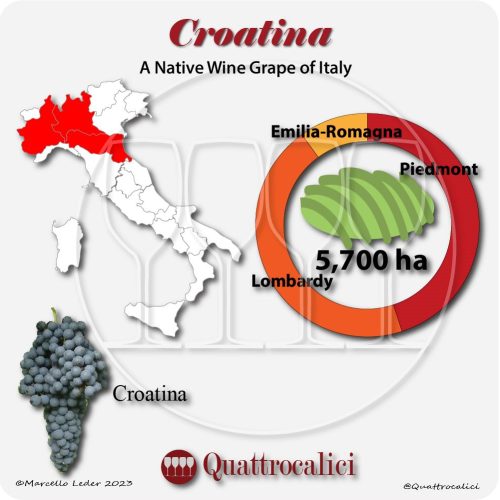
Croatina then spread to Veneto and Sardinia, but it remains largely a variety mainly in the Oltrepò Pavese and Novara and Vercelli areas. In Piedmont, it can also be found in the Cuneo area (particularly in the Roero area, still under the name Bonarda) and in the Alessandria area, especially in the Colli Tortonesi. In Emilia-Romagna, the cultivation of Croatina is concentrated in the Piacenza area, where the Colli Piacentini Bonarda DOC sees it vinified in purity, while in the Colli Piacentini Gutturnio DOC it is paired with Barbera. The cultivated area of Croatina in Italy does not exceed 4000 hectares, with peaks of almost 6000 reached before the 1980s. The most important DOC wine types that prescribe the use of Croatina in purity, in addition to those already mentioned, are Collina Torinese Bonarda DOC, Colline Novaresi Croatina and Bonarda DOC, Pinerolese Bonarda DOC, Coste della Sesia Bonarda DOC, San Colombano al Lambro DOC, and Oltrepò Pavese Bonarda DOC. Many other denominations foresee it in blends with other grapes.
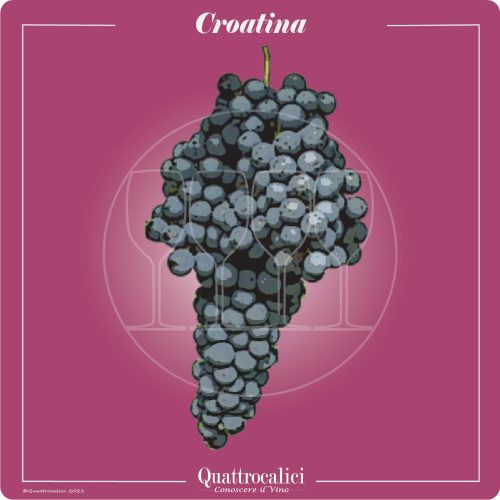
Ampelographically, Croatina presents a generally large, conical, winged, elongated, and moderately compact cluster. The berry is medium, spherical or spheroidal, regular, with a pruinose, thick, and consistent skin of light blue color. Croatina is typical for presenting variable morphological characteristics, with clusters and berries of visibly different shapes and sizes. Croatina has a mid-late ripening period, with harvest generally between late September and early October. Vinified in purity, Croatina gives a pleasant, fruity, and floral wine, with good alcohol content and a dry, full-bodied, and not very acidic flavor. It is often vinified in combination with other varieties, such as Bonarda and Vespolina in Piedmont, and Barbera and Uva Rara in Oltrepò Pavese, to which Croatina adds color and softness.