The Best Tool to Learn about Italian Wine

italian wine regions - quattrocalici

Wine in Sardinia

local grapes, wine, and food

Sardinia's wine figures

From white to red wines, the ideal oenological journey through Sardinia also involves less common types, including some gems representative of the region such as Malvasia di Bosa and Vernaccia di Oristano. Among other significant wines of Sardinia, those based on Vermentino, the island’s most famous white grape, and Cannonau among the red grapes, stand out, although recently two other varieties have been gaining prominence: Carignano and Bovale. The viticultural heritage of Sardinia goes well beyond these examples, representing only the varieties most known outside the region. In Sardinia, there are many native grape varieties, many of which were originally introduced by the Spaniards, though after centuries of mutations and adaptation to the territory, they are rightly considered typical grapes of the region. International varieties and grapes typical of other Italian regions, such as Nebbiolo, Sangiovese, Montepulciano, and Barbera, often join the local varieties.

Wine figures of Sardinia

Wines of Sardinia

Viticolture in Sardinia

Sardinia covers about 26,000 hectares of vineyards (2010), of which 13% are located in mountainous territories, 69% in hilly areas, and 18% in plains. This corresponds to a production of 638,000 hectoliters per year, of which 56% consists of red and rosé wines and 44% of white wines.

With its unique position in the heart of the Mediterranean, Sardinia boasts a long and rich history in wine production, supported by a diversity of soils, a favorable climate, and various territorial zones that contribute to the distinctive character of its wines. The island offers a mosaic of wine landscapes, from the coast to the internal hills, which is reflected in the variety of its wines, among which Cannonau, Vermentino, and Carignano stand out.

Sardinia presents a wide range of soils, from coastal sand to the clayey, calcareous, and granitic soils of the hinterland. This diversity translates into a wide variety of wines, each with unique characteristics. For example, the granitic soils of the northeast, typical of Gallura, are particularly suited to the production of Vermentino, giving the wine distinctive mineral notes. In the south, in the territories of Sulcis and Carignano, sandy soils help protect the vines from phylloxera, contributing to the production of wines with deep fruity aromas and an elegant structure.

The climate of Sardinia is typically Mediterranean, characterized by mild winters and hot, windy summers. These climatic conditions are ideal for viticulture, allowing a long ripening season and ensuring a perfect balance between acidity and sugars in the grapes. The wind plays a crucial role in keeping the vines healthy, reducing the risk of fungal diseases. Moreover, the temperature variations between day and night, especially in the internal and hilly areas, enrich the aromatic profile of the grapes. Gallura, known for its Vermentino di Gallura DOCG, the only Sardinian wine with a controlled and guaranteed denomination of origin, is characterized by granitic soils that confer a unique mineral note to the wine. The southwest of the island is renowned for Carignano del Sulcis, produced in sandy soils that give the wine a particular intensity and complexity. Ogliastra, Nuoro, and Gennargentu are the heart of Cannonau production, a full-bodied and aromatic red wine that benefits from the temperature variations between day and night.

History of Winemaking in Sardinia

According to archaeological studies and research, vines and wine have been present in Sardinia for about 5,000 years, though findings suggest that vines were introduced to Sardinia by the Phoenicians during the period they occupied the island. According to the Roman historian Lucius Junius Moderatus Columella, there are indeed historical records of the existence of wine in the city of Tharros, the ancient Punic-Roman center of which vestiges remain today. Due to its strategic geographical position, Sardinia has been subject to conquests over the centuries by Carthaginians, Romans, Arabs, Aragonese, Genoese, Pisans, and finally the Piedmontese. Viticulture and wine production have been significantly influenced by the traditions and cultures of these various peoples, through periods of decline and others of genuine splendor. The Aragonese introduced new and fundamental viticultural and oenological techniques and new grape varieties, which are still present in Sardinia today and play an important role. Some of the most well-known Sardinian grapes, such as Cannonau and Carignano, were introduced by the Spanish. In the late 1700s, Sardinian wines, such as Cannonau di Nuoro, Vermentino di Gallura, Vernaccia di Oristano, Malvasia di Bosa, Monica passito, Girò, Moscato, and Nasco began to become known beyond the region’s borders. The development of Sardinian enology was halted by the arrival of phylloxera at the end of the 1800s, from which only vines planted in sandy soils were saved. Only at the beginning of the 1950s, thanks to the birth of countless cooperative wineries, did viticulture regain a foothold in the region, although at this time production was focused on quantity, particularly for colored and concentrated red wines with high alcohol content, often used for blending with other wines. The arrival of quality production, here as in other regions of Italy, has allowed Sardinian wines to achieve the high levels of excellence seen today.

Vineyards in Sardinia
Vineyards in Sardinia Image: Depositphotos.com

Wine grapes of Sardinia

Wine appellations of Sardinia

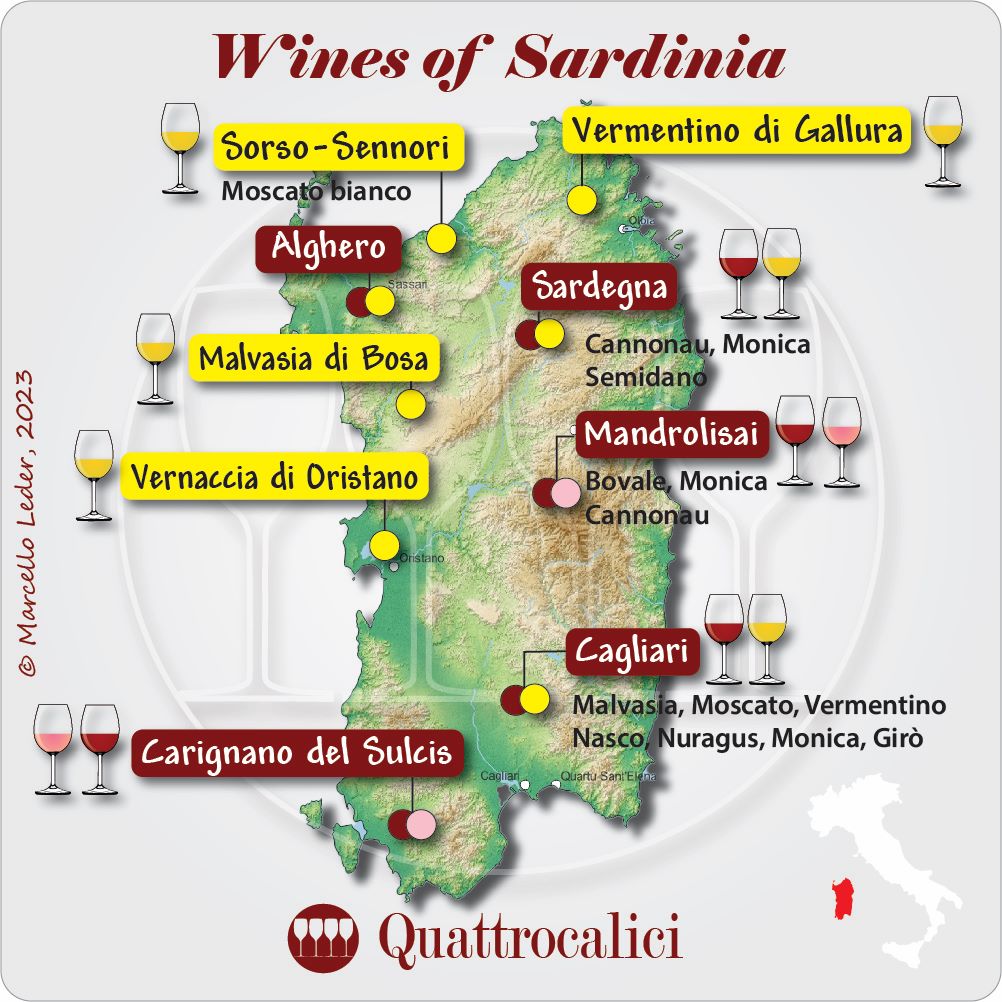
In Sardinia, there are currently 17 Controlled Designation of Origin (DOC) and one Controlled and Guaranteed Designation of Origin (DOCG), which is awarded to Vermentino di Gallura. The 19 DOCs of Sardinia are: Alghero, Arborea, Cagliari, Campidano di Terralba, Cannonau di Sardegna, Carignano del Sulcis, Girò di Cagliari, Malvasia di Bosa, Mandrolisai, Monica di Sardegna, Moscato di Sardegna, Moscato di Sorso-Sennori, Nasco di Cagliari, Nuragus di Cagliari, Semidano di Sardegna, Vermentino di Sardegna e Vernaccia di Oristano. The sole DOCG and the 19 DOCs account for 66% of the wine produced in Sardinia, while the IGP (Protected Geographical Indication), in which native grapes are often blended with so-called international grapes, account for 15% of the production. Sardinia has 15 IGT (Typical Geographical Indication) wine designations and 5 DOP (Protected Designation of Origin) agricultural products, among which Fiore Sardo DOP cheese and Sardinian Saffron DOP are noteworthy. There is a single PGI (Protected Geographical Indication), the Sardinian Lamb PGI.

Wine areas of Sardinia

The main wine production areas in Sardinia are Vermentino di Gallura, Cannonau di Sardegna, and Vernaccia di Oristano.

Vermentino di Gallura: The most famous white wines of Sardinia are produced with Vermentino. This grape produces excellent wines across the island, but Gallura, in the northern part of the region, is the most classic and representative area. Vermentino di Gallura is Sardinia’s only DOCG wine. A key characteristic of this wine is its almond aroma. In Gallura, Vermentino is the most cultivated grape, accounting for about 80% of the total, while the rest is mainly represented by Moscato Bianco, Bovale, Caricagiola, and Nebbiolo, which is used here for the production of interesting IGT red wines.

Cannonau di Sardegna: Cannonau is the most famous black grape of Sardinia. It seems to have been introduced to the island during the Spanish rule, although it is not entirely clear which variety it originally comes from. Cannonau has similarities with Canonazo from the Sevilla area, Granaxo from Aragon, although the most widespread hypothesis links it to Grenache Noir. Cannonau is cultivated throughout the region, though the most typical area is around Nuoro, where two of the three subzones of Cannonau di Sardegna DOC are located: Oliena and Jerzu, while the third subzone, Capo Ferrato, is in the province of Cagliari. Cannonau, especially that from the Oliena area, is a high-alcohol, robustly structured wine. Recently, the introduction of more modern oenological technologies allows for the production of excellent and very balanced Cannonau wines. Due to its low acidity, Cannonau is often vinified in blend with other grapes, especially native ones, to improve its taste balance.

Vernaccia di Oristano: Vernaccia di Oristano is one of the most evocative and ancient wines of Sardinia, with the first historical records dating back to 1300. It was also the first wine in the region to be awarded DOC status, in 1972. The wine is produced with grapes from the homonymous native Sardinian variety. The wine’s production is quite different from the oenological techniques of normal white wines. Vinification, maturation, and aging follow ancient traditional methods, making this wine similar to Spanish Jerez (Sherry) while maintaining its own identity. Vernaccia di Oristano matures in partially filled chestnut barrels, and a colony of yeast (flor) develops on the wine’s surface over time, giving the wine complex and unique organoleptic qualities. During aging, which can last for decades, the wine comes to express extraordinary aromas of almond, hazelnut, and its typical “rancio” aroma.

Other Production Areas: In Sardinia, there are also other characteristic varieties from which interesting wines are produced. Among these, the famous Malvasia di Bosa, a sweet wine produced in small quantities, and Moscato, available in the DOCs of Cagliari, Sardinia, and Sorso-Sennori. Among other white grape varieties, Nuragus today is capable of producing wines of good quality, far from the “rustic” and modest ones of the past. In the Alghero area, Torbato, a white grape variety of Spanish origin, produces both still and sparkling white wines. Among the black grape varieties, excellent results in recent years are being obtained with Carignano, which produces full-bodied and elegant wines, followed by Monica, Cagnulari, Nieddera, and Bovale, often used together with Cannonau and Carignano.

Regional Cuisine of Sardinia

Seafood cuisine of Sardinia

In Cagliari, typical seafood dishes include Fregula cun còciula (fregula with clams); còciulas e cotzas a sa schiscionera (clams and mussels cooked in a pan), Burrida a sa casteddaia (a dish based on catshark, vinegar, and walnuts), cassòla (a fish soup with shellfish and mollusks), as well as spaghetti with clams and bottarga and Spaghittus cun arrizzonis (spaghetti with sea urchins, also served in variations with artichokes or wild asparagus).

On the Sulcis coasts, the cuisine is heavily influenced by Genoese traditions and focuses on red tuna fishing and related products like bottarga (tuna roe under salt), tuna heart, musciame (tuna cured meat), buzzonaglia (tuna preserved in olive oil), lattume (sperm of male tuna fish), and not forgetting cascà, a semolina couscous with vegetables, of Tabarchino origin. In the Oristano area, eels are highly valued. A typical product is bottarga di muggine (dried mullet roe under salt), which can be consumed in thin strips dressed with oil, as well as grated on pasta. Sa Merca consists of boiled and salted mullet slices, wrapped in a marsh grass pouch, the zibba. In Alghero, you can find Catalan-style lobster, boiled with tomatoes, celery, and onion, served with a sauce made from the head with added lemon juice, olive oil, salt, and pepper. Ray in agliata is an Alghero specialty prepared by boiling it and covering it with tomato sauce, vinegar, garlic, and parsley. In Gallura and the Maddalena archipelago, octopus salads are typical, while in Olbia, dishes based on mussels, clams, and cockles are popular.

Inland cuisine of Sardinia

The inland cuisine of Sardinia is based on very simple ingredients and varies from area to area. Sardinian durum wheat semolina gives rise to high-quality pasta in various shapes. “Favata” is a dish widespread throughout the island, made of dried fava beans, pork, vegetables, and wild herbs. Known starters include prosciuttos of pork or wild boar like those from Villagrande and Talana, accompanied by mushrooms, olives, and cheeses, among which Pecorino Sardo, fresh or aged. Sausages and cold cuts from Irgoli are typical starters of the inland areas, together with Frue or Frughe, which is sheep’s curdled milk. Among the first courses, Sardinian gnocchetti, also known as malloreddus, are traditionally flavored with saffron or served with a campidanese sauce, made with sausage sauce. Culurgiones are dumplings filled with ricotta and mint or a filling of potato, fresh cheese, and mint; macarrones de busa are a kind of bucatini made with a special elongated iron, while macarrones furriaos are gnocchetti seasoned with very fresh pecorino, melted together with semolina to form a sort of cream. Zuppa gallurese or suppa cuatta is a dish made of Sardinian bread, casizolu, spices, and pecorino, all softened with broth and baked.

The main courses are based not only on roasted meat but also on boiled, stewed, or offal-based meats. Porceddu is a suckling pig of about 4–5 kg or twenty days, slowly cooked on a spit and flavored after cooking with myrtle or rosemary. Roast milk lamb (anzone or angioni), with a maximum weight of 7 kg, with white, tender meat and intense flavor, is one of the island’s most ancient traditions. Wild boar meat (sirbone) is traditionally cooked with the carraxu method (cooking in a buried pit).

Sweets and desserts of Sardinia

Sweets, like other products of Sardinian gastronomy, vary greatly from area to area. The most known are Seadas or Sebadas, thin pastry discs enclosing a filling of fresh pecorino cheese, fried and topped with melted honey; Formagelle or Casadinas are small pies filled with a thin layer of fresh cheese flavored with lemon. Pardulas are very similar to Casadinas but are filled with ricotta, have a dome shape, are softer than casadinas, and are covered with powdered or granulated sugar. Pabassinas are widespread throughout the territory and are prepared with semolina, walnuts, raisins, almonds, or hazelnuts.

Typical Bread of Sardinia

Sardinia’s ancient tradition has created many varieties of bread that have survived to the present day, among which are: Pane carasau, thin, very crispy discs obtained through double baking in a wood-fired oven; Pistoccu is mainly produced in Ogliastra, prepared in the same way as carasau

Quattrocalici Wine Guide