


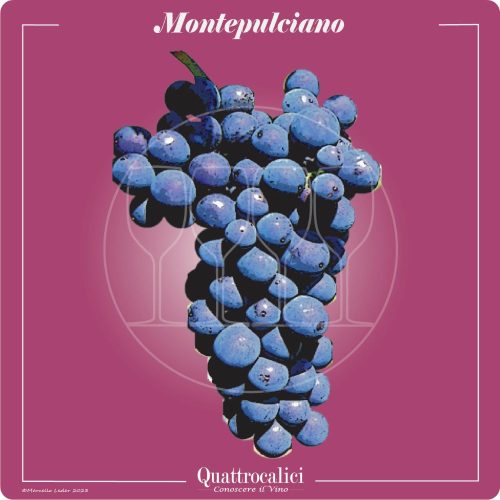
The Montepulciano grape variety is a black grape widely grown in central Italy, particularly in Abruzzo, Marche, and Molise. Despite sharing its name with the town of Montepulciano in Tuscany, the grape is not used there, as Vino Nobile di Montepulciano DOCG is produced with the Sangiovese grape, and it is well established that the two varieties have nothing in common. The origin of Montepulciano is almost certainly from Abruzzo, particularly from the province of Pescara, although some of its finest expressions are found in Marche, especially in the Conero DOCG. Montepulciano is the second most cultivated black grape variety in Italy, after Sangiovese and slightly ahead of Barbera. The variety is used in varying proportions to produce wines in 50 different DOC and DOCG types.
While it yields excellent results when vinified in purity, Montepulciano also blends well with other varieties, particularly Sangiovese. The most famous wines made from Montepulciano come from Abruzzo, where they are produced on the low hills and plains along the Adriatic coast under the Montepulciano d’Abruzzo DOC designation. The best examples from Abruzzo come from the northern part of the region, at the foot of the Colline Teramane (Montepulciano d’Abruzzo Colline Teramane DOCG). Two other central Italian wines made from Montepulciano grapes are Rosso Conero (Conero DOCG) and Rosso Piceno DOC, both from Marche. In general, Montepulciano wines are globally appreciated for their soft flavors, intense color, and gentle tannins. The variety has not only developed a reputation for its dry red table wines, but also for a notable exception: Cerasuolo d’Abruzzo DOC, a bright and light rosé wine.
