The Best Tool to Learn about Italian Wine

italian wine regions - quattrocalici

Wine in Marche

local grapes, wine, and food

marche wine figures

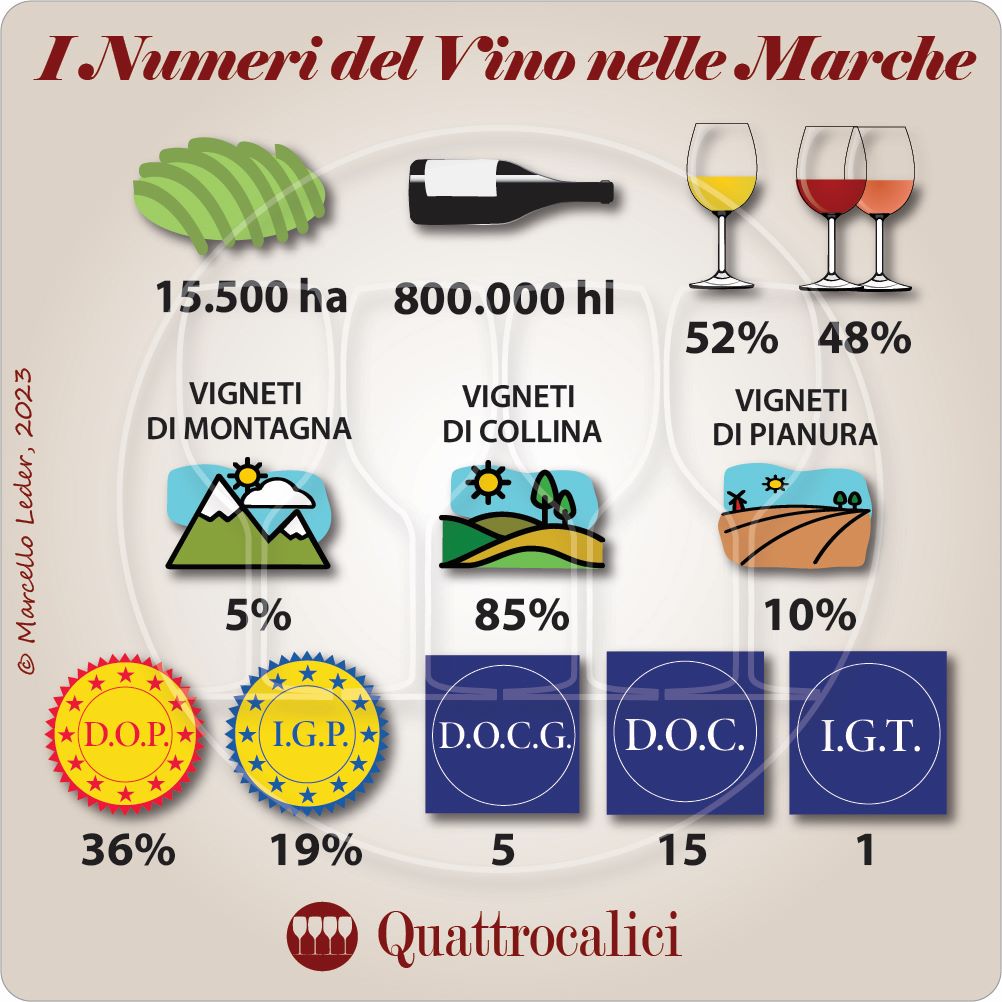
The wines of the Marche region are among the most famous and sought-after among those from the central regions of Italy. The Marche region has a very varied territory, with 70% hilly and 30% mountainous landscapes. The flat areas are limited to small regions along the coast and along the riverbanks. The climate of the Marche is very diverse, depending on the orientation and altitude of the terrain. It is more Mediterranean along the coast and towards the south, and more continental inland and towards the north, with greater temperature variations and a higher risk of frost. The pedoclimatic characteristics make the Marche particularly suited for viticulture, indeed its 12,000 hectares of vineyards are almost entirely in hilly areas, ensuring a production of over a million hectoliters of wine per year. The traditional training systems using individual trees or live tutors like elms or maples have given way to more modern espalier forms.

Wine figures of Marche

Wines of the Marche region

Viticolture in Marche

The Marche region, located in the central part of Italy along the Adriatic Sea, features a particularly varied territory that stretches from sandy coastlines to the Apennine mountains. This diversity of landscapes is also reflected in the region’s pedoclimatic conditions, which significantly influence viticulture in Marche.

The Marche territory can be divided into three main areas: the coastal zone, the hills, and the mountains. The hills, in particular, are the ideal habitat for viticulture, thanks to their exposure and the soil composition that promotes water drainage, a crucial element for the health and quality of the vines. These soils are often calcareous and clayey, with areas that also present formations of sand and gravel, contributing to a diversity of wine profiles.

The climate in Marche is typically Mediterranean along the coast, with hot summers and mild winters, and gradually becomes cooler and more humid as one moves inland and altitude increases. This climatic gradient allows for the cultivation of different grape varieties, each adapted to the most suitable local microclimates.

Marche’s viticulture benefits from this territorial and climatic complexity, resulting in the production of high-quality wines that are strongly characterized. Viticulture in Marche is characterized by a strong connection with the territory and a pursuit of quality, with an increasing focus on sustainable and environmentally respectful practices. This approach has allowed the region to earn a reputation for excellence in the Italian and international wine landscape.

History of Winemaking in Marche

The earliest traces of viticulture in the Marche date back to the 10th century BC, in the current area of Rosso Piceno DOC, introduced by Greek colonists who are credited with founding the city of Ancona. Among the Picenes, between the 8th and 7th centuries BC, viticulture and wine production played a central role. The Romans were present in the Marche from 295 BC. Pliny the Elder described the varieties of vines cultivated in his time and the wines produced from them. Between the 6th and 13th centuries AD, the presence of abbeys and monks was quite widespread in the Marche, and among them, for liturgical needs and dining, there was always a small vineyard. The monks were responsible for passing down viticultural techniques, attempting to improve the product, and striving to enhance its preservability. In the age of the Communes, wine ceased to be a drink exclusive to the clergy and entered the habits of a broader community of people. During the transition years from the Papal State to the Kingdom of Italy, the Marche was afflicted by scourges such as Oidium, Peronospora, and Phylloxera, and it took about forty years before solutions to combat them were found. After World War I, farmers and landowners committed to improving the productivity of the land, with a slow introduction of new technologies that increased the incomes of peasant families. With the initial successes came the fragmentation of estates and the reduction of their size, then, with the end of sharecropping, new types of landowners emerged who, by merging multiple estates, created directly managed companies. In 1953, by the work of the Fazi Battaglia winery, the amphora-shaped bottle was created, which is still associated with Verdicchio today. In the early 1990s, a profound restructuring of the vineyards began, moving to training systems suitable for mechanization, and both ancient Marche cultivation and international grape varieties were introduced.

Wines in Marche region
Vineyards in Corinaldo (Ancona) Image: Depositphotos.com

Wine grapes of Marche

The grape varieties cultivated in the Marche are 60% white grapes (especially Verdicchio). Verdicchio is today among the most interesting indigenous white grape varieties in Italy, capable of producing complex and well-structured wines. Among the black grape varieties, the most important are Montepulciano and Sangiovese. The Marche region also has indigenous varieties such as Lacrima, a black grape characterized by a very original aromatic component, and Vernaccia Nera. In the Marche, Chardonnay, Ciliegiolo, Passerina, Pecorino, Trebbiano Toscano, and Malvasia Bianca Lunga are also cultivated.

Wine appellations of Marche

The Denominations of Origin for wine in the Marche, starting north from the Metauro area, include the Bianchello del Metauro DOC, based on the Biancame grape, and the Colli Pesaresi DOC, with the Bianchello and Sangiovese grapes. The Castelli di Jesi area is dedicated to Verdicchio wine, with the Verdicchio dei Castelli di Jesi DOC and Verdicchio dei Castelli di Jesi Riserva DOCG, as well as the Verdicchio di Matelica Riserva DOCG. The coastal area around the Conero promontory is instead suited for red wines based on Montepulciano with the Conero DOCG and Rosso Conero DOC. The Apennine area of Serrapetrona is known for sparkling wines based on the Vernaccia Nera grape (Vernaccia di Serrapetrona DOCG). Further down, the Macerata area (Colli Maceratesi DOC) features white wines based on the Maceratino grape, a clone of Verdicchio. The Colli del Tronto and Colli Ascolani are known for Rosso Piceno DOC (Montepulciano grape) and Falerio DOC, with Trebbiano Toscano, Passerina, Pecorino grapes.

Wine areas of Marche

Wine production in the Marche is widespread throughout the region, which can ideally be divided into 3 main cultivation zones, to which other, less extensive but equally important from a production standpoint areas are added.

Verdicchio dei Castelli di Jesi and Matelica

Verdicchio, undoubtedly the most famous grape of the Marche, is the absolute protagonist of the Castelli di Jesi and Matelica zones. The DOC of Verdicchio dei Castelli di Jesi includes the definition of the classical area, which is the most typical and traditional, while the Riserva style, together with Verdicchio di Matelica, boasts the DOCG status. Verdicchio is an extremely versatile grape and, in addition to the production of dry wines, it is also used for passito (sweet) and sparkling wines. Depending on the winemaking style, the characteristics of Verdicchio wines vary considerably, from light and fresh to robust and structured, also suitable for barrel aging.

Rosso Conero and Rosso Piceno

Red wine in the Marche means primarily Montepulciano and Sangiovese. In 2004, Rosso Conero obtained the DOCG status for its riserva version (Conero DOCG). The Rosso Conero area benefits from the influence of sea breezes, which, together with the calcareous soil composition, allow for a unique red wine. Rosso Piceno, on the other hand, is produced further south in a rather large area that reaches the borders of the province of Pesaro. Montepulciano constitutes at least 85% of both wines.

Vernaccia di Serrapetrona

The Vernaccia Nera of Serrapetrona (Macerata) has a total vineyard area of just 45 hectares. Although recently rediscovered, it was the first in the Marche to receive the Controlled and Guaranteed Denomination of Origin (DOCG) recognition. Vernaccia di Serrapetrona wine is a red sparkling wine produced in both dry and sweet versions, using a rather special system. Indeed, after the harvest, part of the grapes are vinified in red, while a portion is left to wither to concentrate the sugar content. The withered grapes are then pressed, and the must is added to the first wine, causing a second fermentation. The Charmat method sparkling process of Vernaccia di Serrapetrona gives the wine its characteristic pink foam and unmistakable aromas.

Other Production Areas

Special mention goes to Lacrima di Morro d’Alba, a red wine made with an aromatic grape variety that gives the wines a distinctive fragrance. It is produced both as a still and sparkling wine, and in a passito version. Bianchello del Metauro is produced in the province of Pesaro with the Bianchello (or Biancame) grape, and Falerio dei Colli Ascolani, based mainly on the Trebbiano Toscano, Passerina, and Pecorino grapes. In the areas of Offida and Esino, where white, red, and sparkling wines are produced. Among the whites, those made with Pecorino and Passerina grapes are particularly interesting. With Maceratino, the white wines of the Colli Maceratesi are produced.

Regional Cuisine of Marche

The cuisine of the Marche region, dominated by mountains and overlooking the sea, is very varied, alternating between dishes with strong and decisive flavors, typical of the mountain areas, and dishes based on shellfish, blue fish, and seafood, typical of the famous Conero Riviera. Not to forget are the famous olives all’ascolana.

Antipasti of the Marchigiana Cuisine

The classic lunch on the Marchigiana coast usually starts with the famous brodetto, of which there are different styles: the Ancona version, based on thirteen different kinds of fish, and the Porto Recanati version, where the fish is cooked in a special saffron-based sauce. To the brodetto, tasty perch fritters can be paired, dipped in a batter of flour and eggs and then fried in olive oil. Moving inland, there is an abundance of tasty and typical antipasti based on white or black truffles, perhaps accompanied by very aromatic and delicious mushrooms.

Typical Dishes of the Marche

Among the interesting typical dishes are those in which the flavors and aromas of the mountains blend with those of the sea, such as Spaghetti mari e monti, based on squid and mushrooms, and Monkfish with porchetta. Other typical first courses include Lasagne all’ascolana, with white truffle, Cappelletti in capon broth, Tagliatelle with squid and Molecche (soft-shelled scampi tails), Chickpea and pork soup, and the classic Tagliatelle al tartufo, strictly with white truffle.

Main Courses of the Marche Cuisine

Typical dishes of the coast include Merluzzo alla marchigiana, with tomato sauce, Ancona sardines, breaded and baked in the oven, Baccalà in bianco, stockfish with a green parsley-based sauce, and Stockfish stewed with potatoes or in potacchio, i.e., braised with tomato, anchovies, garlic, rosemary, parsley, and chili pepper. Among the mountain dishes are Polenta costarella and sausages, Chickpea and pork soup, Eggs fried in butter and sprinkled with truffle, and Mushroom and truffle salad.

Desserts of the Marchigiana Pastry

The Marchigiana cuisine offers many recipes for regional desserts of absolute interest. We recall the Castagnole, sweet dough balls fried in oil and lard and dusted with powdered sugar, the Beccute, sweet bread buns made with flour and decorated with pine nuts and raisins, the Caciuni, large bread dough ravioli filled with pecorino, eggs, sugar, and lemon zest, the Ciambelle al mosto, made with flour, anise seeds, oil, sugar, and freshly squeezed grape must, and the Cicerchiata, a typical carnival sweet, almost similar to the more famous Neapolitan struffoli.

Quattrocalici Wine Guide