


The Best Tool to Learn about Italian Wine

Italy's Native Wine Grapes Guide

Passerina

Grape's Data Sheet

The Passerina Wine Grape in Italy

Passerina - The Grape and the Wines

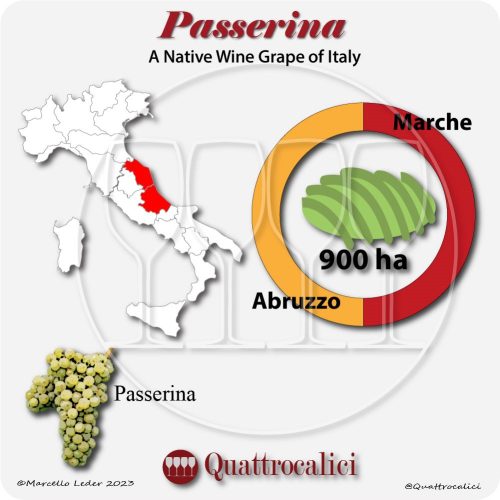
The Passerina grape is a white variety native to central Italy. Today, it is primarily grown in the Marche and Abruzzo regions, though its exact origin is disputed between the Marche and the Frosinone province. In the rest of Lazio, it is almost absent. The curious name Passerina seems to derive from “passeri” (sparrows), which are known to eat its small berries, although the grape is known under various synonyms, contributing to uncertainty about its origin. Passerina appears to belong to the Trebbiani family, with which it has often been confused, as well as with Bombino Bianco. Some believe it to be a mutation of Biancame, another native grape found in the Marche. Despite its higher quality, Passerina has lost ground in favor of Trebbiano Toscano, which offers higher yields and better resistance to adversities.

In recent years, Passerina has enjoyed significant success, often blended with Pecorino or vinified on its own, thanks to the Marche and Abruzzo appellations that have included it in their regulations. Notable examples from the Marche include Falerio dei Colli Ascolani DOC and Offida Passerina DOC, which allow for Vin Santo, Passito, and Spumante versions. In Abruzzo, it is used in blends (15-40%) in Controguerra Bianco DOC and Controguerra Passerina DOC, including Passito versions. In Lazio, it can be found as Passerina del Frusinate IGT.

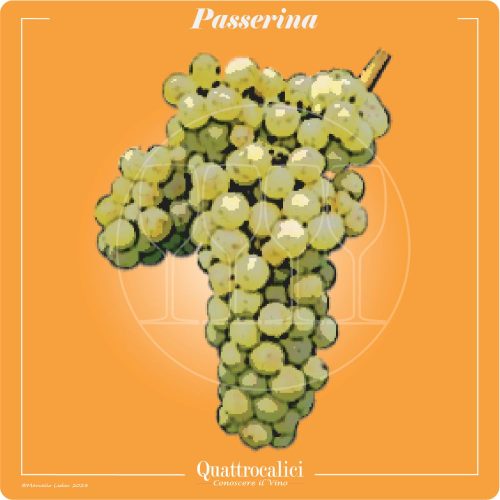
The Passerina grape has medium to large pyramidal clusters, sometimes with wings, and medium density. Its small berries are golden yellow with a thick, waxy skin covered in heavy bloom. The grape is grown using expanded training systems and long pruning. Its ripening period is medium, typically at the end of September. Passerina is a vigorous variety with good and consistent yields. The grape musts have a high sugar concentration and strong acidity, which translates into the wines during vinification. When vinified, whether blended or in purity, Passerina contributes appreciated acidity to wines, which can also be made as Spumante, Passito, or Vin Santo.

In pure form, Passerina wines have a pale yellow color with greenish hues, and an aromatic range that includes tropical fruits, citrus, honeyed notes, and sometimes herbal hints, rounded out by spices. On the palate, the acidity is prominent but balanced by pleasant salinity and a slightly bitter finish. As a sweet wine, Passerina reveals dried fruit aromas and spicy notes of caramel and vanilla. The sustained acidity makes Passerina a good candidate for aging.

In terms of food pairing, dry versions of Passerina pair well with risottos, shellfish, fried dishes, or fish soups, as well as local specialties like Sarde alla Marchigiana. Passito wines are ideal with dry pastries, while Vin Santo pairs well with creams or blue cheeses. Spumante versions are best enjoyed with cured meats or fish appetizers.
passerina a native wine grape of Italy

Passerina - General Info Table

Passerina is one of the  Local Grapes with White berry widespread mainly in Abruzzo, officially listed in the “Catalogo nazionale varietà di vite” since 1971. Its surface under vines in Italy is 895 ha.
Berry colorWhite berry
Grape CategoryLocal Grapes
Main RegionAbruzzo
Surface under Vines in Italy895 ha
Year of listing1971

Passerina - Ampelographic Data

Each grape variety is characterized by Ampelographic Descriptors that define the appearance of its main elements. The ampelographic features of the Passerina grape variety are:
Leaf Features
The leaf of the Passerina grape variety is medium-sized, pentagonal, with five lobes.
Bunch Features
The bunch of the Passerina grape variety is sparse, medium-sized, cone-shaped, pyramidal.
Berry Features
The berries of the Passerina grape variety are medium-sized, of spheroidal shape and with firm, thick and yellow-greenish colored skin.

Passerina - Wine Features

The Varietal Wine obtained from each and every Grape Variety, features precisely defined organoleptic characteristics. Referred to Passerina grapes, they are as follows:
Varietal Wine's features
The wine obtained from Passerina grapes is . On the palate the wine is dry, fruity, floral.

Passerina - Agricultural & Productive Features

Each and every grape variety features very specific agricultural and productive characteristics, such as productivity, yield, ripening time, the ideal type of climate or pruning system, sensitivity to adversities, varying degrees of disease resistance and many others. For the Passerina grape variety, the main characteristics are:
Ripening timelate
Vegetative vigorhigh vigor

Passerina - Appellations of Origin

The Quattrocalici Grape Varieties Database collects data on all grape varieties that are explicitly mentioned in at least one Italian PDO (Protected Designation of Origin) or PGI (Protected Geographical Indication) denomination. The Passerina grape variety is mentioned in the regulations of the following denominations:
DenominationTypeRegion
Abruzzo DOCDOCAbruzzo
Anagni IGTIGTLatium
Colli Aprutini IGTIGTAbruzzo
Colli Cimini IGTIGTLatium
Colli del Sangro IGTIGTAbruzzo
Colline Frentane IGTIGTAbruzzo
Colline Pescaresi IGTIGTAbruzzo
Colline Teatine IGTIGTAbruzzo
Controguerra DOCDOCAbruzzo
del Vastese o Histonium IGTIGTAbruzzo
Falerio DOCDOCMarche
Frusinate o del Frusinate IGTIGTLatium
Lazio IGTIGTLatium
Marche IGTIGTMarche
Offida DOCGDOCGMarche
Offida DOCG sottozona PasserinaSottozona DOCGMarche
Terre Aquilane o Terre de l’Aquila IGTIGTAbruzzo
Terre di Chieti IGTIGTAbruzzo
Terre di Offida DOCDOCMarche
Terre di Offida DOC sottozona Passerina vino santoSottozona DOCMarche
Terre Tollesi o Tullum DOCGDOCGAbruzzo