

The Trebbiano Toscano grape variety shares a common origin with other members of the Trebbiani family, known in Italy since Roman times. Its name derives from the Latin “Trebula”, meaning farmhouse. Pliny the Elder mentioned a “Vinum Trebulanum”, interpreted as a local wine or homemade wine. Distinguishing between the various clones, often named after their region of cultivation, is not always straightforward. History brought Trebbiano Toscano to France, where it is known as Ugni Blanc and forms the base for Cognac and Armagnac production, possibly linked to the relocation of the Papal Court to Avignon in the 14th century. Others attribute its spread to Catherine de’ Medici’s marriage to Henry II of Valois, King of France.
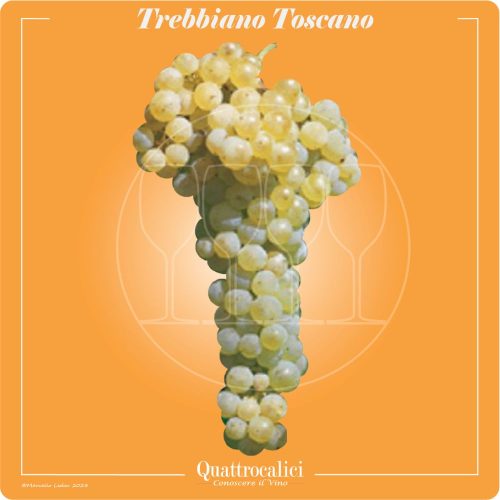
Trebbiano Toscano is a variety known more for its productivity than its character, and its high acidity makes it well-suited for appassimento, achieving its greatest expression in Vin Santo del Chianti. Its high yields do not significantly compromise quality, so it is often left to grow freely with minimal pruning. In Tuscany, its vineyard area exceeds even that of Sangiovese. The grape cluster is cylindrical and winged, of large size, with medium-sized berries and fairly thick skins. The musts are light-bodied, low in alcohol, but high in acidity, which is then transferred to the wine.
Trebbiano Toscano is exceptionally vigorous, with late bud break that protects it from frost, a characteristic also valued in France. It shows good resistance to powdery mildew and rot but is somewhat susceptible to downy mildew. Its late ripening usually occurs in October, although in some regions it is harvested earlier to capitalize on its acidity.
The wines made from Trebbiano Toscano are generally dry, with elevated acidity, and are considered light and somewhat neutral, lacking significant aromatic appeal. It is typically blended with other grape varieties, as in the case of Vin Santo, where it gains complexity and aroma from the addition of Malvasia.
