

Tuscany is one of the most important Italian regions for wine, famous worldwide for its renowned labels. In Tuscany, wine has been part of history and culture for centuries. Even the landscape here tells the strong viticultural vocation of the territory. From the hills of Chianti and the Etruscan Coast to the panoramas of the Val d’Orcia and the Val di Chiana, kilometers of splendid rows stretch before our eyes.
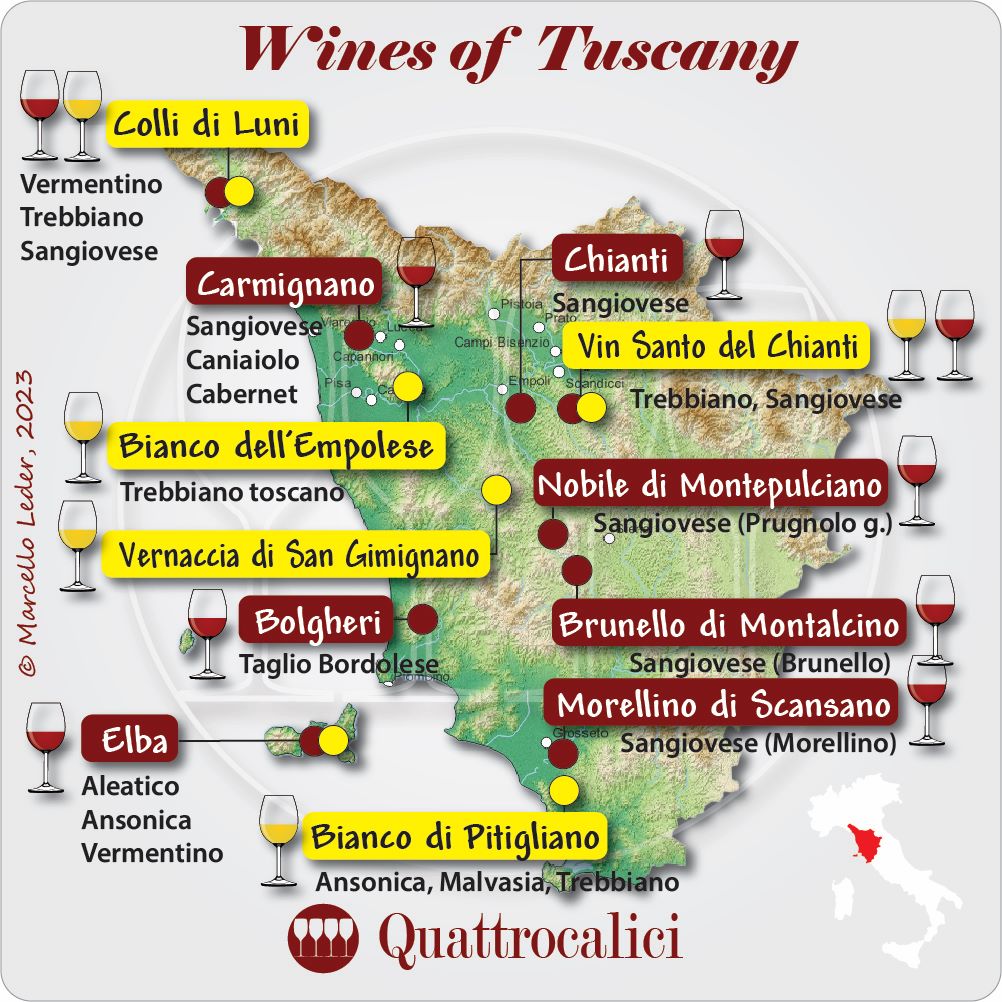
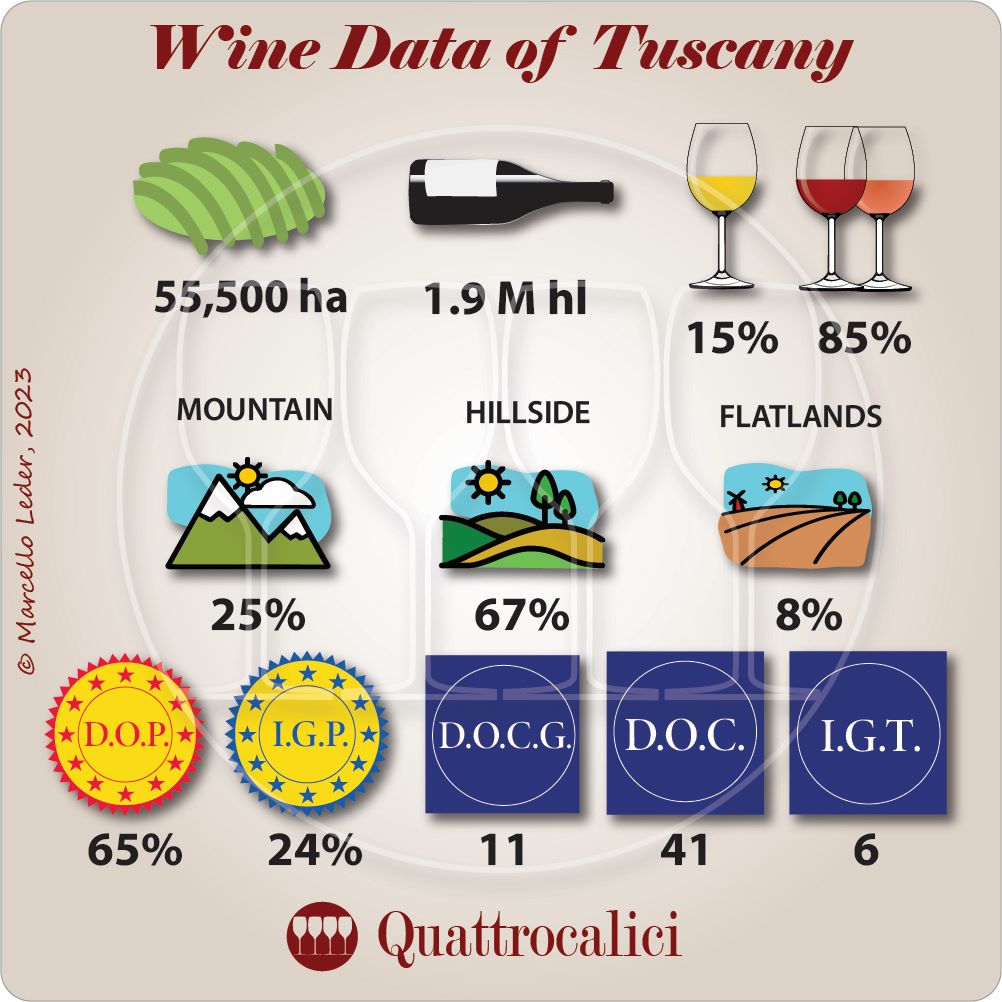
The viticultural heritage of Tuscany includes a total of 11 Denominations of Controlled and Guaranteed Origin (DOCG), 41 Denominations of Controlled Origin (DOC), and 6 Typical Geographical Indications (IGT). Among the most significant wines are Brunello di Montalcino, Vino Nobile di Montepulciano, Chianti Classico, and the Supertuscans produced in the Bolgheri area. Sangiovese is the undisputed protagonist of Tuscan red wines, and we find it in almost all denominations, with different nuances depending on the style and territory of origin.
In Tuscany, however, white wines are also produced, until a few years ago forgotten, but recently brought back to prominence by the fame of Vernaccia di San Gimignano, the first DOCG white wine of the region. Vermentino is instead present along much of the northern coastal strip, starting from the Colli di Luni. Bianco di Pitigliano is instead a protagonist in the Maremma Grossetana.
To complete the overview, one cannot forget Vin Santo and its ancient tradition, present in various forms throughout Tuscany, obtained in its most common versions from partially dried Malvasia and Trebbiano grapes and left to mature for many years in caratelli, characteristic small wooden barrels.