


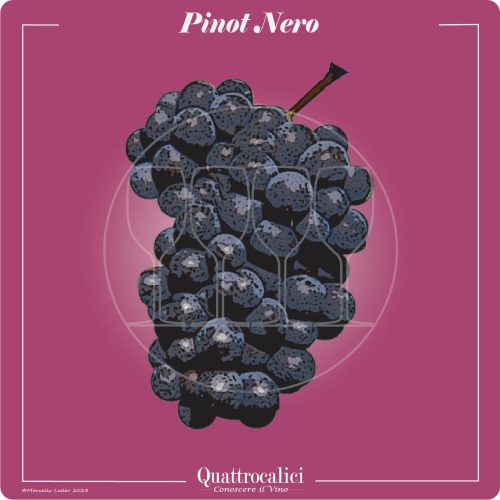
Pinot Nero is considered one of the most noble of the red-skinned grape varieties worldwide (the only possible comparison being with Nebbiolo). Pinot Nero belongs to the group of “international” grape varieties of French origin, widely cultivated around the world. Pinot Nero is a challenging grape, both in terms of cultivation and vinification. The red vinification of Pinot Nero represents a significant challenge for any oenologist and leads to variable results from year to year, even in the regions most suited to its cultivation. Pinot Nero is also extremely sensitive to the terroir, resulting in very different interpretations depending on the area of production. For all these reasons, during tasting, Pinot Nero presents both the consumer and the professional with one of the most complex oenological realities.
The origin of Pinot Nero is Burgundy, where some of the greatest red wines in the world are made. The neutral color of its pulp also makes it suitable for white vinification, producing a wine that is the best base for the production of classic method sparkling wines, especially when blended with Chardonnay, to which it adds body, complexity, and remarkable longevity. In Champagne, especially in the Montagne de Reims area, it is included in all the main cuvées. In Italy, Pinot Nero is found vinified as a red wine, particularly in Trentino-Alto Adige, Oltrepò Pavese, Veneto, Friuli, and even in Tuscany. When vinified as a white, it is used in the composition of classic method sparkling wines, from Franciacorta to Oltrepò Pavese, to Trento DOC.
