


The Best Tool to Learn about Italian Wine

italian wine regions - quattrocalici

Wine in Basilicata

local grapes, wine, and food

Basilicata's Wine data

Basilicata is a predominantly mountainous and hilly region, with many areas suitable for viticulture and wine production, yet only 8% of its territory is flat. South of the volcanic area of Vulture begins the Apennine zone, while to the west stands the Maddalena mountain range, marginally affecting Basilicata, separated from the Vulture massif by the Melandro Valley and the Upper Agri Valley. The entire eastern side is hilly and subject to continuous changes due to the erosive phenomena of clay soils, creating deep grooves in the soil along the hillsides (calanchi) in the Lower Agri Valley and Matera area, with little or no vegetation. The flat areas are mainly in the Metapontine Plain, facing the Ionian Sea, formed from the accumulation of eroded material carried downstream by the rivers, which are abundant in the region. Some rivers, such as the Agri, Basento, Bradano, Cavone, and Sinni, originate and flow entirely within Basilicata, emptying into the Ionian Sea, while others, like the Noce, Ofanto, and some tributaries of the Sele, partially cross the region, flowing into the Tyrrhenian or Adriatic Seas.

The climate in Basilicata ranges from mild to continental, transitioning from the coastal areas to the mountainous inland. Precipitation is much more abundant in the mountains, while in the hilly and coastal areas, it is less widespread. Particularly, the Murge area experiences dry and very hot periods. The Metapontino area alternates mild and rainy winters with hot, dry, and fairly windy summers, ideal for the production of white grape varieties such as Greco and Malvasia, yielding medium-bodied wines with great aromatic consistency. The hilly area towards Matera, characterized by clay and sandy soils with marine sediments, cultivates Greco and Primitivo grapes, producing structured wines with great olfactory complexity. The alluvial and marine valley floor, with its fertile and deep soils, is ideal for cultivating Merlot, Cabernet Sauvignon, and Sangiovese. The Vulture area, in the northeastern part of the region, is particularly suited for growing Aglianico del Vulture. The vineyard soils near the extinct volcano are rich in potassium, giving the wines freshness, sapidity, and minerality. During the typically dry summers, the porosity of the tuff ensures adequate moisture for the vines, thanks to the water accumulated in the winter months. The more inland hilly area of Matera, with altitudes up to 300 meters, has less pronounced Mediterranean characteristics. The summers are still hot and dry, with significant temperature variations, favoring the cultivation of Primitivo and Sangiovese grape varieties.
Wine figures of Basilicata

Viticolture in Basilicata

In Basilicata, the hills, particularly those at the foot of Mount Vulture, are highly suited for viticulture. In the Val d’Agri region, the unique pedoclimatic conditions and the high altitude of cultivation (often exceeding 500 meters) create significant day-night and summer-winter thermal fluctuations, leading to the production of surprisingly exceptional wines. The climate is influenced by the region’s topography, being colder and rainier in the mountainous parts with continental characteristics, and milder towards the sea.

The vine training systems predominantly used are Guyot and spurred cordon, though the historical bush vine (Sapling, Alberello) method is still practiced in particularly rugged and challenging areas. The total vineyard area in Basilicata is about 2,000 hectares, of which 47% is located in mountainous terrain, 45% in hilly areas, and only 8% in plains. This distribution reflects the region’s emphasis on quality and terroir-driven viticulture, capable of producing distinctive wines that capture the unique characteristics of their environment.

History of Winemaking in Basilicata

The viticulture in Basilicata has ancient origins, dating back to the time of Greek colonists. Around the 8th century BC, the Greeks settled along the coasts of the region, bringing with them their advanced vine cultivation techniques. These settlers introduced native vine varieties, some of which are still cultivated today. During the Roman period, viticulture continued to thrive, as evidenced by numerous writings from the time praising the wines of the region.

In the Middle Ages, with the fall of the Roman Empire and subsequent barbarian invasions, viticulture experienced a temporary decline. However, starting from the 10th century, under the dominion of monasteries and churches, vine cultivation in Basilicata saw a new flourishing. The monks, with their knowledge and agricultural techniques, significantly contributed to improving the quality of the wines.

During the Renaissance, Basilicata, like the rest of Italy, saw further development in viticulture. Aristocratic families and large landowners began to invest in wine production, bringing improvements in cultivation and winemaking.

With the advent of Italian unification in 1861, Basilicata’s wine sector began to integrate with the national market. However, the sector faced several challenges, including phylloxera, a parasite that devastated many vineyards across Europe towards the end of the 19th century. This event led to the restructuring of vineyards and the introduction of new cultivation techniques.

The 20th century marked a period of ups and downs for viticulture in Basilicata. The First and Second World Wars had a negative impact, but the post-war period saw a gradual recovery. From the 1960s onwards, there was a growing interest in quality rather than quantity, with a focus on the production of DOC and IGT wines.

Today, Basilicata is renowned for its quality wines, with “Aglianico del Vulture” standing out as one of the most prestigious red wines of the region. Modern producers combine traditional methods with innovative techniques to create wines that reflect the region’s unique terroir. Viticulture has become an important economic and cultural driver, contributing to the promotion of Basilicata both nationally and internationally.

Il vino in basilicata
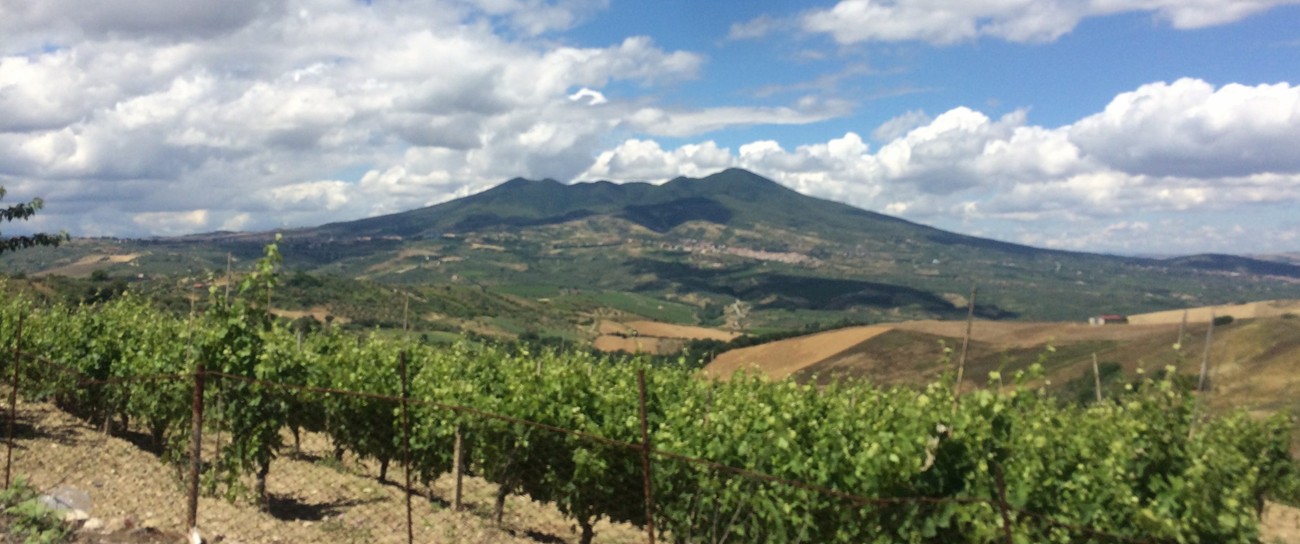
Vineyards at the foothills of Monte Vulture

Wine grapes of Basilicata

In Basilicata, black grape varieties are predominantly cultivated, accounting for nearly 90% of the region’s modest 2.000 hectares of vineyards. Aglianico del Vulture is the most prominent grape variety, covering over 40% of the vineyard area and alone accounting for 90% of the region’s DOP (PDO) and IGP (PGI) wine production. In the Val d’Agri (Terre dell’Alta Val d’Agri DOC) and around Roccanova (Grottino di Roccanova DOC), international grape varieties such as Merlot and Cabernet Sauvignon, along with Sangiovese and Montepulciano, are also grown. In the Matera area, Primitivo is the main grape variety, complemented by Merlot and Cabernet Sauvignon. Other black grape varieties in the region include Aleatico and Bombino Nero.

While less widespread, white grape varieties include Malvasia Bianca, Verdeca, Bombino Bianco, and Chardonnay. The presence of these varieties, although limited compared to the dominance of black grape varieties, highlights the diversity and adaptability of viticulture in Basilicata, capable of producing a range of wines that reflect the region’s varied terroir.

Wine appellations of Basilicata

In Basilicata, the Appellations of origin for wine include the Aglianico del Vulture Superiore DOCG, based on the Aglianico del Vulture grape variety. In the Val d’Agri, there is the Terre dell’Alta Val d’Agri DOC, and in the Roccanova area, the Grottino di Roccanova DOC, where Merlot and Cabernet Sauvignon, Sangiovese, and Montepulciano are grown. In the Matera area (Matera DOC), Primitivo is the principal grape variety, complemented by Merlot and Cabernet Sauvignon. Thus, the regional DOCs for wine are four, with only one IGT. There are also 8 agri-food denominations, including DOP and IGP, among which the famous Pane di Matera IGP is noteworthy. These denominations reflect the diversity and richness of Basilicata’s agricultural and viticultural heritage, emphasizing quality and regional identity in both food and wine production.

Wine areas of Basilicata

In Basilicata, the cultivated grape varieties and different vine training systems define three viticultural areas: Vulture, with some extensions into Alto Bradano, Val d’Agri, and the Matera area, with its hilly slopes descending towards the Ionian Sea.

The Vulture Area

Aglianico del Vulture Superiore DOCG is produced in vineyards planted with about 7000 vines/hectare and yields lower than 5-6 tons/hectare. The wine is characterized by an impenetrable ruby red color, an elegant aroma with hints of ripe red fruit and sour cherry, cherry in spirit, and licorice, cloves, black pepper, and toasted notes after aging in barriques. Traditional producers still use large barrels. Its significant acid-tannic content makes this wine very long-lived and it pairs perfectly with a peppered Podolica beef fillet.

Val d’Agri

Located in the heart of the region, in the province of Potenza, Val d’Agri is a very interesting area hosting two of Basilicata’s four DOCs. The vineyards are planted in sandy and clay-rich soils at 600-700 meters altitude, benefiting from strong thermal fluctuations from August to mid-October. The wines of Val d’Agri (Terre dell’Alta Val d’Agri DOC) and the Roccanova area (Grottino di Roccanova DOC), made predominantly from Merlot and Cabernet Sauvignon, Sangiovese, and Montepulciano grapes, produce structured wines with hints of red berries, spices, and licorice.

These distinct viticultural areas and their unique terroir contribute to the diversity and complexity of Basilicata’s wines, making the region a significant player in the Italian wine scene.

Regional Cuisine of Basilicata

The regional cuisine of Basilicata has deep roots in rural traditions and culture. These origins connected to the land are evident in cheeses like Pecorino di Filiano DOP and Canestrato di Moliterno IGP, as well as in Caciocavallo Podolico, which pairs perfectly with a glass of Aglianico del Vulture Superiore DOCG. Equally interesting are the Luganiga (traditional aged sausage), stews, and bakedTortiere” made with lamb and potatoes, best enjoyed with a red Grottino di Roccanova DOC.

The region is famous for its homemade pasta made from durum wheat, such as Strascinati or Maccheroni, shaped with a ferretto (iron rod), served with meat ragù and Cacioricotta, or Cavatelli with Sarconi IGP beans, ideally paired with a Merlot from Val d’Agri DOC. Another hallmark is Pane di Matera IGP, made with semolina from the Cappelli wheat variety and characterized by its typical cornetto shape. A unique gastronomic excellence from the inland areas with a hint of the sea is Baccalà (salted cod) with Peperoni Cruschi, dried and fried Senise IGP peppers in Vulture DOP extra virgin olive oil, making them crispy and aromatic. This dish is often paired with a Malvasia Bianca or Greco wine from the Ionian coast. For desserts, almond and walnut biscuits and sweet fritters with cinnamon are delightful, especially when accompanied by a sparkling Moscato Dolce from the Vulture area.

These dishes and products highlight the rich gastronomic heritage of Basilicata, where traditional flavors are preserved and celebrated, showcasing the region’s unique agricultural and culinary identity.

Quattrocalici Wine Guide