


The Best Tool to Learn about Italian Wine

Italy's Native Wine Grapes Guide

Greco

Grape's Data Sheet

The Greco Wine Grape in Italy

Greco - The Grape and the Wines

Greco is a grape variety widely grown throughout central Italy, particularly in Campania, but also in Abruzzo, Lazio, Liguria, Molise, Puglia, Sardinia, Tuscany, and Umbria. Like almost all grape varieties that contain the term “greco” or references to it in their name, it most likely originates from Greece and was brought to Italy by the settlers who founded the first cities of Magna Graecia, the geographical area of southern Italy that was colonized by the Greeks starting from the 8th century BC. From the original Greco variety, two distinct grape varieties have developed: Greco Bianco, a Calabrian grape named after the town of Bianco on the region’s Ionian coast, and the Greco proper.

The Greco grape is part of numerous denominations in southern Italy, particularly the Greco di Tufo DOCG in Campania, which includes the town of Tufo and seven other hill communities. Despite being one-third the size of the Fiano di Avellino DOCG, the Greco di Tufo DOCG is the largest denomination by production of PDO wines in Campania. The vineyards of the region are rich in tuff, a rock formed from volcanic ash, from which the town of Tufo gets its name. The wine must contain at least 85% Greco, with Coda di Volpe usually making up the remaining percentage. Greco di Tufo wines are ready to drink up to 3-4 years after harvest and have good aging potential, evolving up to 10-12 years. The Greco grape has a late ripening and is susceptible to downy mildew and powdery mildew. It features characteristic “winged” clusters, and after veraison, the grapes take on a gray-golden color. The phenolic compounds present in the grapes contribute to the characteristically deep color of the wine. Wines made from the Greco grape are known for their aromatic qualities and are characterized by a bouquet vaguely similar to Viognier, with fruity notes of peach and slightly herbaceous notes that tend to become more intense with the wine’s age.
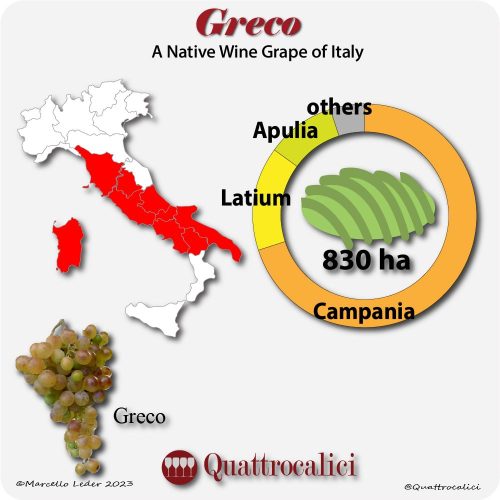
greco a native wine grape of Italy

Greco - General Info Table

Greco is one of the  Local Grapes with White berry widespread mainly in Campania, officially listed in the “Catalogo nazionale varietà di vite” since 1970. Its surface under vines in Italy is 830 ha.
Berry colorWhite berry
Grape CategoryLocal Grapes
Main RegionCampania
Surface under Vines in Italy830 ha
Varietal GroupGreci
Synonym(s)Greco di Tufo
Year of listing1970

Greco - Ampelographic Data

Each grape variety is characterized by Ampelographic Descriptors that define the appearance of its main elements. The ampelographic features of the Greco grape variety are:
Leaf Features
The leaf of the Greco grape variety is medium-sized, orbicular, with five lobes, with three lobes.
Bunch Features
The bunch of the Greco grape variety is dense, very small, cylindrical.
Berry Features
The berries of the Greco grape variety are , of spheroidal and yellow-greenish colored skin.

Greco - Wine Features

The Varietal Wine obtained from each and every Grape Variety, features precisely defined organoleptic characteristics. Referred to Greco grapes, they are as follows:
Varietal Wine's features
The wine obtained from Greco grapes is straw yellow. On the palate the wine is fine, typical.

Greco - Agricultural & Productive Features

Each and every grape variety features very specific agricultural and productive characteristics, such as productivity, yield, ripening time, the ideal type of climate or pruning system, sensitivity to adversities, varying degrees of disease resistance and many others. For the Greco grape variety, the main characteristics are:
Preferred pruninglong pruning
Productivityhigh
Sensitivitiespowdery mildew, Peronospora

Greco - Appellations of Origin

The Quattrocalici Grape Varieties Database collects data on all grape varieties that are explicitly mentioned in at least one Italian PDO (Protected Designation of Origin) or PGI (Protected Geographical Indication) denomination. The Greco grape variety is mentioned in the regulations of the following denominations:
DenominationTypeRegion
Basilicata IGTIGTBasilicata
Benevento o Beneventano IGTIGTCampania
Bianco di Pitigliano DOCDOCTuscany
Campania IGTIGTCampania
Cannellino di Frascati DOCGDOCGLatium
Capri DOCDOCCampania
Cilento DOCDOCCampania
Colli Cimini IGTIGTLatium
Colli di Salerno IGTIGTCampania
Cori DOCDOCLatium
Daunia IGTIGTApulia
Dugenta IGTIGTCampania
Epomeo IGTIGTCampania
Fiano di Avellino (Apianum) DOCGDOCGCampania
Frascati DOCDOCLatium
Frascati Superiore DOCGDOCGLatium
Gravina DOCDOCApulia
Greco di Tufo DOCGDOCGCampania
Irpinia DOCDOCCampania
Lazio IGTIGTLatium
Marino DOCDOCLatium
Matera DOCDOCBasilicata
Molise o del Molise DOCDOCMolise
Murgia IGTIGTApulia
Paestum IGTIGTCampania
Penisola Sorrentina DOCDOCCampania
Pompeiano IGTIGTCampania
Puglia IGTIGTApulia
Roma DOCDOCLatium
Salento IGTIGTApulia
Sannio DOCDOCCampania
Sannio DOC sottozona Guardia Sanframondi o GuardioloSottozona DOCCampania
Sannio DOC sottozona Sant’Agata dei GotiSottozona DOCCampania
Sannio DOC sottozona SolopacaSottozona DOCCampania
Sannio DOC sottozona Solopaca classicoSottozona DOCCampania
Sannio DOC sottozona TaburnoSottozona DOCCampania
Tarantino IGTIGTApulia
Valle d’Itria IGTIGTApulia
Vesuvio DOCDOCCampania
Vignanello DOCDOCLatium