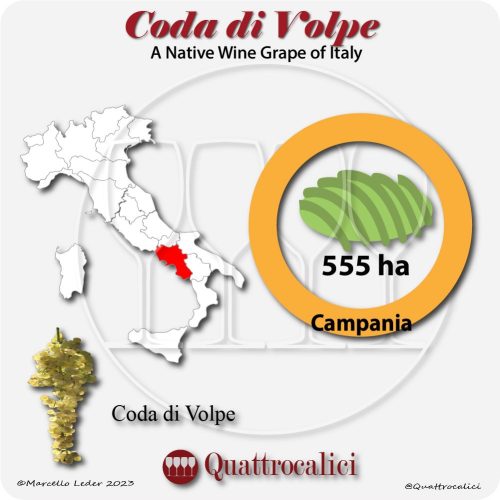


The grape variety Coda di Volpe is an ancient white grape variety characteristic of Campania, with precise historical references dating back to the times of ancient Rome. Pliny the Elder already mentioned in his “Naturalis Historia” a grape variety called “Cauda Vulpium” suitable for pergola training. Its name derives from the characteristic shape of the bunch, which resembles a fox’s tail. Coda di Volpe is cultivated throughout most of the region and is part of numerous DOC designations of origin in Campania. In Irpinia, it finds the most favorable conditions, on medium-altitude hills with good sun exposure. It is widely cultivated at the foot of Vesuvius, but also in Benevento, in the areas of Sannio and Taburno.
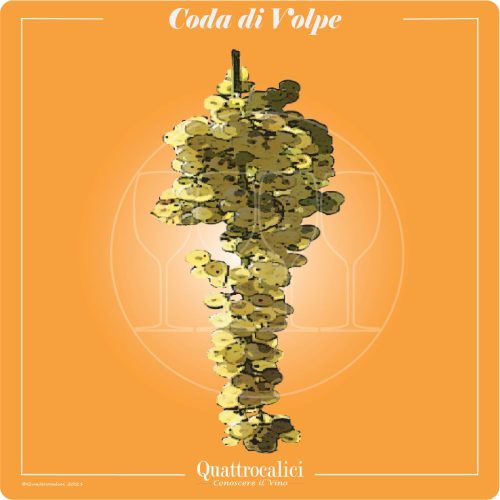
The Coda di Volpe grape variety has large clusters, with a density ranging from loose to compact, elongated to resemble a fox’s tail, with two large wings and a length that can reach up to 40 cm. The berries are small, spherical, with thick yellow skins and a very concentrated bloom. Its yield is medium, but producers often keep it at low levels to carry out subsequent vinification in purity. Coda di Volpe is harvested in the last two weeks of September. At maturity, it reaches high sugar levels, but with low total acidity. Coda di Volpe is vinified both in a dry, still version and as a sparkling wine, including sweet varieties. By allowing the grapes to mature until the end of the natural period, a sweet, still wine with a minimum of 14.5% vol is obtained. Coda di Volpe wine presents a straw yellow color with golden reflections, a pleasant aroma, with characteristic fruity notes of pear, quince, pineapple, banana, yellow peaches, and floral and mineral hints. Its taste is typically savory, fresh due to acidity, and dry, with good structure, with very persistent fruity and floral memories. Its freshness makes Coda di Volpe enjoyable paired with first courses with delicate fish sauces and seafood risottos, but also pasta dishes with vegetables typical of the rural tradition. Among second courses, it pairs well with white meats, shellfish, and fish stews.