
The Best Tool to Learn about Italian Wine

italian wine regions - quattrocalici

Wine in Apulia

local grapes, wine, and food

Wines in Apulia

Puglia’s wine production ranks among the most significant in Italy in terms of volume. For years, Puglia’s wine was sent northward, destined for other regions and parts of Europe, where it was used as a “blending” wine to strengthen local wines, enhancing their color, structure, and alcohol content. However, in recent years, this situation has changed, and Puglia’s producers have begun to craft quality wines, recognizing the region’s enormous winemaking potential. Grapes like Negro Amaro, Primitivo, and Uva di Troia have gained international prominence in recent years, marking a resurgence in Puglian wines. Puglia as a whole is also a key area in Italy for the production of rosé wines, which are ideal both for pairing with local cuisine and for the warm climate that characterizes the area for much of the year. In Salento, rosés wines are primarily based on Negro Amaro, in Alta Murgia, and at Castel del Monte, on Bombino Nero, while in the Bari area, they are made from Uva di Troia and Montepulciano grapes.

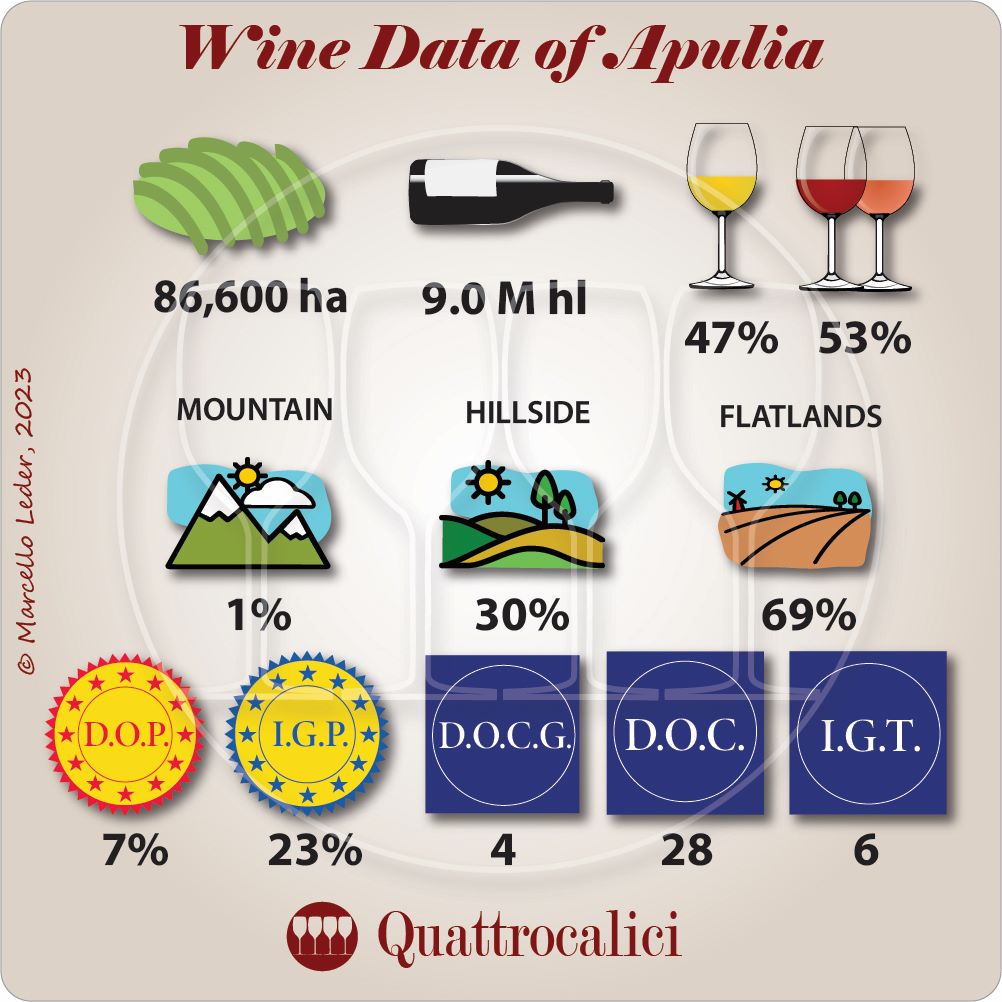
Wine figures of Apulia

Apulia Wine data

Viticolture in Apulia

Puglia’s territory is roughly half hills and half plains. Starting from the north, the first wine region encountered is the Gargano, a promontory made of limestone and eruptive rocks, sometimes steep and covered with Mediterranean scrub. This is followed by the Tavoliere in the province of Foggia; the Murge, a vast area covering the provinces of Barletta-Andria-Trani, Bari, and Brindisi; and finally Salento, encompassing the province of Lecce and parts of Brindisi and Taranto. Puglia’s impressive vineyard area has halved since the boom years, reaching about 95,000 hectares in 2010, with the vast majority located in plains. The annual wine production exceeds 8 million hectoliters (as of 2015). The region is currently experiencing a significant development in the wine industry, especially since, after years of producing high-yield blending wines prized for their color and consistency, there is now a focus on enhancing the territory by achieving respectable quality levels, particularly for wines made from native grape varieties. Especially between Brindisi and Taranto, the most common training system is the traditional bush vine (Alberello), which, however, is increasingly being replaced by the trellised system (Spalliera).

History of Winemaking in Apulia

Vines were likely present in Puglia even before the Greek colonization in the 8th century BC. Some varieties now considered indigenous to this region, such as Negro Amaro and Uva di Troia, were introduced by the Greeks. The “alberello” vine cultivation system, the most widespread method in Puglia, is also of Greek origin. In his monumental work “Naturalis Historia,” Pliny the Elder noted that the region of Puglia was home to the Black Malvasia of Brindisi and Lecce, Negroamaro, and Uva di Troia. Pliny the Elder referred to Manduria as “viticulosa,” meaning “full of vineyards.” With the construction of the port of Brindisi in 244 BC, the trade of Puglian wine experienced a prosperous period. In Taranto, to facilitate shipping and loading, enormous quantities of wine were stored in special cellars carved into the rock along the coast.

Following the fall of the Roman Empire, viticulture and wine production in Puglia underwent a period of decline. It was only thanks to the monks that these activities continued to thrive in the region. The importance of developing viticulture and wine production was also well understood by Frederick II, who planted thousands of vines in the Castel del Monte area, importing plants from nearby Campania.

During the Renaissance, Puglian wines began to spread to other parts of Italy and France. In subsequent periods, Puglia was noted more for the enormous quantities of wine produced rather than their quality. When phylloxera appeared in the vineyards of northern Italy and Europe, Puglia’s vast wine production helped mitigate the effects of this blight, even reaching France, where production was insufficient to meet local demands.

The delayed arrival of phylloxera in Puglia attracted French entrepreneurs who began producing wine there to export to France, Germany, and Austria. However, eventually phylloxera reached Puglia as well, marking the collapse of what seemed to be a flourishing resurgence. The following years saw massive production without any quality criteria, predominantly focused on blending wines, meant to add body and color to productions from other parts of Italy and Europe. It wasn’t until the 1990s that a new awareness of the enological potential of the region emerged among local producers and wineries from other parts of Italy.

Il vino in puglia
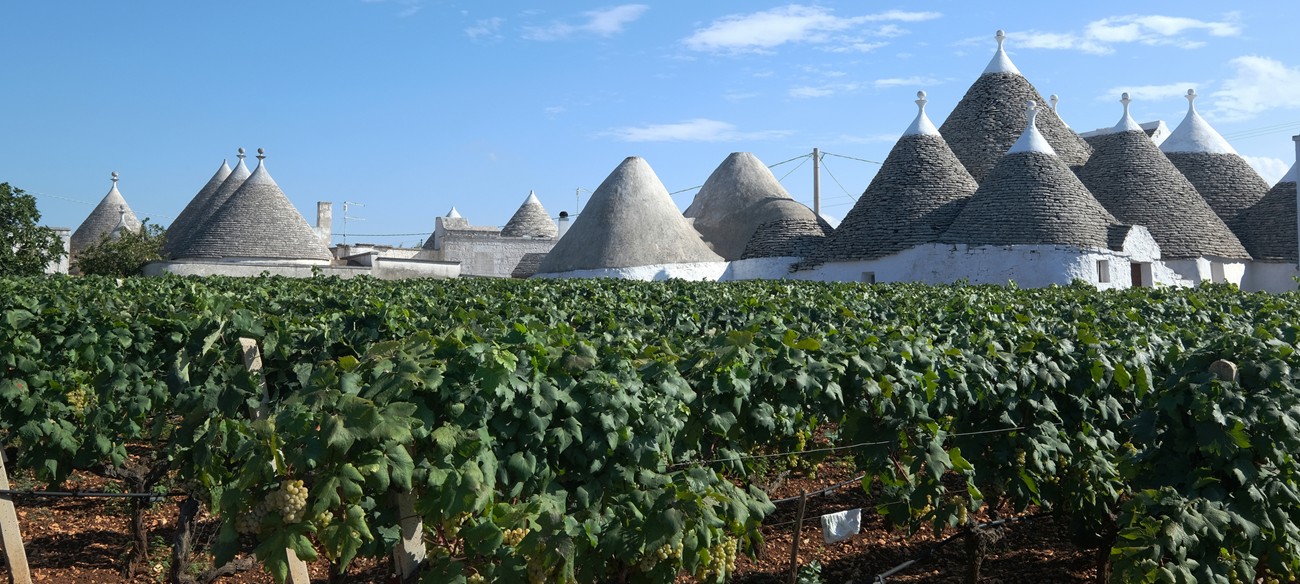
Vineyards in Alberobello Image: Depositphotos.com

Wine grapes of Apulia

In Puglia, significantly more black grape varieties are cultivated than white. The most widespread black grape varieties in Puglia include Negro Amaro, Primitivo, Uva di Troia, Malvasia Nera (from Lecce and Brindisi), Montepulciano, Sangiovese, Aglianico, Aleatico, Bombino Nero, Susumaniello, and Ottavianello, the latter being the regional name for Cinsaut. International grape varieties are also present, notably Merlot and Cabernet Sauvignon. Despite this richness in grape varieties, Puglia is primarily known for wines derived from Negro Amaro, Primitivo, and Uva di Troia grapes, each in their respective favored areas: Negro Amaro in the south, in Salento; Primitivo in the central region; and Uva di Troia as the most widespread variety in the northern part.

As for white wines, they are predominantly produced from native grape varieties, such as Bombino Bianco, Malvasia Bianca, Verdeca, Bianco d’Alessano, and Pampanuto. Significant as well are Fiano, Moscato Bianco, and Chardonnay, which, despite not having “historical” ties to Puglia, is one of the most cultivated and widespread white grape varieties in the region.

Wine appellations of Apulia

In Puglia, the Appellations of Origin for wines, starting from the province of Foggia in the Daunia area, include the San Severo DOC and Cerignola DOC. In this area, the most widespread grape varieties are Bombino Bianco and Bombino Nero, Sangiovese and Montepulciano, Trebbiano Toscano, and Uva di Troia (black grape). Around Bari, we find the Castel del Monte area, with three DOCGs: Castel del Monte Bombino Nero DOCG, Castel del Monte Nero di Troia Riserva DOCG, and Castel del Monte Rosso Riserva DOCG. This area also features Aglianico and the more common international varieties.

Further down, near Bari, there are Gravina DOC, Martinafranca DOC, and Locorotondo DOC. In this area, substantial white wines are produced, with grape varieties such as Verdeca (Gravina), Bianco d’Alessano (Martinafranca), and Malvasia Bianca Lunga (Locorotondo). Further south, in the Salento peninsula, in addition to the primary grapes Negro Amaro and Primitivo, Malvasia Nera di Brindisi is also found. These grapes characterize the wines of the local DOCs, including Primitivo di Manduria DOC and Salice Salentino DOC.

In the region, there are 4 DOCGs, 3 derived from the pre-existing Castel del Monte DOC, plus Primitivo di Manduria Dolce Naturale DOCG. Additionally, there are 28 DOCs and 6 IGTs. Of the 8 agri-food DOPs, 6 are dedicated to Extra Virgin Olive Oil, one to Canestrato Pugliese DOP cheese, and another to the famous Pane di Altamura DOP. Four IGPs are all attributed to fruit and vegetable products.

Wine areas of Apulia

Wine production in Puglia is a widespread practice, representing not only an economic resource but also a connection to the tradition and culture of these places. The winemaking of Puglia is favored by the climate and the amount of sunshine the land receives throughout the year. The “alberello” cultivation system is the most widespread in Puglia, as it allows the vine to make the most of the soil’s resources, improving the quality of the grape and therefore the wine.

The North and Tavoliere

North of Bari, in the province of Foggia and the Tavoliere region, Montepulciano and Sangiovese (black grapes), and Bombino Bianco and Trebbiano Toscano (white grapes) are cultivated. Near Barletta, in the Castel del Monte area, Uva di Troia and Bombino Nero produce robust red wines, part of the three DOCGs: Castel del Monte Bombino Nero DOCG, Castel del Monte Nero di Troia Riserva DOCG, and Castel del Monte Rosso Riserva DOCG. The Moscato di Trani DOC, in sweet natural and passito styles, is based on the Moscato Bianco grape.

Salice Salentino

The Salice Salentino wine area, named after the locality in the province of Lecce, primarily produces red and rosé wines. Salento is one of Italy’s most important areas for rosé wine production. Here, in 1943, Italy’s first bottled rosé wine, the famous Five Roses by Leone de Castris, was produced. The red and rosé wines of the Salice Salentino DOC are made with Negro Amaro and Malvasia Nera grapes. Salice Salentino Bianco is mainly produced with Chardonnay and Pinot Bianco grapes. Another interesting wine is the Salice Salentino Aleatico, produced in passito and fortified styles, which can include small parts of Negro Amaro, Malvasia Nera, and Primitivo.

Primitivo di Manduria

Primitivo is the most widespread red grape in central Puglia and is used to produce Primitivo di Manduria, one of the region’s most important DOCs. Although Primitivo is considered a native grape of Puglia, it appears to be genetically similar to Dalmatia’s Plavac Mali and is known as Zinfandel in California. Primitivo likely gets its name from its tendency to ripen earlier than other varieties. Primitivo di Manduria is made exclusively from Primitivo grapes, aged in barrels or barriques. It is also produced in sweet natural and fortified versions, the latter in both sweet and dry styles.

Other Production Areas

In the northern part of the region, the Uva di Troia grape, also known as Nero di Troia, is predominant, being the main variety of the DOC Cacc’e Mmitte di Lucera. Uva di Troia is used purely for the production of red wines. In Puglia, white wines such as Locorotondo and Martina Franca DOC are also produced, mainly with Verdeca and Bianco d’Alessano grapes. Among the DOC areas in Puglia, Alezio, Brindisi, Castel del Monte, Copertino, Gioia del Colle, Gravina, Ostuni, San Severo, and Squinzano DOCs are notable. Finally, wines from the Salento IGT denomination, especially those made with Negroamaro and Primitivo, are of particular interest.

Regional Cuisine of Apulia

The cuisine of Puglia is distinguished by the importance given to the quality of basic ingredients. Vegetables are fundamental, including turnip tops, green cabbage, peppers, eggplants, artichokes, legumes, and all seafood products. Although there are regional dishes, recipes generally vary according to the area, whether coastal, flat, or hilly inland. In spring and summer, the preference is given to vegetables and fish, while in other seasons, legumes and homemade pasta topped with various sauces, alone or combined with vegetables or fish, are predominant.

Among the pasta first courses, the most typical are Orecchiette, famous for the ragù with brasciole (horse meat rolls) and with turnip tops, followed by Cavatelli with mussels or Baked Rice à la Bari, also known as Riso, patate e cozze (rice, potatoes, and mussels). Among the main dishes of Puglia, vegetables, legumes, and sheep and pork meats, often grilled, prevail. The seafood is extraordinary, thanks to the long Adriatic coast. Notable dishes include Lamb with lampascioni (wild onions), Bombette di vitello (veal rolls), Stuffed Mussels in sauce, Borage omelet, and Fried olives with burrata. Seafood, strictly raw, including famous sea urchins, is a must in the Bari area. Extra virgin Olive Oil, for which Puglia is among the leading Italian regions in production, finds its place in all dishes. There are numerous cheeses, including Cacioricotta from Salento, Burrata, and Canestrato, as well as Caciocavallo, common in many southern regions.

Regarding desserts, notable are Cartellate, Christmas fritters made of twisted puff pastry. Other sweets include Sassanelli, biscuits with vincotto, orange, cocoa, and cinnamon, Pasticciotto, a shortcrust pastry filled with custard and baked, and Scarcella, an Easter sweet shaped like a wheel and covered with icing.

Quattrocalici Wine Guide