

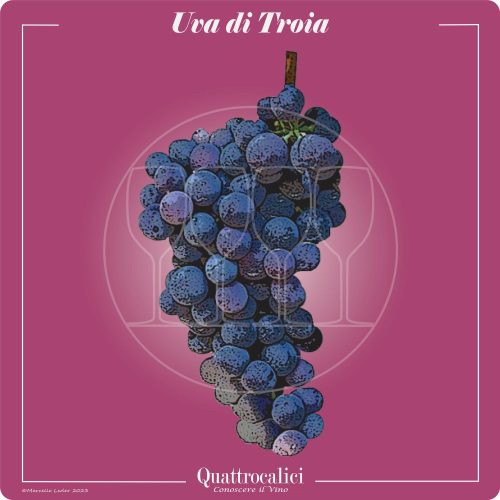
Uva di Troia, also known by one of its synonyms, Nero di Troia, is the third major native grape variety of the Puglia region. The name Uva di Troia suggests its possible origin in Asia Minor, where the ancient city of Troy was located. However, in Italy, Troia is a small town in the Foggia province, likely founded by Greek colonists from Asia Minor. Another hypothesis suggests an Albanian origin for the variety, tracing it to the city of Cruja. The Uva di Troia is extensively cultivated along the Apulian coastal region, particularly in the areas of Barletta and Bari province. There are at least two distinct biotypes: one with larger bunches and berries, and the other, known locally as Carmosina, with smaller bunches and berries, which holds the most promising winemaking characteristics.
The vineyard area dedicated to Uva di Troia in Puglia drastically declined from nearly 5,000 hectares in 1982 to just 1,700 hectares by 2000. However, in recent years, the grape has seen renewed interest, leading to increased investment in its cultivation. Historically, Uva di Troia was often blended into wines for its color, alcohol content, and body, but thanks to the dedication of winemakers, it is now increasingly vinified in purity with excellent results.
Uva di Troia ripens in early October and produces pyramidal clusters, which can be simple or winged, of large size and medium compactness. The berries are spherical and medium-sized, with a thick, highly pruinose skin of black-violet color. The variety has moderate-to-low yields, limiting its cultivation but boasts excellent adaptability to various soil types and training systems. It is resistant to powdery mildew but susceptible to downy mildew. It is primarily grown in Corato, Barletta, Andria, Cerignola, Canosa, San Ferdinando di Puglia, and Trani.
This grape is highly appreciated by lovers of full-bodied wines due to its deep color density and strong personality. Its low productivity and the dedication of producers have greatly improved its quality over the past few decades. In 2011, it was awarded its own DOCG, the Castel del Monte Nero di Troia Riserva DOCG. In these wines, the tannins are softened through barrique aging, resulting in a harmonious balance while maintaining a robust structure on the palate. On the nose, it offers aromas of blackberries and licorice, with balsamic and occasionally herbaceous notes. The flavor is spicy, with hints of wood.
In addition to the DOCG, Uva di Troia plays a significant role in the Cacc’e Mmitte di Lucera DOC, Canosa Rosso DOC, Cerignola DOC, as well as the Puglia and Daunia IGT designations.
