The Best Tool to Learn about Italian Wine

italian wine regions - quattrocalici

Wine in Campania

local grapes, wine, and food

campania wine facts

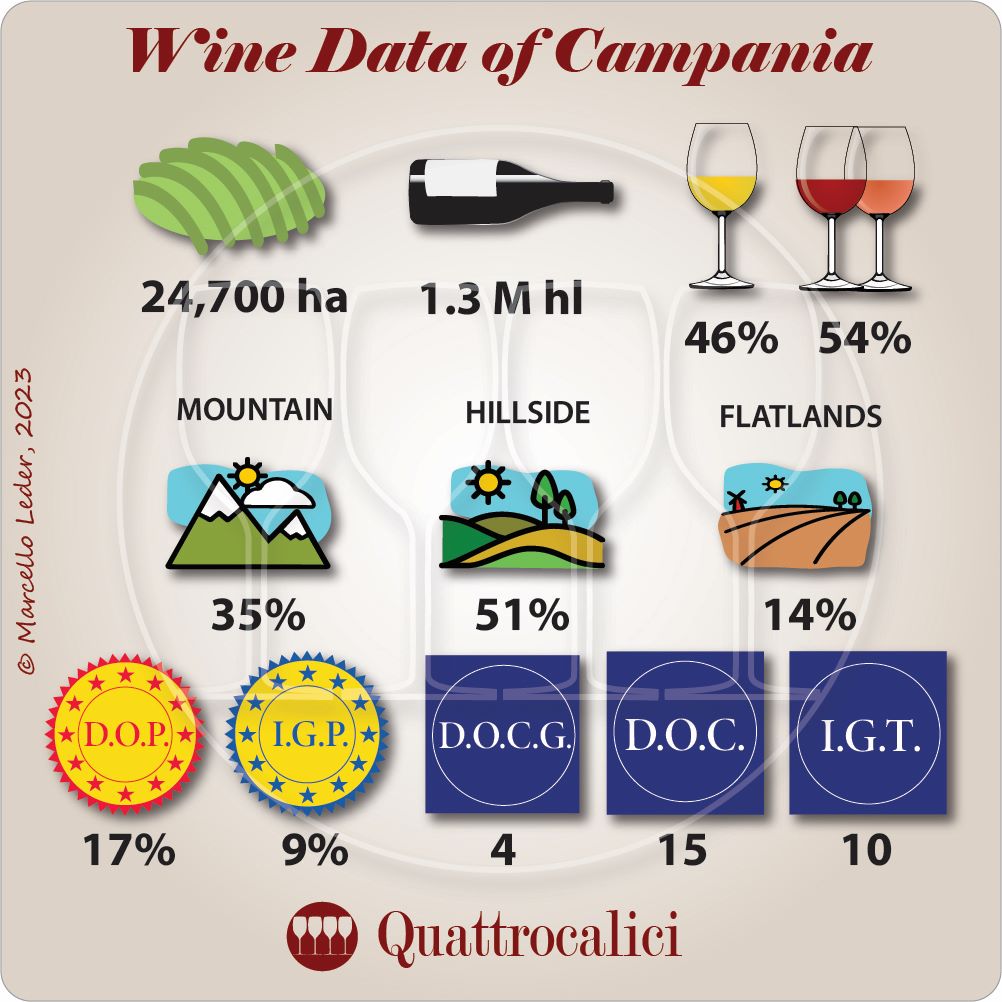
Campania is a region with ancient winemaking traditions that, in recent times, has produced high-quality wines from both white and red grape varieties. Geographically, vine cultivation in Campania benefits from a landscape that is over 50% hilly and more than 30% mountainous. The plains account for just 15% of the region’s surface area.

There are more than 25,000 hectares of vineyards in Campania, with a predominant production of black grape varieties. The prevalent vine-training system is shifting from the traditional pergola to cordon training and Guyot systems, although the training methods vary across this vast region depending on the area. In the Caserta area, tree-trained vines were preferred, while the bush vine is more common in the Avellino area and the general high hill-mountain zones.

Wine figures of Campania

campania wines

Viticolture in Campania

Viticulture in Campania is a sector with a deeply rooted, millennia-long history, representing one of the most characteristic and distinctive aspects of the regional agricultural landscape. This land, rich in history, culture, and traditions, offers a variety of wines that reflect the uniqueness of its territories, the result of a harmonious interaction between nature and human expertise.

The cultivation systems fotr vines in Campania have evolved over the centuries, adapting to the characteristics of the terrain and climate. Traditionally, Campanian viticulture is characterized by the use of tree or pergola systems, which make the most of the favorable climatic conditions, ensuring good sun exposure and optimal ventilation. These systems not only contribute to the quality of the grapes but also represent a distinctive element of the Campanian agricultural landscape.

In recent decades, there has been a gradual modernization of cultivation techniques, with the introduction of cordon training systems that allow for greater mechanization of processes and better health control of the vines. These changes reflect the sector’s evolution towards increasingly sustainable and environmentally friendly practices.

Campania holds a significant position in the Italian winemaking panorama, with a vineyard area extending over several thousand hectares, mainly distributed in the provinces of Avellino, Benevento, Caserta, Naples, and Salerno. The region stands out for its varied production, ranging from fresh and aromatic white wines to full-bodied and structured reds, including high-quality sparkling and dessert wines.

The most recent statistics indicate an annual grape production that underscores the importance of the winemaking sector for the regional economy. The production of grapes in Campania is characterized by a balance between quantity and quality, with growing attention towards sustainable and organic viticulture practices.

History of Winemaking in Campania

The history of viticulture in Campania is a journey through centuries of dedication, innovation, and passion for wine. From the Roman era, when its wines were celebrated throughout the Empire, to the present day, with the rediscovery and valorization of native grape varieties, Campania has always played a leading role in the history of Italian wine. The Campanian winemaking tradition, with its rich variety of grape varieties and its capacity for renewal while maintaining a strong link to the past, continues to be a source of inspiration and pride for Italy and the international wine world.

The history of viticulture in Campania has very ancient origins, predating the Roman era and presumably beginning with the arrival of the ancient Greeks. It was indeed the Greeks who introduced the seeds of the vitis vinifera to Campania: the main native grapes of the region, such as Aglianico, Greco, Fiano, Falanghina, Biancolella, and Piedirosso, are of Greek origin. The name “Aglianico” seems to derive from the term “Ellenico,” meaning “from Greece.” The contribution of the Greeks was fundamental to the success of Campania’s wines that was recorded in Roman times. During the Roman Empire, Campanian viticulture experienced flourishing development, and its wines were exported beyond the Italian peninsula. Many of the famous wines of the time, such as Caleno, Faustinum, and particularly Falernum, were produced in Campania. Pompeii became the main wine trading center of Campania. From the ports of Pozzuoli and Sinuessa, tens of thousands of hectoliters were shipped to countries across the Mediterranean and Gaul. With the end of the Roman Empire, the decline of Campanian viticulture began, reaching the Middle Ages, which marked one of the darkest periods for vines and wine in this region. Even in the Medieval period, however, some Campanian wines enjoyed moderate success. Already in the 1300s, the marked acidity of Asprinio showed its potential in the production of sparkling wines, and by the 1700s, many merchants traveled to Aversa to purchase grapes for producing sparkling wines. The end of this century marked a new decline in Campanian oenology. Oidium and phylloxera arrived in Campania much later than elsewhere, but viticulture still suffered immense damage. The path to quality was only embarked upon from the 1980s onwards. Recently, Campanian wines are recording incredible successes and significant interest from consumers, both for white and red wines. Greco di Tufo, Fiano di Avellino, Falanghina, for the whites, Taurasi, and the various expressions of the imposing Aglianico for the reds, are just a few examples that today make Campania one of the most interesting regions in Italy from an oenological point of view.

wine in campania
"Heroic" viticolure in the Costiera Amalfitana area Image: Depositphotos.com

Wine grapes of Campania

Campania is particularly rich in grape varieties, especially in native vines that have recently been rediscovered and valued as they deserve, producing some of the most interesting wines in Campania. Among the native white grape varieties of Campania, Asprinio, Falanghina, Fiano, Greco, Coda di Volpe, Pallagrello Bianco, Biancolella, and Forastera are noteworthy. Among the native black grape varieties, Aglianico stands out, joined by Piedirosso (also known as Per’e Palummo, meaning Pigeon’s Foot), Sciascinoso, Pallagrello Nero, and Casavecchia. The latter variety, forgotten for years and recently rediscovered with excellent results, is a grape of excellent quality capable of producing extremely elegant and richly colored red wines, having a higher anthocyanin content than Aglianico. Barbera and Sangiovese are the most cultivated varieties among those not originally from the region.

Wine appellations of Campania

Among the Denominations of Origin for wine in Campania, for many years the impressive Taurasi DOCG was the only wine to be awarded the DOCG status. Since 2003, it has been joined by Greco di Tufo DOCG and Fiano di Avellino DOCG. The region also produces interesting IGT wines, made with both native and international grape varieties. Currently, Campania has 4 DOCG labels—2 for white wines and 2 for red wines—and 14 DOC labels, complemented by 10 IGT labels, showcasing the region’s winegrowing vocation, with magnificent vineyards at the foot of Vesuvius, on the islands of Ischia (Ischia DOC) and Capri (Capri DOC), in the Sorrento Peninsula (Penisola Sorrentina DOC), in the province of Caserta (Falerno del Massico DOC), of Benevento (Aglianico del Taburno or Taburno DOCG), Colli del Sannio (Falanghina del Sannio DOC and Sannio DOC), and Valle Caudina. 18 PDO and PGI labels, including 4 solely for Extra Virgin Olive Oil, complete the picture for agri-food products, among which the Mozzarella di Bufala Campana DOP, the San Marzano Tomato DOP, and the Amalfi Coast Lemon IGP are worth mentioning.

Wine areas of Campania

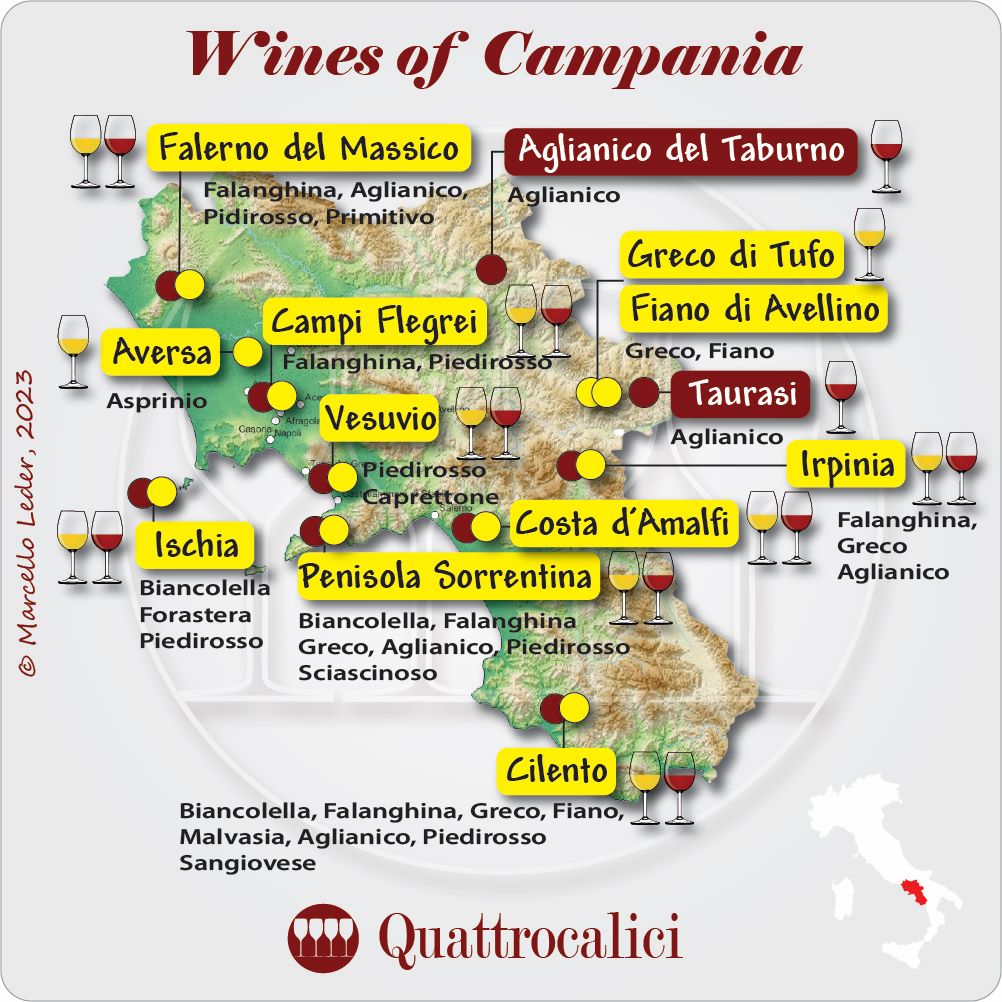
The highest concentration of vineyards in Campania is found in the province of Avellino, which is home to Taurasi, Greco di Tufo, and Fiano di Avellino, and in the province of Benevento, with Sannio DOC and Taburno DOC.

Taurasi and Aglianico

The Irpinia area in the province of Avellino is the premier zone for Aglianico, where the wine that represents its highest expression, Taurasi DOCG, is produced. Known as the “Barolo of the South,” Taurasi is a very rich, concentrated, and complex wine, elegant and impressive. Aglianico also produces the interesting red wines of the Taburno DOC in the province of Benevento. Aglianico stars in the reds of the Sannio DOC area, also in the province of Benevento. Moreover, Aglianico is the main grape in the production of red wines of the Falerno del Massico DOC, in the province of Caserta.

Greco di Tufo and Fiano di Avellino

The province of Avellino records the highest concentration of vineyards, from which wines such as Taurasi, Greco di Tufo, and Fiano di Avellino originate. The Fiano vine has been cultivated in Campania for over 2000 years. Its original name was Vitis apiana (“vine of the bees”), because the insects were attracted by the sweetness of its grapes. The origin of the Greco vine’s name is more obvious, referring to its Greek origins.

Other Production Areas

Also in the province of Caserta is Aversa, the homeland of the famous Asprinio, a dry or sparkling savory white wine produced from the homonymous vine. Falanghina is also grown in this area, forming the basis of the white wines of the DOC Falerno del Massico and Galluccio. The Vesuvius area is known for Lacryma Christi white, red, and rosé wines, with whites obtained from Verdeca, Greco, and Falanghina grapes. The island of Ischia is of particular interest for its white wines from Forastera and Biancolella grapes and reds from Piedirosso. Sciascinoso, locally called Olivella due to its olive-shaped berries, is characteristic of the Sorrento Peninsula and is used in blends to add a note of color and acidity to the wine. On the Amalfi Coast, in the subzones of Ravello and Furore, wines with orange blossom notes are produced, including blends of native grape varieties Fenile, Ripolo, Pepella, and Ginestra.

Regional Cuisine of Campania

The regional cuisine of Campania boasts a variety of typical products, such as Mozzarella and Ricotta, San Marzano tomatoes, Amalfi Coast lemons, Sorrento walnuts, and Limoncello. Pizza, with its soft and puffy crust, is fundamental, but as street food, there are also Pizza a portafoglio (wallet-shaped pizza) and Fried pizza, in addition to Potato croquettes and Zeppole, small fritters made with dough. Pasta is a symbol of Campania, with that of Gragnano being a pride of the region. Famous dishes include Spaghetti alle Vongole (with clams) and Maccheroni col Ragù, Gnocchi alla Sorrentina, with tomato sauce and mozzarella, and Ziti alla Genovese, with meat sauce, onions, and herbs. Sartù di riso is a timbale filled with ground meat, peas, cheeses, eggs, salami, and tomato sauce. Among soups and stews, there are Soffritto soup, Pasta e patate, Pasta and bean soup with mussels, and Minestra maritata, with various types of meat and vegetables. Among the meat-based main courses, we find Rabbit alla Ischitana, Sausages with friarielli (a type of broccoli), and pork or veal cooked in pizzaiola sauce. Fish dishes include cod (in sauce, stewed with potatoes or fried), anchovies (marinated, breaded and fried, stuffed, or baked), and Polpo alla Luciana, with tomato, garlic, parsley, and chili pepper. Eel, or Capitone, is consumed during the Christmas period, cut into chunks and fried. A characteristic dish is Impepata di cozze, stewed mussels, served with slices of toasted bread. Mixed fried fish and shellfish can be served as an appetizer. Among the desserts, we find the famous Babà and Torta Caprese, made with almonds, chocolate, eggs, and sugar. Delizie al limone from Sorrento are small cakes filled with lemon cream and covered with a cream glaze, while Graffa is a fried doughnut sprinkled with granulated sugar. The very famous Pastiera is a tart made of shortcrust pastry filled with a mixture of ricotta, sugar, eggs, and wheat boiled in milk, covered with strips of the same pastry crossed in a Saint Andrew’s cross pattern.

Quattrocalici Wine Guide