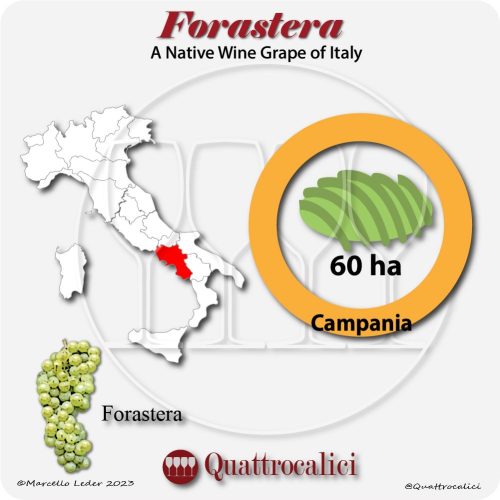


The Forastera grape is a white grape variety that saw its greatest diffusion on the islands off the coast of Campania, particularly Ischia, to save the vineyards affected by the phylloxera crisis of the mid-19th century. The name Forastera and its various synonyms, Furastiera, Forestiera, and Frastera, indicate its origin from outside the island. It is precisely in Ischia that the grape is cultivated today, while on the other islands, it seems almost disappeared. Viticulture spread on the Campanian islands mainly thanks to the Greeks, who in the 7th century BC introduced the Biancolella grape, the protagonist of island viticulture until the phylloxera crisis. In the post-phylloxera period, Forastera began to appear, although Biancolella remained, saved by American rootstocks. Forastera can also be found sporadically in the rest of Campania and in Sardinia, but it is in Ischia that it is most valued.
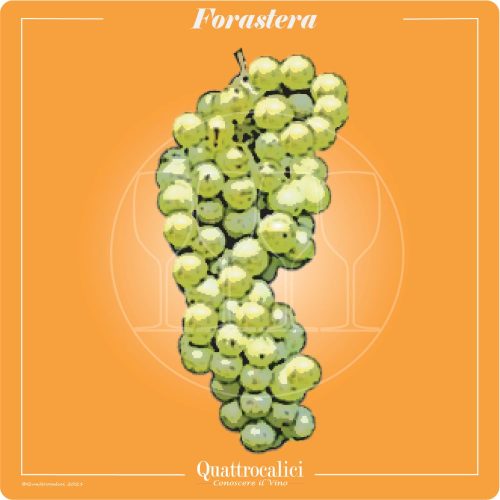
Forastera has medium-sized clusters, cylindrical or pyramidal in shape, and loose. The berries are medium-sized with a thin skin, well covered with bloom, and yellow-greenish in color. It has a mid-ripening period (second half of September) and high, regular yields. Forastera has high vigor and is characterized by its resistance to phylloxera, which brought it to Ischia. However, Forastera could not establish itself due to its extreme difficulty in cultivation, resulting in good and poor years, making the wine not easily marketable, and therefore it is often used in blends. In purity, Forastera wines, pale straw yellow in color, are soft, well-scented with floral and white fruit aromas. On the palate, it is fresh and dry, suitable for pairing with fish dishes, but also excellent as an aperitif. Forastera is included in the Ischia DOC regulations, as well as in many Campanian IGTs such as Beneventano, Pompeiano, Paestum, Epomeo, Campania, Terre di Volturno, Colli di Salerno, and Roccamorfina IGT.