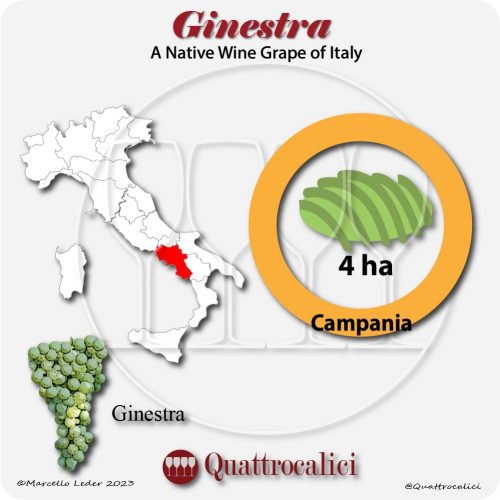



The Ginestra grape variety has been present in Campania since 1825, when Acerbi cited it among the most widespread vine species around Naples. This grape variety is currently cultivated in the Salerno municipalities of Scala, Ravello, Amalfi, Maiori, and Minori, but also in Furore, Tramonti, Corbara, and Positano, where it is known as Biancazita. It is thus almost exclusively found throughout the Amalfi Coast. It is also known as Biancatenera. The Ginestra grape owes its name to the aroma of its grapes, which makes it interesting from an enological perspective. It also shows an excellent ability to accumulate sugars while maintaining high levels of total acidity. It is included as a complementary grape variety in the ampelographic base of the DOC Costa d’Amalfi white type.
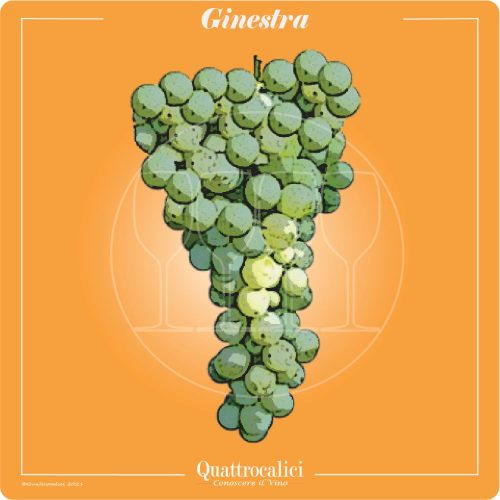
The cluster of the Ginestra grape is small and loose, conical-pyramidal in shape, and has one wing. Its berries are rather small and elliptical in shape. Although it has a fair resistance to downy mildew, the particular sensitivity of Ginestra to botrytis has reduced its cultivated area. Ginestra ripens between the second and third decades of September and is traditionally mixed with other minor varieties in the area. Its wines have floral scents of ginestra, which evolve with aging into notes of hydrocarbons, making it similar to Riesling. The wine obtained has a moderate alcohol content and good acidity.