

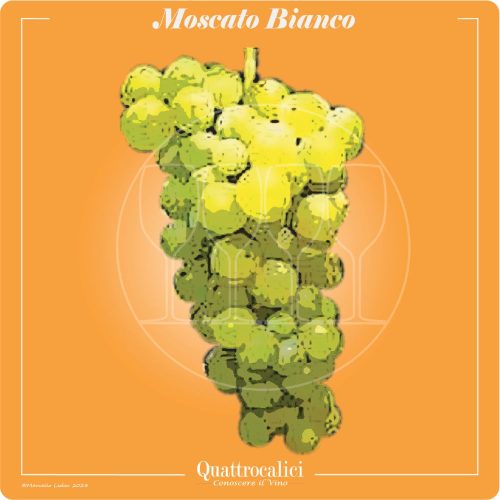
The Moscato Bianco grape is an aromatic variety widespread throughout almost the entire Italian peninsula and is one of the most important in terms of vineyard area. It belongs to the large family of Moscati grapes, aromatic varieties whose name derives from “muscum,” meaning moss, a characteristic aroma found in the grape itself, and likely corresponds to the Anathelicon Moschaton of the Greeks or the Uva Apiana in ancient Rome. It corresponds to the French variety Muscat à Petit Grains, where the French term “musqué” is correctly translated as “aromatic.” Moscato Bianco has numerous synonyms, mostly referring to the wines produced from it or the different production areas across Italy. The main ones include Moscadello di Montalcino, Moscato di Canelli, Moscato di Trani, Moscato d’Asti, Moscato di Siracusa, Moscato di Sorso Sennori, and Weisser Muskateller in Alto Adige.
In Piedmont, Moscato Bianco is by far the most extensively cultivated white grape variety and one of the main varieties in many municipalities in the provinces of Cuneo, Asti, and Alessandria. It is also present, though sporadically, in many other Piedmontese wine-growing areas, including mountainous and foothill regions. Throughout the rest of Italy, it is known and used for the production of aromatic wines in Valle d’Aosta, Oltrepò Pavese, Tuscany, Puglia, Sicily, and Sardinia. Its cultivation is widespread in wine-producing regions worldwide.
Moscato Bianco is a highly versatile grape variety, with its wines typically divided into three main categories: dry and aromatic wines that are very fresh and easy-drinking; sweet sparkling wines such as Asti DOCG; and late harvest or sweet dessert wines like passito. Moscato Bianco wines are highly aromatic, light, and elegant, with good freshness and floral, citrus, and sage notes. They are characterized by their lightness rather than a heavy structure. These wines are elegant, with excellent acidity and a subtle minerality. Asti Spumante is notable for its drinkability, while Moscato Bianco Passito, of which one of the highest expressions is Moscato di Loazzolo DOC, is a completely different wine—honeyed, mature, with a sweetness that can sometimes be viscous, and marked notes of candied fruit and dried flowers.
