The Best Tool to Learn about Italian Wine

italian wine regions - quattrocalici

Wine in Calabria

local grapes, wine, and food

Calabria's wine data

Calabria, washed by the clear waters of the Ionian and Tyrrhenian Seas and separated from Sicily by the Strait of Messina, is a region steeped in history and traditions, boasting an extensive cultural heritage. With approximately 9,000 hectares of vineyards, Calabria ranks as the fifteenth Italian region in terms of vine cultivation area, an expanse comparable to that of the province of Trento alone. The vineyards of Calabria constitute only 1.62% of the Italian viticultural heritage. After years of stagnation, the wine sector in Calabria is experiencing a revival, with new focus on the quality of products, the adoption of modern marketing and communication tools, and the valorization of its rich assortment of native grape varieties.

Wine figures of Calabria

Calabria's wines

Viticolture in Calabria

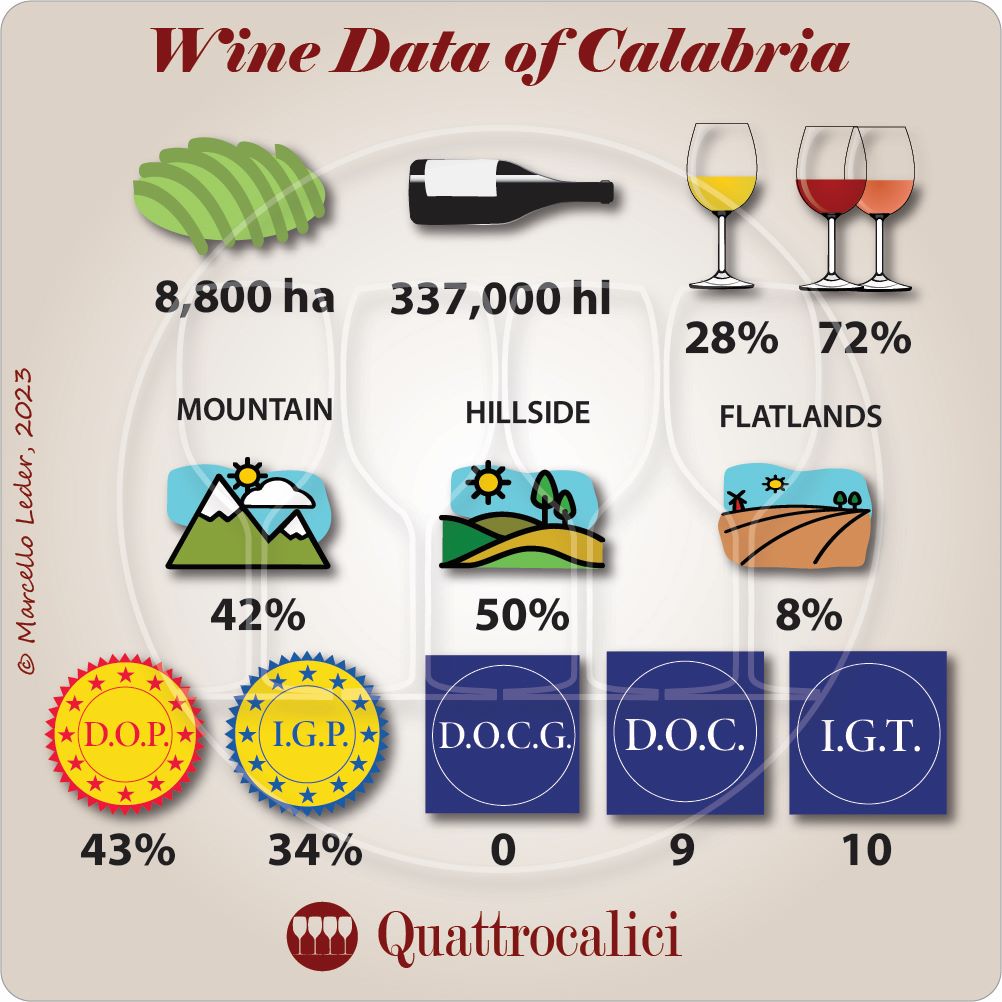
In Calabria, there are approximately 9,000 hectares dedicated to vineyards, in a region where less than 10% of the land is flat. Around 50% of the land is hilly, and more than 40% is mountainous. Consequently, the vineyards are primarily located on hillsides (50%) or in mountainous areas (42%). The total annual wine production is about 337,000 hectoliters, with PDO (Protected Designation of Origin) wines accounting for 43% and PGI (Protected Geographical Indication) wines for 34.6%. The production is mainly focused on red and rosé wines (72%), while white wines constitute 28% of the output.

History of Winemaking in Calabria

The origins of viticulture in Calabria trace back to the first millennium BC. At that time, the Calabrian peninsula was inhabited by the Bruttii, who were part of the Italic peoples, a group of Indo-European lineage that migrated to Italy in several waves, spreading along the central and southern Apennine ridges. The Greeks, starting from 750 BC, colonized the coasts of Calabria, which they named Enotria, or “Land of Wine,” thus providing the first evidence of viticulture pre-dating their arrival. With the Greek colonies, two types of viticulture developed in Calabria: one of Italic origin, in the interior, and the other of Greek origin, along the coasts, with trading centers in Croton, Locri, and Sybaris. The arrival of the Roman conquerors led to a relative abandonment of viticulture in favor of arable crops, but also to new productions that replaced the Greek wines. Pliny the Elder cites as excellent the wines such as Palmatium, from Palmi, and Sanatum (Savuto).

The first writings on Calabrian viticulture date back to the year 1000 AD, but it was at the end of the 1600s that viticulture reached its greatest expansion, to the extent that Calabrian wines were even mentioned by Sante Lancerio, the bottler of Pope Paul III Farnese. At the end of the 1800s, phylloxera led to the complete destruction of Calabria’s vineyards. The subsequent reconstruction of the viticultural heritage has been partial and slow, but gradually led to a recovery in production of wine in the region. For many years, Calabria supplied blending wines to both Italian and foreign producers, thanks to their intense color and high alcohol content. The situation has changed today, and the tenacity of Calabrian winegrowers has ensured that the region has established reputable production realities and wines of respect.

Calabria's vineyards
Vineyards on Calabria's coastline

Wine grapes of Calabria

Calabria is a region particularly rich in native grape varieties. The focus in Calabria is predominantly on black grape varieties, among which the most famous and widely cultivated is Gaglioppo, followed by Magliocco Canino, Nerello Mascalese, Nerello Cappuccio, and Greco Nero. The Calabrese grape variety, also known as Nero d’Avola, is also among the most cultivated in the region. Black grape varieties account for about 80% of the total production. The white grape varieties from Calabria include Greco Bianco, Trebbiano Toscano, Montonico, and Guarnaccia.

Wine appellations of Calabria

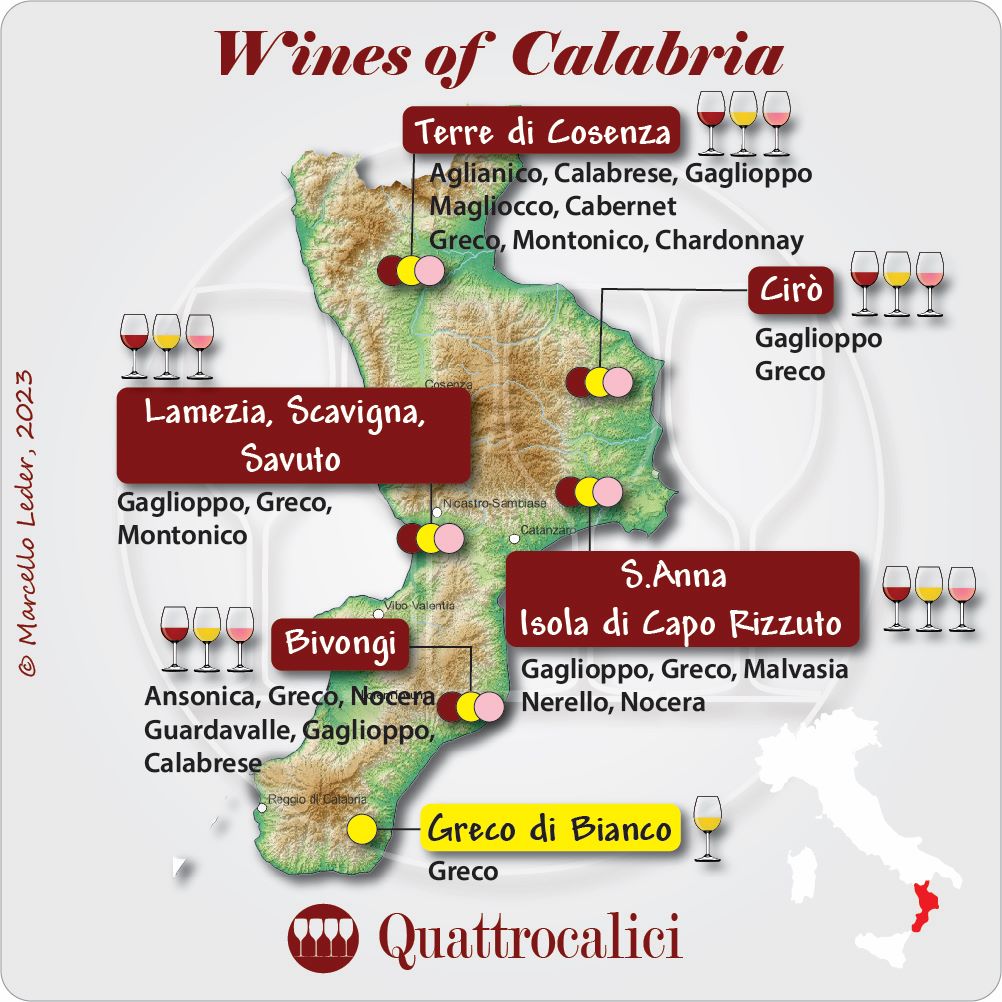
Calabria boasts a variety of wine appellations, encompassing 9 DOC (Denominazione di Origine Controllata) and 10 IGT (Indicazione Geografica Tipica) designations. In the province of Cosenza, the Pollino and Verbicaro areas, once autonomous DOCs, are now incorporated into the Terre di Cosenza DOC. Further south, in the province of Crotone, lie the Cirò (Cirò DOC), Savuto (Savuto DOC), and Val di Neto (Val di Neto IGT) zones. These areas are known for their significant red wines, with the previously mentioned Gaglioppo standing out among the native grape varieties. In the extreme south, in the Reggio di Calabria area, the Greco di Bianco DOC, a well-known dessert wine, and the Costa Viola IGT are found.

In addition to wine, Calabria is recognized for 12 PDO (Protected Designation of Origin) and PGI (Protected Geographical Indication) agricultural products. Notably, these include three Extra Virgin Olive Oils with PDO status, the Bergamot essential oil of Reggio Calabria PDO, and among the cured meats, the Sopressata di Calabria PDO.

Wine areas of Calabria

The main wine-producing areas in Calabria are the Cosentino, the Lametino, the Cirotano, and the Locride regions.

Cosentino, located in the north at the border with Basilicata, is the most extensive production area, with its vineyards situated at elevations between 500 and 700 meters. The Terre di Cosenza DOC designation and its seven subzones, defined by the 2011 regulations, have revitalized viticulture in northern Calabria by consolidating the historical DOC and IGT of the province and categorizing the myriad of wines produced in this area more systematically. The most widespread grape variety here is Magliocco Canino, which yields wines of intense color, powerful structure, and aromas of blackberry and spices, especially in the Colline del Crati subzone, while it shows less color concentration and excellent balance in the Esaro Valley (Esaro Subzone). From vineyards reaching 800 meters in altitude, elegant and fragrant white wines are produced from Greco Bianco and Guarnaccia, either as varietal wines or blends. Moscato di Saracena is a sweet wine with toasted aromas, made from dried Moscatello grapes and concentrated must of Guarnaccia and Malvasia grapes.

Lametino, to the south along the Savuto river, hosts the Savuto DOC and Lamezia DOC. The omnipresent Magliocco Canino is complemented by Gaglioppo, Greco Nero, and Aglianico in the small Scavigna DOC. Among the white grape varieties are Trebbiano Toscano, Malvasia Bianca, Chardonnay, and even Gewürztraminer.

In the province of Crotone, on the Ionian side, lies the Cirò DOC, with its wines made primarily from Gaglioppo grapes, whose renaissance is the result of lower yields per hectare and improved production technologies. Modern versions of Cirò DOC maintain fairly transparent hues, quickly fading into orange, with a warm palate but appreciable tannin. The rosé wines from Gaglioppo grapes are also interesting, fresh, and fragrant with rosehip and raspberry notes.

In the province of Reggio Calabria, the Bivongi DOC produces wines from international and ancient grape varieties, including Greco Nero and Nocera, along with Nerello Mascalese and Nerello Cappuccio, resulting in both straightforward, immediate wines and more structured interpretations that improve with aging.

Locride extends from the slopes of the Aspromonte towards the coast overlooking the Ionian Sea. This area is home to the Mantonico vine, which, even when slightly dried, produces a sweet and fresh wine. In the municipalities of Bianco and Casignana, the Greco Bianco grape variety is used to make the famous, rare, and highly sought-after sweet wine Greco di Bianco. The grapes are dried in the sun for 10-15 days, resulting in a sweet and soft wine with notes of orange blossom, bergamot, apricot, honey, and sage.

Regional Cuisine of Calabria

Although Calabria is a region nestled between two seas, its traditional cuisine is primarily terrestrial, almost mountainous. Indeed, the interior of the region is dominated by the mountains of Sila and the Pollino massif. Calabrian cuisine is simple, rustic, and authentic, closely tied to local products.

Special mention goes to the excellent quality of olives and extra virgin olive oil, a significant portion of which is organically produced. Among other local products, the renowned Tropea onion stands out, along with a wide variety of beans and vegetables in general, and chili peppers, for which Calabria holds an absolute primacy in Italy. The production of citrus fruits is also significant, including oranges, lemons, mandarins, clementines, as well as citrons and bergamot, the essence of which is used by the liquor and pastry industries but especially by the perfume industry.

Fish dishes are nonetheless present in traditional Calabrian cuisine and are mainly related to bluefish (particularly anchovies and sardines) and tuna. The most commonly used meats are sheep and pork, from which traditional salamis are produced, including Calabrese Sopressata. Cheese production is also important, both from cow’s milk (Provole, Caciocavallo, fresh and salted Ricottas) and sheep’s milk (particularly Pecorino Crotonese, Silano, and Pollino, as well as some goat cheeses). In Calabrian cuisine, bread and pasta are fundamental, often homemade with hard wheat of local varieties. The home production of preserved vegetables in oil or dried, to be used in winter or as appetizers, is widespread. Many dishes tied to tradition date back to the populations present in the region in ancient times, such as the Greeks and Albanians, and thus many dishes are prepared on the occasion of religious celebrations of the Orthodox rite.

Quattrocalici Wine Guide