


The Guarnaccia grape is a minor white grape variety originating from the Calabria region, where it is scarcely cultivated, except in its preferred area, the province of Cosenza. No historical document can clarify the origin of Guarnaccia, and it is believed that, like many grape varieties in southern Italy, it may be one of the many grapes imported from Greece during the Hellenic colonization in the 7th century BC. This hypothesis is supported by the grape’s distribution, concentrated on the Campanian coast, the island of Ischia, and Lazio, as well as in Calabria. Here, Guarnaccia is widely grown in the area between the municipalities of Verbicaro, Altomonte, and Saracena (Cosenza), in the southern part of the Pollino National Park. Its name suggests a Spanish origin, but there is no confirmation of this.
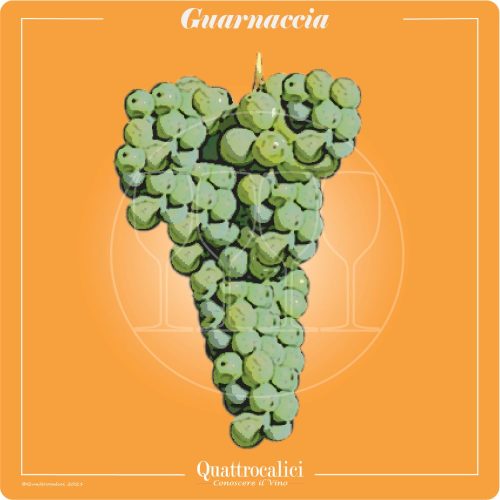
Together with Malvasia and Moscatello, Guarnaccia is used to produce the unique dessert wine Moscato al governo di Saracena. Guarnaccia is a vigorous grape variety, with a medium ripening period (in the third decade of September). From an ampelographic point of view, its bunch is medium, elongated, conical, simple or with a wing, and moderately compact. The berry is medium, from spheroidal to short ellipsoidal, with a visible navel. The skin color ranges from greenish-white to yellow-amber, very pruinose; its pulp is juicy, with a pleasant flavor similar to Muscat. Guarnaccia is included in the Calabrian regulations for DOP Terre di Cosenza Pollino and Verbicaro, but it is also present in the regulations for IGT Calabria, Palizzi, Locride, Arghillà, Pellaro, Scilla, Costa Viola (in the province of Reggio Calabria), and Valdamato (in the province of Catanzaro), Lipuda and Val di Neto (in the province of Crotone). Wine made from pure Guarnaccia is a deep straw yellow color and has floral, fruity, herbaceous, and mineral aromas. It is an intense and full-bodied wine, with good freshness and acidity.
