


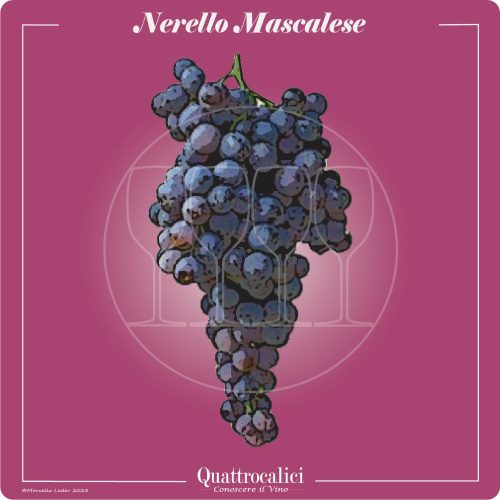
The Nerello Mascalese is a black grape variety predominantly grown on Mount Etna, within the Metropolitan City of Catania, and in the Torre Faro area, a district of Messina. It is also known as Negrello or Niuriddu Mascalisi in Sicilian. The Nerello Mascalese constitutes 80-100% of the blend in Etna Rosso DOC wines and 45-60% in Faro DOC wines. This grape variety is native to the slopes of Mount Etna, with its origins lost in the mists of time.
It is primarily cultivated at altitudes ranging from 350 to 1,000 meters above sea level, traditionally using the alberello (bush) training system, although the more modern cordone speronato (spur-pruned cordon) system is also used. The name “Nerello” is linked to the grape’s deep color, while “Mascalese” comes from its long-standing cultivation in the Contea di Mascali, where the soils are predominantly volcanic sands.
In the Etna region, between Mascali and Randazzo, you can still find ancient Nerello Mascalese vineyards, clinging to the mountains on black volcanic stone terraces, with vines planted in a non-geometrical pattern. This irregular arrangement stems from the historic propagation method of burying vine shoots to multiply the plants, a technique that has left many of these vineyards with ungrafted vines.
The Nerello Mascalese grapes have an oblong shape and a light red color. The variety ripens late, with harvest occurring between the second and third week of October. Wines made from Nerello Mascalese have a high alcohol content (13-14%) and are particularly well-suited for aging. The organoleptic characteristics of Nerello Mascalese wines can vary greatly depending on the region where the grapes are grown. Like Nebbiolo and Pinot Noir, Nerello Mascalese is highly sensitive to vintage conditions and its terroir.
