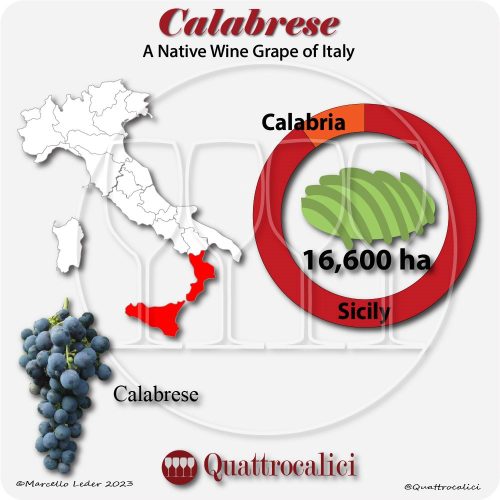



The Calabrese grape, more commonly known as Nero d’Avola, is undoubtedly the quintessential indigenous Sicilian grape variety, with approximately 12,000 hectares cultivated in Sicily. Its origin lies in the localities of Eloro, Pachino, and Noto, in the province of Siracusa. The name “Calabrese” might suggest origins in Calabria, but it is indeed an indigenous Sicilian grape. The Calabrese grape exhibits a certain territoriality in the organoleptic properties of its wines. There are notable differences in character between wines produced with Calabrese in the central-western part of Sicily and those from the southeastern region. The former are almost always fruitier and sweeter on the palate, while those from the southeastern region are decidedly finer and more complex, with pronounced notes of dried flowers and spices, especially those cultivated in the controlled origin denominations Eloro DOC and Noto DOC.
Wines produced with the Calabrese grape exhibit good acidity, which gives wines from the most suitable areas a good predisposition for long aging, especially if the grapes are cultivated using the traditional “alberello” system. Calabrese wines have a strong character and, depending on the vinification style, can be somewhat angular or very elegant. On the nose, depending on the type of maturation, they present notes ranging from floral violet to fruity black cherry, to spices in longer-aged versions, while others exhibit an ethereal note due to the alcohol content. Calabrese is vinified both as a pure variety and blended with other grapes. The oldest of these blends is Cerasuolo di Vittoria DOCG, where Calabrese is blended with Frappato, produced on the southern coast of Sicily between Ragusa and Gela. Calabrese is also often blended with Merlot, Cabernet Sauvignon, and especially Syrah.