


The Greco Nero is an indigenous black grape variety from Calabria, part of the large family of Greek vines, which mainly includes white grape varieties cultivated and used throughout central and southern Italy. Various hypotheses have been advanced about the origin of Greco Nero, although, being part of this family, it probably dates back to the Hellenic domination of the 7th century BC, when Greek settlers landed in southern Italy to found new cities and established the civilization of Magna Graecia. The Greco Nero is a grape that is an integral part of Calabrian tradition, always cultivated in this region, particularly in the provinces of Catanzaro and Crotone. In the Bivongi DOC area, its dialectal name is Magliaccione, or Greco Niuru in areas adjacent to Bivongi.
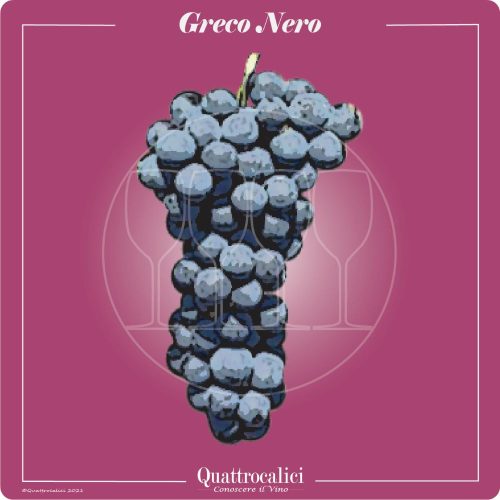
In the past, Greco Nero has been confused with other grape varieties such as Marcigliana or Marsigliana, present in the Catanzaro area. It has also been compared to Verdicchio Nero and Aleatico. The Greco Nero from Calabria is often mistaken for other Greco Neros found in Le Marche, Teramo, Avellino, Tuscany, Velletri, and Terni. From an ampelographic point of view, Greco Nero has medium-sized leaves and medium-large, conical, and short clusters, sometimes, though rarely, winged. Their density is medium-compact. The berries are small to medium, oval, and with a lot of bloom, the skins are thin, and their color is black with bluish hues. Greco Nero prefers warm and less fertile soils. It is grown with low expansion systems, such as the bush-trained system, using very short pruning. Greco Nero has high resistance to fungal diseases and adverse weather conditions. Its yield and productivity are medium-high. Greco Nero is also cultivated in Basilicata and Campania, where it is part of the blends in some IGT wines. Wines made from the Greco Nero grape have a light ruby red color, with a vinous and harmonious aroma. Generally used in blends, its vinifications in purity are not very common.
