

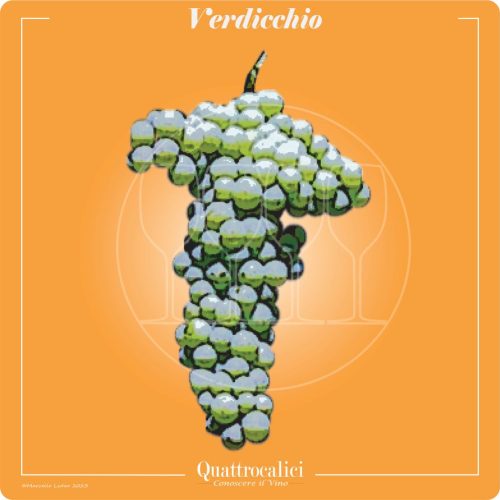
The Verdicchio is a white grape variety primarily cultivated in Le Marche, particularly on the hills between Jesi and Matelica, where it has been grown since at least the 8th century. Its name, similar to others like Verdeca and Verduzzo, derives from the greenish hue of its berries. Recent DNA studies have confirmed its genetic identity with the Trebbiano di Soave and the Trebbiano di Lugana, suggesting that Verdicchio might have been introduced to Le Marche by Veronese vintners around the 15th century. However, the Registro Nazionale Varietà di Vite distinguishes these Trebbiani as separate from Verdicchio, as they differ notably in aromatic profile. The Trebbiano Verde, found in Lazio, also seems to match the Verdicchio, though it is less refined and more productive than its Marchigiano counterpart.
The primary cultivation areas for Verdicchio are the Castelli di Jesi in the province of Ancona and Matelica in the province of Macerata. Around 90% of production occurs in the hills surrounding Jesi, with the smaller Matelica area contributing the rest. Over 1,000 wineries operate on 2,500 hectares, yielding a potential 385,000 quintals of grapes annually. These regions correspond to distinct production areas for two DOC wines, which differ in characteristics: Verdicchio dei Castelli di Jesi has more body, while Verdicchio di Matelica often boasts a more pronounced aromatic intensity.
While Verdicchio has spread to other parts of Le Marche, as well as Umbria and Abruzzo, it tends to lose its distinctive qualities—and sometimes reveals undesirable traits—when grown outside its native terroir. The variety is versatile, excelling in both stainless steel and oak vinification, and has the potential to produce long-lived wines thanks to its structure, high acidity, and alcohol content. However, many producers focus on crafting wines that are approachable in their youth.
Verdicchio grapes are marked by their greenish tint, even at full ripeness, which lends the variety its name. The resulting wines often exhibit this same distinctive coloration. Verdicchio wines are celebrated for their freshness, complex aromatic profile, and signature almond and savory finish. The grape’s versatility allows it to shine in still wines, sparkling wines (using both classic and Charmat methods), dessert wines, and late-harvest wines, making it one of the most eclectic varieties in Italian viticulture.
