

The Best Tool to Learn about Italian Wine

italian wine regions - quattrocalici

Wine in Abruzzo

local grapes, wine, and food

Wines of Abruzzo

Abruzzo is a region of Italy known for its remarkable diversity and captivating offerings, spanning both its wine production and local gastronomy. Predominantly characterized by mountains and hills, Abruzzo is delimited to the north by the Tronto River, serving as the boundary with the Marche region. To the east, the Central Apennines mountain range separates it from Lazio, while the Trigno River forms its southern border with the Molise region. The Adriatic Sea bounds it to the west.

In the western part, a mountainous expanse unfolds, comprised of the Monti della Laga, the Gran Sasso, and the Massif of Maiella ridges. This terrain gradually descends to a subapennine hilly area before reaching the Adriatic. The climate in the region is generally mild, particularly along the Adriatic coast, transitioning to a more continental climate inland and at higher altitudes. The average rainfall is substantial, with lower levels along the coast and increased precipitation further inland.
Wine figures of Abruzzo

Wine data of Abruzzzo

Viticolture in Abruzzo

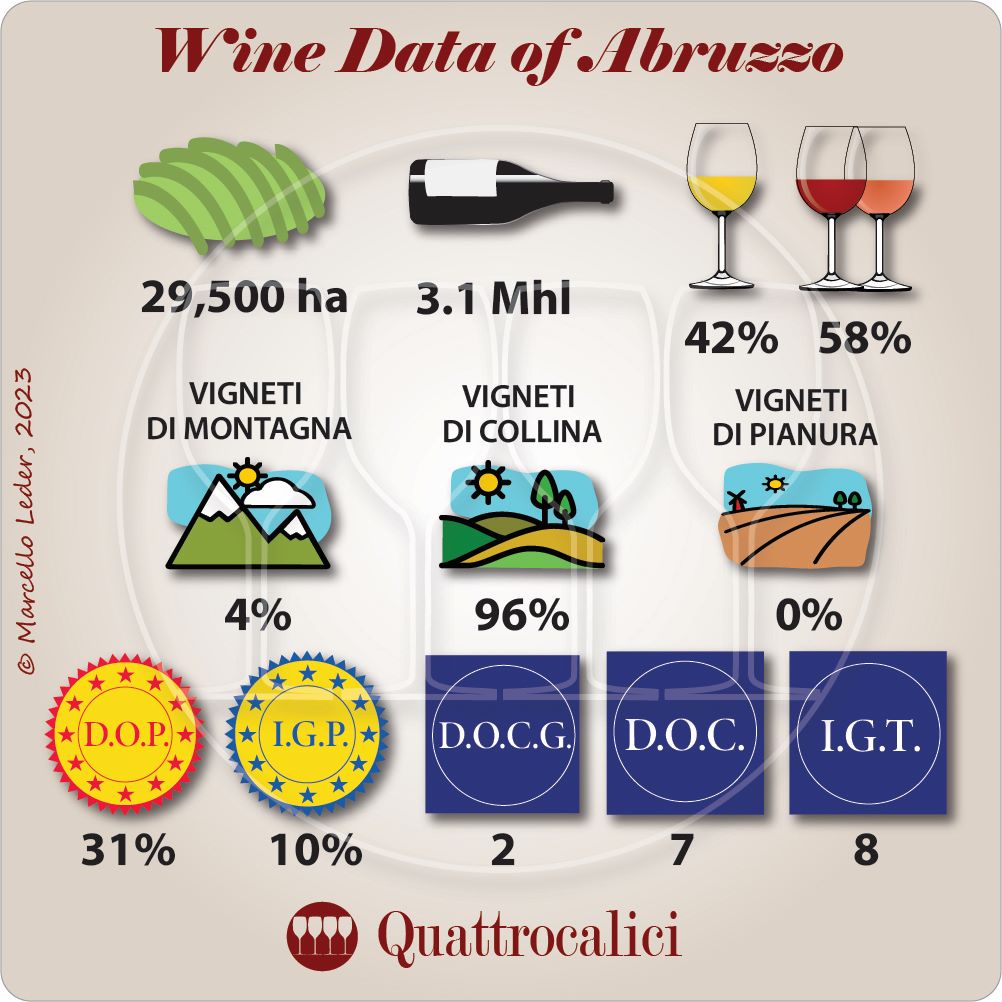
In Abruzzo, the vineyard area exceeds 32,000 hectares, with almost 96% located in hilly regions, while 4% is dedicated to mountain viticulture. Regarding training systems, the Pergola, locally known as “Capanna,” is still widespread, but outdated methods like the Alberate maritate have been replaced by more modern training forms such as Spur training, and Cane training systems, such as Guyot. The total wine production surpasses 2.6 million hectoliters, with over 30% of it classified under DOC and DOCG (PDO) denominations.

History of Winemaking in Abruzzo

The presence of vineyards in Abruzzo dates back to Roman times, and since then, Abruzzese wines have been mentioned in writings by authors from every era. Polybius mentioned these wines while narrating Hannibal’s deeds in the Battle of Cannae (216 BC). In his 1596 work “De naturali vinorum historia de vinis Italiae,” Andrea Bacci spoke of the wines of Sulmona and the Peligni territory, and in 1792, Michele Torcia first described the presence of the Montepulciano grape in Abruzzo. From the 19th century onward, there are countless references to Montepulciano, which became emblematic of the region in the early 20th century.

In 1897, Edoardo Ottavi and Arturo Marescalchi, in their “Vade-Mecum del commerciante di uve e di vini in Italia,” mentioned grape varieties such as Camplese or Campolese (Passerina), Racciapollone (Montonico), Tivolese, Verdicchio, Malvasia, Moscatello, Cordisco, and Primutico (Montepulciano), Gaglioppo, Aleatico, and Lacrima. Following the phylloxera crisis, more productive varieties like Trebbiano Toscano and Abruzzese were replanted, and Abruzzo’s viticulture, like many other regions in Italy, pursued immediate profit, favoring quantity over quality.

A significant shift occurred in the second half of the 20th century, with initiatives aimed at achieving excellence in the agri-food sector. Meanwhile, many indigenous varieties fortunately did not completely disappear from the region. Today, some of these have been rediscovered and rightly valued for their excellent chemical-physical and organoleptic characteristics.

Vineyards in Colline Teramane hills
Vineyards in Colline Teramane hills - Image: Depositphotos.com

Wine grapes of Abruzzo

In Abruzzo, the majority of grape varieties, both red (bacca nera) and white (bacca bianca), are indigenous. The most famous is Montepulciano, widespread throughout the region and neighboring areas. It forms the foundation of wines such as Rosso Piceno and Rosso Conero in the Marche region, as well as Rosso Biferno in Molise. Montepulciano is characterized by its hardiness and resistance to pests, though it is somewhat susceptible to powdery mildew. The mid-altitude hills of Abruzzo particularly enhance its qualities, especially in terms of its polyphenolic content, including anthocyanins and tannins, which contribute to its red color.

Montonico is another indigenous variety, grown on the slopes of Gran Sasso, where significant day-night temperature variations, especially in summer, impart unique characteristics to the wine, both in still and sparkling (made using the traditional method) forms. Passerina, initially cultivated around Teramo, particularly in Controguerra and neighboring areas up to beyond Giulianova, is now found throughout the region.

Trebbiano d’Abruzzo is known for its high acidity and is often used in blends to add freshness. Cococciola, a white grape variety with large berries from the province of Chieti, is mainly grown in the towns of Vacri and Villamagna. Pecorino is typical of the Piceno-Aprutina ridge, though it seems to originate from mountain towns such as Visso, Arquata del Tronto, and surrounding areas.

Sangiovese is also a staple in Abruzzo, as it is in all central Italian regions. Among the international white grape varieties are Chardonnay, Pinot Bianco, and Pinot Grigio, and among the reds are Merlot, Cabernet Franc, and Cabernet Sauvignon.

Wine appellations of Abruzzo

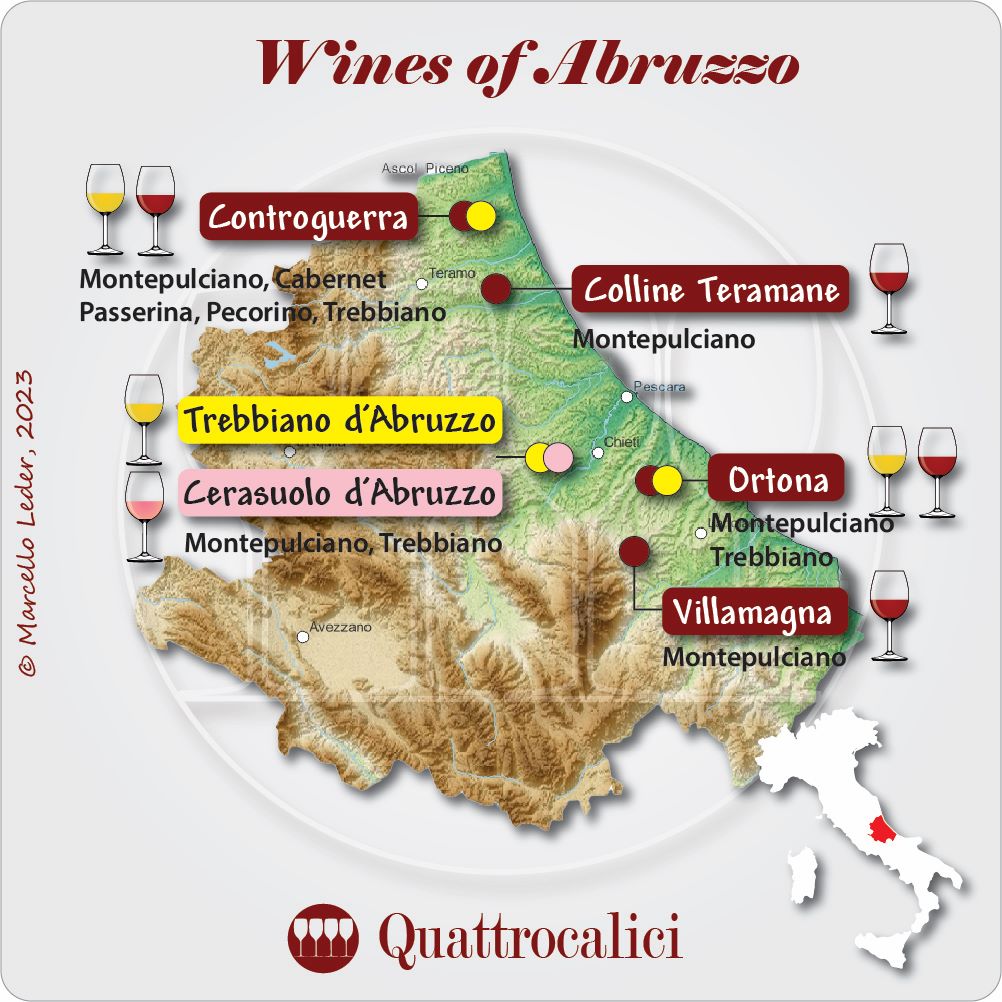
Among the wine appellations of Abruzzo, the most renowned is Montepulciano d’Abruzzo Colline Teramane DOCG. Wines under this designation must undergo one year of wood aging before market release, differentiating them from the corresponding Montepulciano d’Abruzzo DOC. Additionally, the Montepulciano grape is used to produce Cerasuolo d’Abruzzo DOC, a rosé wine that is fruity, fresh, smooth, well-bodied, and easy to drink, complementing a wide range of dishes.

Other DOC appellations in the region include Trebbiano d’Abruzzo DOC and Controguerra DOC, the latter offering a variety of products from sweet wines to sparkling wines, using both indigenous and international grape varieties, with a focus on the terroir since only five municipalities are involved. The Abruzzo DOC, a more recent addition, encompasses all indigenous grape varieties of the Abruzzese territory, including sparkling and sweet wine types.

Abruzzo has two DOCG appellations: the aforementioned Montepulciano d’Abruzzo Colline Teramane DOCG and Terre Tollesi o Tullum DOCG, established in 2019 from a pre-existing DOC. There are also 7 DOC and 8 IGT designations. In addition, the region boasts 6 PDO agricultural food products, including 4 solely for Extra Virgin Olive Oil, another significant product alongside wine. Notably, there’s the Zafferano dell’Aquila PDO and one PGI agricultural food product.

Wine areas of Abruzzo

In terms of viticulture, Abruzzo can be divided into two distinct zones:

Il Teramano:

  • Montepulciano d’Abruzzo delle Colline Teramane DOCG: In the province of Teramo, this area represents the historic region of Montepulciano. Wines here can include up to 10% Sangiovese and must age for a minimum of one year, or three years for riserva.
  • DOC Controguerra: Located in the northern part of the denomination, near the Marche region, it bases its red, rosato, novello, and passito wines on Montepulciano (min. 70%). The white wines, still, passito, and sparkling, are predominantly Trebbiano (Toscano and/or Abruzzese). Varietal wines use both indigenous grapes like Pecorino and Passerina, and international varieties like Cabernet, Merlot, and Chardonnay.
  • Montepulciano d’Abruzzo DOC and Trebbiano d’Abruzzo DOC: These denominations cover most of the region, excluding the mountainous inland areas. They are reserved for varietal wines made from the respective grapes, including superior and riserva types.
  • Cerasuolo d’Abruzzo DOC: A famous Italian rosé wine, made in the same DOC area as Montepulciano, known for its delicacy and structure.

Il Pescarese e il Teatino:

  • Province of Pescara: Here, Montepulciano, including riserva, is produced in the Montepulciano d’Abruzzo DOC’s subzones, Terre dei Vestini and Casauria. In the same areas, Trebbiano achieves excellence within the Trebbiano d’Abruzzo DOC, in base, superior, and riserva types.
  • Terre dei Peligni and Alto Tirino: These subzones in the province of L’Aquila feature vineyards in foothill areas.
  • Teate Subzone (Province of Chieti): Home to the second and recent DOCG, Terre Tollesi or Tullum (2019), it surrounds Tollo. The denomination includes four wine types: two whites based on Passerina and Pecorino, two reds (base and riserva) based on Montepulciano, and a Chardonnay-based white sparkling wine.
  • Province of Chieti: This is the most important area for viticulture, with over 80% of regional production. It hosts the Terre Tollesi or Tullum DOCG, the DOC Ortona with Montepulciano reds and Trebbiano whites, and the DOC Villamagna, known for its Montepulciano-based reds, including a riserva version.

Regional Cuisine of Abruzzo

In Abruzzo, bread and bakery products play a significant role in regional gastronomy, featuring a wide array of items such as corn bread, the rich Easter Pizza, potato bread, and Panonta, which is made with a dough greased in the frying oil of bacon.

Among the “first courses“, the famous Spaghetti alla chitarra (also known as Tonnarelli or Maccheroni alla chitarra) stands out. It’s an egg pasta with a square cross-section, also popular in Molise and Puglia. In Abruzzo, spaghetti alla chitarra is traditionally served with rich mixed meat sauces. Scrippelle, originating near Teramo, are ultra-thin omelets akin to French crêpes. They can be enjoyed sprinkled with Pecorino chees and immersed in chicken broth, stuffed with meat and baked, or used as the foundation for delicious timbales.

For meat dishes, classic sheep arrosticini are notable. They consist of simple cubes of sheep meat threaded on skewers and cooked over charcoal. The local cheese production includes various types of pecorino, caciotte, and mozzarellas. In the realm of cured meats, various kinds of pork liver sausages stand out.

In desserts, alongside various types of taralli, there are Bocconotti, Ferratelle, Pan ducale, Fiadone, and Torroni. The Confetti (sugar-coated almonds) from Sulmona are world-renowned.

Quattrocalici Wine Guide