


The Lacrima grape variety is also known by the name of the wine obtained from it, Lacrima di Morro d’Alba. It is an indigenous grape variety of the Marche region, with ancient origins. It appears that as early as 1167, Frederick Barbarossa drank wine produced from this grape while residing in the castle of Morro d’Alba during the siege of Ancona. The origins of the name seem to derive from the fact that the berry, when ripe, exudes droplets of juice that resemble tears. According to others, the name might be connected to the elongated shape of the berry, or to a distant relationship with the Spanish “lacrima” grape. Traditionally, the cultivation of this grape variety was carried out by “marrying” it to a living support, such as a tree like the elm or maple, or to a wooden pole.
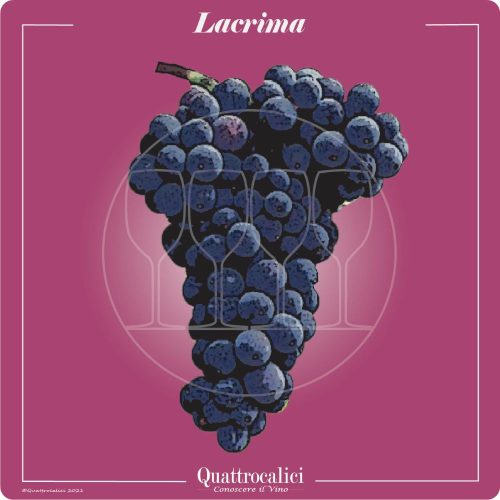
Over the centuries, the spread of the Lacrima grape variety has become increasingly restricted, confined to the area of its origin, Morro d’Alba. For this reason, it even risked extinction in recent decades, until it was protected in the 1980s with modern cultivation techniques and the designation of origin. Small quantities of this grape variety are also cultivated in Romagna, Tuscany, and Puglia. The Lacrima grape variety has medium-sized, pyramidal-shaped, loose clusters with wings. The berries are also medium-sized, round, with skins that exhibit characteristic tear-like droplets when ripe. Their color is a very dark blue, almost black. Despite its susceptibility to botrytis, rot, and parasites, the Lacrima grape variety shows excellent vigor and above-average yields, although very dependent on climatic conditions. Lacrima is very sensitive to climatic variations and is a difficult grape variety to cultivate, requiring drastic and numerous prunings.
