
The Best Tool to Learn about Italian Wine

italian wine regions - quattrocalici

Wine in Molise

local grapes, wine, and food

Wine figures of Molise

Molise is a small region with a total area of 4,438 km², and this is reflected in its viticulture and wines as well. It is predominantly a hilly (45%) and mountainous (55%) region, with vineyards located both on hills and in mountainous areas. The total vineyard area is only 6,400 hectares, mostly in the province of Campobasso, producing about 350,000 hectoliters. The vineyards are 58% in mountainous areas and 42% in hilly regions. The plateaus that develop between the Abruzzo and Samnite Apennines give the region a semi-continental climate, with hot summers and cold, snowy winters. Along the coastal strip, temperatures are milder, with modest temperature variations and scarce precipitation. There are two main areas for viticulture: the first, larger area stretches along the valley of the Trigno River (on the border with Abruzzo) and the valley of the Biferno; the second is located inland around Isernia. The traditional Pergola training system is disappearing in favor of the more modern Cordon Spur and Guyot systems.

Wine figures of Molise

Wines of Molise

Viticolture in Molise

Molise, located in the heart of Southern Italy, bordered by Abruzzo, Puglia, Lazio, and Campania, features viticulture primarily concentrated in two provinces: Campobasso and Isernia. The most prominent wine-growing areas are found along the hills that border the Adriatic coast and in inland areas, where altitude and proximity to the sea create an ideal environment for viticulture. The climate of Molise plays a fundamental role in the region’s viticulture. Characterized by cold winters with snowy precipitation, especially in the inland and mountainous areas, and by hot but breezy summers due to the sea breeze, it offers optimal conditions for the ripening of grapes. This thermal variation between day and night promotes the development of complex aromas in the wines, a distinctive trait of Molise’s wine products.

The soils of Molise’s vineyards are predominantly clayey and calcareous, with areas where the presence of sand and gravel ensures good drainage. This diversity of soils allows for the cultivation of a variety of grapevines, both indigenous and international, and the production of wines with unique characteristics.

History of Winemaking in Molise

The history of viticulture in Molise weaves through centuries of traditions, evolutions, and rediscoveries, narrating an indissoluble bond between the land of Molise and grape cultivation, which has its roots in the pre-Roman era. Even before the arrival of the Romans, the Italic populations residing in what we now know as Molise, including the Samnites, practiced viticulture. These ancient peoples cultivated vines and produced wine, taking advantage of the favorable climatic conditions and the fertility of the soils. With the expansion of the Roman Empire, Molise’s viticulture experienced further expansion and refinement, thanks also to the introduction of advanced cultivation and wine production techniques.

During the Middle Ages, viticulture in Molise, as in the rest of Italy, came primarily under the control of monasteries and churches. These ecclesiastical institutions not only kept the tradition of viticulture alive but also contributed to improving cultivation and winemaking techniques. In this period, wine was not just an essential component of the daily diet but also a valuable product for trade.

In the modern age, Molise’s viticulture continued to develop, albeit with ups and downs due to various historical and economic factors, including Italian unification and the two world wars. Despite these challenges, the passion and dedication of Molise’s winemakers allowed the preservation and transmission of local wine traditions. The 20th century marked a turning point for viticulture in Molise, with a gradual technological and methodological renewal that led to the production of superior quality wines. It was in this period that indigenous grape varieties, such as Tintilia, began to be valued, now representing a symbol of regional viticulture. The last decades have witnessed a real renaissance of Molise’s viticulture. The introduction of Controlled Designation of Origin (DOC) and the adoption of higher production standards have brought Molise wines to the attention of a broader, national, and international audience. The commitment to finding a balance between innovation and tradition has allowed Molise producers to offer wines that express the uniqueness of the regional terroir.

Wine in Molise
Vineyards near Termoli, in Molise

Wine grapes of Molise

The grape varieties cultivated in Molise are significantly influenced by neighboring regions, such as Campania, Puglia, but especially Abruzzo, of which Molise was a part until 1963. In Molise, the most important grape varieties are black grapes, among which the indigenous Tintilia stands out with wines under the Tintilia del Molise DOC denomination. Other cultivated grape varieties are those characteristic of the adjacent territories. Montepulciano and Aglianico are the most important black grapes, while Falanghina, Trebbiano (both Toscano and Abruzzese), Greco, Bombino Bianco, and Malvasia Bianca are notable white grapes. Sangiovese is used either as a single varietal or blended with Montepulciano for the production of Pentro DOC Rosso wine. Among the international grape varieties, Chardonnay, Cabernet Sauvignon, Merlot, and Syrah are also cultivated.

Wine appellations of Molise

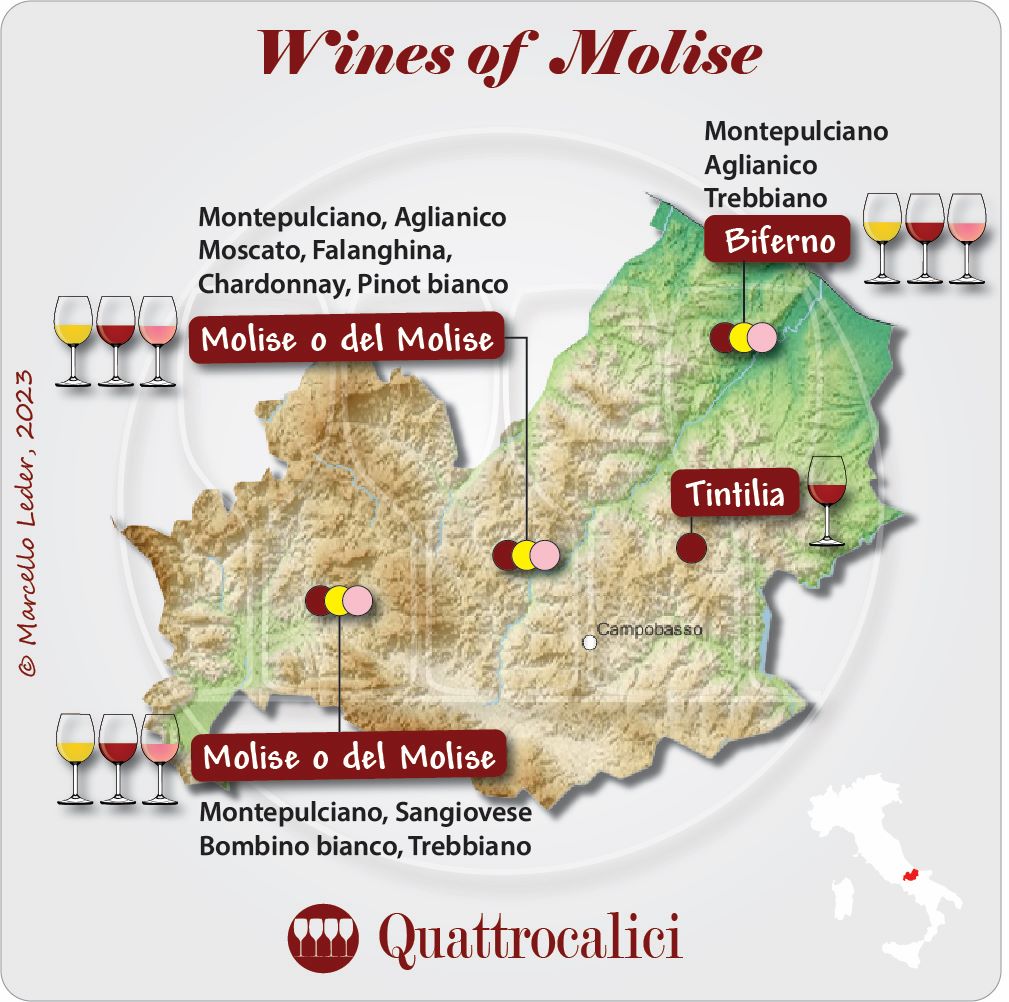
In Molise, there are 4 Controlled Designation of Origin (DOC) and 2 Typical Geographical Indication (IGT) wine designations. The Biferno DOC includes red (also Superiore and Riserva), rosé, and white types, based on Montepulciano (70–80%) and Aglianico (15–20%) grapes for the red and rosé wines, while the white wine is produced with blends based on Trebbiano Toscano (60–70%). The Pentro or Pentro d’Isernia DOC offers red, rosé, and white varieties, blending Montepulciano and Sangiovese for the first two, and Trebbiano Toscano (60–70%) and Bombino Bianco for the white. Both were established in 1983. Later, in 1998, the Molise or del Molise DOC was introduced, covering a large part of the Molise territory, with a wide variety of types and grape varieties. The regulation admits 5 types of wine: red (also Riserva), sparkling, passito, novello, and frizzante. The red and Riserva versions must be produced with at least 85% Montepulciano. The Riserva can be labeled as such after a minimum aging of two years, including six months in wooden barrels. Other permitted grape varieties include Aglianico, Cabernet Sauvignon, and Sangiovese for red wines; Falanghina, Chardonnay, Greco, Moscato Bianco, Pinot Bianco, Sauvignon, and Trebbiano for white wines. The novello can be produced with pure Montepulciano. The frizzante can be made with Chardonnay, Pinot Bianco, and Moscato, each with at least 85% of the grape variety. The sparkling wine can be made with Chardonnay, Pinot Bianco, or Moscato, all with a minimum of 85%.

The Tintilia del Molise DOC was established in 2011. Its production area encompasses many municipalities in Lower Molise, the Biferno Valley, the Fortore and Trigno area, Central Molise, Upper Molise, and the Volturno Valley. The regulation admits red, rosé, and red Riserva types, all based on Tintilia grapes for at least 95%. The Riserva must undergo a minimum aging of two years. The Osco or Terra degli Osci IGT and Rotae IGT were established in 1995. The region also has two Protected Designation of Origin (DOP) agrifood products, one for Molise Extra Virgin Olive Oil DOP and the other for the ubiquitous Salamini Italiani alla Cacciatora DOP.

Wine areas of Molise

From a viticultural perspective, Molise can be divided into two distinct zones. On one side, there’s the foothill and coastal area, represented in the province of Campobasso by the Biferno DOC, and on the other, the more inland and mountainous area in the province of Isernia, by the Pentro d’Isernia DOC. The more recent (2011) Tintilia del Molise DOC designation encompasses both these territories.

In the Biferno DOC, the main grape for white wines is Trebbiano Toscano, while the reds and rosés are dominated by Montepulciano, accompanied by Aglianico, which can make up 10 to 20% of the blends.

The Pentro di Isernia DOC regulation includes four types of wine: White, Rosé, and Red, plus a Red Riserva. The reds and rosés must contain 75-80% Montepulciano, plus 20-25% Tintilia. The white wines are based on at least 80% Falanghina grape.

The Tintilia del Molise DOC designation, created in 2011, includes only wines obtained from the native Tintilia grape, vinified as a varietal.

Regional Cuisine of Molise

The cuisine of Molise is very simple, featuring recipes made from a few basic local ingredients. The most commonly used meats are sheep and lamb, but also pork, often transformed into cured meats. Even the seafood dishes along the coastal strip are based on locally caught fish (especially oily fish).
Among the appetizers, we primarily find cured meats, such as Sopressata, Sausages with fennel or black pepper, and Saggicciotto, a characteristic Molisan salami. The main dishes are mostly pasta-based, like maccheroni alla chitarra and fusilli, with meat sauces or alla Molisana, featuring tomato, bacon, olives, and pecorino cheese. Among the soups, Sagne (a typical pasta shape) with beans, Nettle soup, and Ditalini in brodo alla Termolese, with fish and tomato. When it comes to main courses, characteristic dishes include those based on lamb offal. Lamb and kid are often cooked on the grill. Molisan rabbit is cooked on skewers, wrapped in slices of raw ham. In the mountain areas, various types of polenta are served with meat or vegetables. Among the vegetables grown in Molise, there are various types of broccoli and turnip greens, as well as celery and peppers, used in Affunniatelle, sautéed with eggs, sausage, onion, and tomato. Fried breadcrumbs (often paired with aromatic herbs) are used as a topping for pasta or vegetables. To conclude, the desserts are mostly rustic, often enriched with almonds, and there is a widespread tradition of nougats.

Quattrocalici Wine Guide