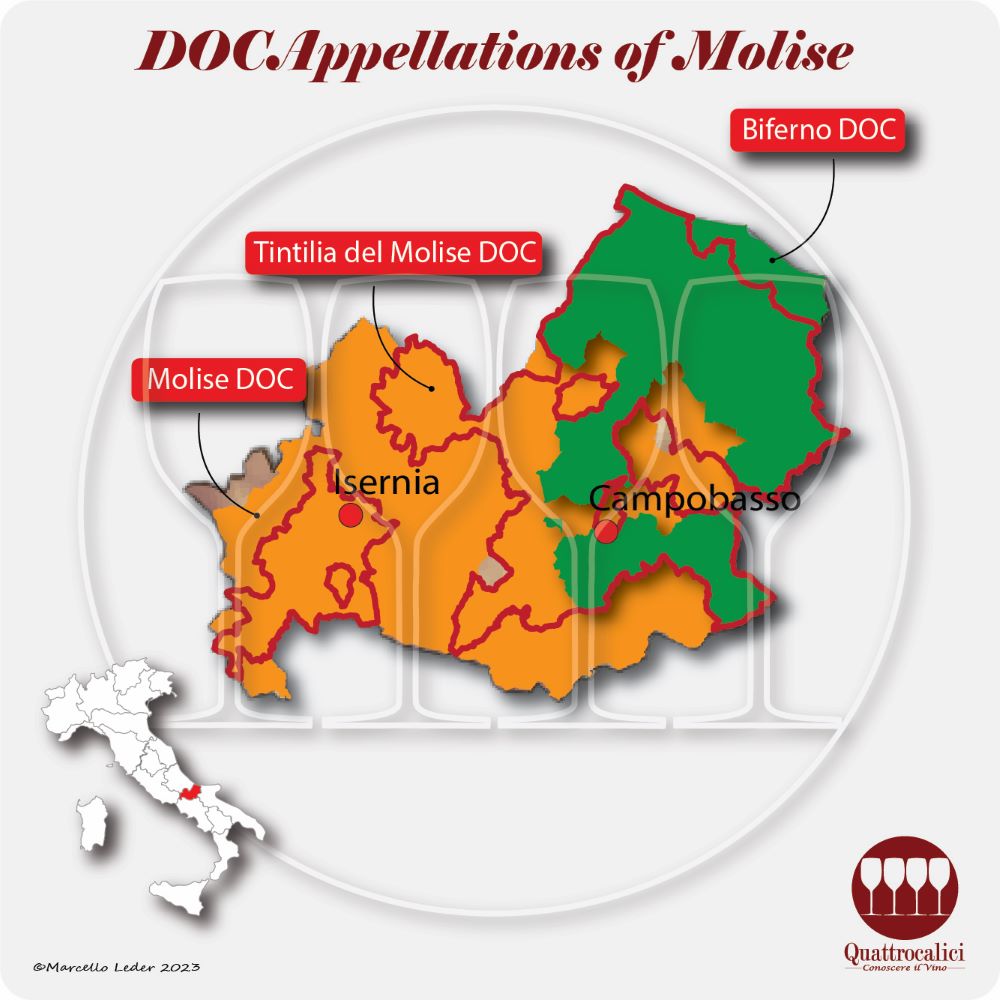


With just two provinces, Isernia and Campobasso, and a vineyard area of about 5,000 hectares, Molise is the third smallest wine region in Italy. History has heavily influenced Molise’s viticulture, which reflects the characteristics of the neighboring regions. The province of Campobasso, located in the northeast, covers two-thirds of the regional area, faces the sea, and encompasses the most suitable hilly territories for viticulture, contributing to almost 90% of the region’s wine production. The province of Isernia, on the other hand, has a much smaller and almost entirely mountainous territory, with just one designation, Pentro d’Isernia DOC, featuring two types of white wine, Trebbiano Toscano and Bombino Bianco, and two types of red wine, Montepulciano and Tintilia. In the province of Campobasso, we find the Biferno DOC, with types such as Aglianico, Montepulciano, and Trebbiano Toscano. The Molise DOC covers all the wine zones of the region, with a broader spectrum of types, all varietal, representing all the grape varieties grown in the region, both white and black, national and international. The Tintilia del Molise DOC, created in 2011, includes three types of wine, all made purely from Tintilia, a base, a reserve, and a rosé version. Two IGTs reference the two provinces, Rotae for Isernia and Terra degli Osci for Campobasso.