

The Best Tool to Learn about Italian Wine

Italy's Native Wine Grapes Guide

Tintilia

Grape's Data Sheet

The Tintilia Wine Grape in Italy

Tintilia - The Grape and the Wines

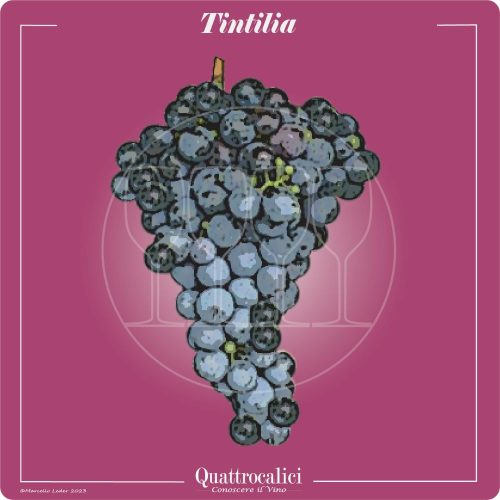
The Tintilia grape variety is an indigenous black-skinned variety found exclusively in Molise. Until recently, it was confused with grape varieties from the Bovale family, present in Sardinia, but subsequent studies disproved this theory. Since 2002, Tintilia has been included in the National Register of Wine Grape Varieties as a variety authorized only for Molise. Its name seems to derive from “tinta,” referring to the intense ruby-red color of its musts, which take on purplish, almost black hues. Thanks to the color and strength of these wines, Tintilia has historically been used to enhance the robustness of other wines produced in the region. Tintilia is a rustic grape, vigorous, resistant to temperature fluctuations and frosts, making it well-suited to the mountainous terrain of Molise, where it has also spread to the region’s interior areas.

Tintilia was progressively abandoned due to its low yields, and starting in the 1960s, it was gradually uprooted and replaced with other non-native varieties such as Sangiovese, Cabernet, and Merlot, along with Montepulciano and Aglianico, which offered higher yields and ensured greater production for vine growers. Recently, however, Tintilia has been rediscovered for its ability to produce high-quality wines. With its relatively loose clusters, small berries, and seeds rich in tannins, Tintilia imparts wine with color, aromas, structure, good acidity, and elegant tannins.

For this reason, Tintilia is highly versatile, yielding both fresh, easy-to-drink wines and structured, elegant ones. When vinified in purity, Tintilia wine has a ruby-red color with purplish reflections, especially when young. On the nose, it reveals aromas of red fruits. On the palate, the wine is full-bodied, with good persistence and always elegant, never aggressive tannins. Tintilia wines are typically aged in stainless steel, which helps preserve their spicy notes. Some producers offer versions aged in wood, often in second- or third-use barrels, to maintain the grape’s aromatic profile.
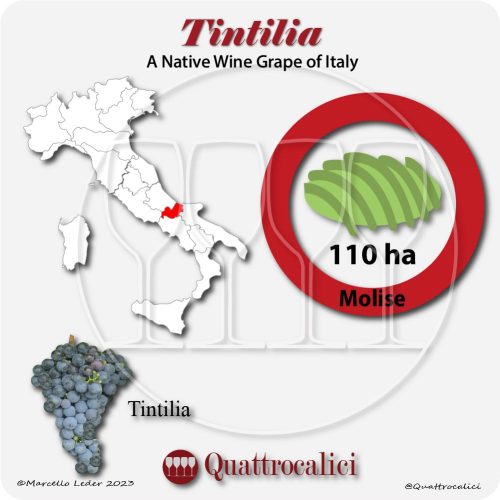
tintilia a native wine grape of Italy

Tintilia - General Info Table

Tintilia is one of the  Native Grapes with Black berry widespread mainly in Molise, officially listed in the “Catalogo nazionale varietà di vite” since 2003. Its surface under vines in Italy is 110 ha.
Berry colorBlack berry
Grape CategoryNative Grapes
Main RegionMolise
Surface under Vines in Italy110 ha
Year of listing2003

Tintilia - Ampelographic Data

Each grape variety is characterized by Ampelographic Descriptors that define the appearance of its main elements. The ampelographic features of the Tintilia grape variety are:
Leaf Features
The leaf of the Tintilia grape variety is medium-sized, orbicular, pentagonal, with seven lobes, with five lobes.
Bunch Features
The bunch of the Tintilia grape variety is sparse, medium-sized.
Berry Features
The berries of the Tintilia grape variety are small shape and with very waxy and black-bluish colored skin.

Tintilia - Wine Features

The Varietal Wine obtained from each and every Grape Variety, features precisely defined organoleptic characteristics. Referred to Tintilia grapes, they are as follows:
Varietal Wine's features
The wine obtained from Tintilia grapes is . On the palate the wine is warm, herbaceous, fruity, tannic.

Tintilia - Agricultural & Productive Features

Each and every grape variety features very specific agricultural and productive characteristics, such as productivity, yield, ripening time, the ideal type of climate or pruning system, sensitivity to adversities, varying degrees of disease resistance and many others. For the Tintilia grape variety, the main characteristics are:
Ripening timelate
Vegetative vigormedium vigor
Productivitylow
Resistancesdrought

Tintilia - Appellations of Origin

The Quattrocalici Grape Varieties Database collects data on all grape varieties that are explicitly mentioned in at least one Italian PDO (Protected Designation of Origin) or PGI (Protected Geographical Indication) denomination. The Tintilia grape variety is mentioned in the regulations of the following denominations:
DenominationTypeRegion
Pentro d’Isernia o Pentro DOCDOCMolise
Tintilia del Molise DOCDOCMolise