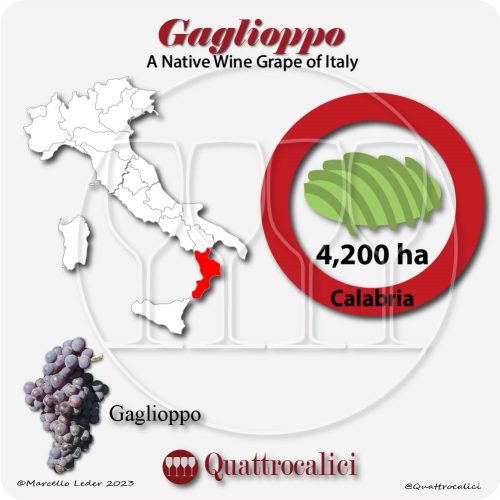



The Gaglioppo grape is a native black grape variety from Calabria, probably of Greek origin, and has spread predominantly in the coastal areas of the region. Gaglioppo is the most widespread variety in Calabria, found in all the region’s red DOC wines, the most significant of which is Cirò Rosso. The origin of the name seems to trace back to the local dialect, where Gaglioppo means “closed fist,” due to the compactness of the cluster. In the area of Cirò Marina, ancient Crimissa, the first Greek colonizers, driven by the desire to find new commercial outlets, made nearby Sibari a key center for wine production, which was then exported throughout the Mediterranean. The wine obtained from Gaglioppo, called Krimisa, became famous and appreciated until the decline of Magna Graecia, which brought down the fate of many Mediterranean grape varieties.
Thanks to its remarkable potential, Gaglioppo was rediscovered after the destruction of the vineyards due to phylloxera and has become one of the most appreciated varieties in Calabrian winemaking. Gaglioppo is cultivated between the provinces of Cosenza and Catanzaro, in that very fertile area located between the Sila and the sea, but its area of choice is the province of Crotone, especially in the Cirò Marina area, where ancient medium-coarse-grained rocks (phyllitic schists) have eroded into thin layers, composed of marl and clay inland and sand towards the coast. This area is one of the hottest in Italy, characterized by a dry climate on the coast while, approaching the Sila and the riverbeds, it becomes more rainy and subject to strong temperature fluctuations, tormented by heat in the summer but refreshed by abundant autumn and spring rains.
Ampelographically, Gaglioppo has a pentagonal and trilobed leaf, with lower margins absent or slightly marked. The cluster is medium, conical, slightly elongated, and with a very developed wing. Its berry is small, spheroidal, with thick, black-violet skin covered in bloom. Culturally, Gaglioppo is resistant to drought and frost and grows well even in coastal areas where soil salinity is very high. However, it is very sensitive to adversities such as downy mildew and powdery mildew, which can compromise its very survival. The traditional training form of Gaglioppo is bush-trained or palmette. Gaglioppo produces a ruby red wine with subtle garnet hues. The nose is characterized by notes of ripe red fruit, cherries, and morello cherries, accompanied by floral scents of violet and spicy notes of licorice. On the palate, it is structured, with almost velvety tannins and a very persistent finish. It pairs well with elaborate first courses, aged cheese and salumi platters, and grilled meats.