The Best Tool to Learn about Italian Wine

italian wine regions - quattrocalici

Wine in Umbria

local grapes, wine, and food

wine figures of Umbira

Umbria is not only known for its wine. It’s one of the most picturesque and fascinating regions of Italy, celebrated for its historical, cultural, and artistic wealth as well as its enchanting landscapes dominated by olive trees and vines. Olive oil and wine are the two fundamental pillars of the region’s food and wine culture. Umbria is 71% hilly and mountainous for the remaining part. The region’s climate features moderately cold winters and hot, dry summers, significant temperature fluctuations, well-distributed rainfall, and infrequent frosts, making it particularly suitable for viticulture. Umbria is the only peninsular Italian region not washed by the sea. The territory is predominantly hilly, especially predisposed to the cultivation of vines and olives. The hilly scenery is indeed a constant feature throughout the region, in a continuous rise and fall of hills and slopes, the gray-green colors of the olive trees, and vineyards interspersed with locations rich in art, history, and tradition.

Wine figures of Umbria

Wines of Umbria

Viticolture in Umbria

Despite its small size, with its 17,000 hectares of vineyards and a production of just over a million hectoliters of wine, Umbria has a high ratio of vineyard area to total available land area. The predominantly hilly morphology makes Umbria particularly suited for viticulture and wine production. Indeed, Umbria is characterized by rather low average yields per hectare (8.7 t/ha), a precondition for the production of quality wine.

Viticulture in Umbria is an ancient practice, rooted in the history and culture of the region. This small, but significant, central Italian area is renowned for the production of high-quality wines, whose unique character is strongly influenced by the climate and morphology of its territory.

Climate

Often described as the green heart of Italy, Umbria benefits from a Mediterranean climate with continental influences, characterized by cold, wet winters and hot, dry summers. This climatic variability is crucial for viticulture, as it offers an ideal growth period for grapes, with slow maturation that favors the development of complex aromas and flavors in wines. The temperature variations between day and night, especially in summer, are another determining factor, helping to preserve acidity and enhance the structure of the wines. These climatic conditions are particularly favorable for grape varieties like Sangiovese, Grechetto, and Sagrantino, the latter being indigenous to the region and the star of the famous Montefalco Sagrantino DOCG.

Morphology of the Territory

The morphology of Umbria plays an equally crucial role in defining the character of its wines. The region is predominantly hilly, with altitudes ranging from modest elevations to mountainous areas. This landscape not only offers spectacular scenery but also determines different conditions for viticulture across various parts of the region. The hills, with their well-drained soils and good sun exposure, are ideal for grape cultivation, allowing for the production of superior quality wine.

The soils of Umbria are a complex mixture, with areas presenting clayey, calcareous, and mineral-rich soils. This geological diversity contributes to the variety of wines produced, each with its unique taste and aroma profile. In particular, Montefalco Sagrantino benefits from the specific pedoclimatic conditions of the area, which give the wine its extraordinary intensity and aging potential.

History of Winemaking in Umbria

The history of viticulture in Umbria is closely intertwined with the cultural and social roots of this Italian region, rich in breathtaking landscapes and significant historical heritage. From the Etruscan and Roman times, Umbria has played a crucial role in wine production, thanks to its climatic conditions and fertile soil, ideal for grape cultivation.

Origins and Development

The first evidence of Umbrian viticulture dates back to the Etruscan period, as demonstrated by numerous archaeological findings that include winemaking tools and wine containers. This ancient civilization already appreciated wine not only as a beverage but also as a central element in religious rituals and celebrations. With Roman domination, Umbrian viticulture experienced significant expansion, thanks to the introduction of new cultivation and wine production techniques that improved quality and preservation. Some great authors, like Pliny the Elder and Martial, extolled the qualities of Umbria’s wines in their works.

The Middle Ages and the Renaissance

The medieval period saw Umbria go through times of turbulence, but viticulture continued to be a fundamental activity. Monasteries and religious orders kept the winemaking tradition alive, improving cultivation and fermentation techniques. In the Renaissance, the region enjoyed a period of peace and prosperity, which further encouraged the development of viticulture. Nobles and merchants invested in vast vineyards, and Umbrian wine began to be appreciated beyond regional borders.

Modern and Contemporary Age

During the modern age, Umbrian viticulture had to face significant challenges, including vine diseases and economic and social changes. However, the passion and dedication of the Umbrians for their terroir allowed them to overcome these difficulties. The revival of oenology and viticulture in Umbria began in the 1960s and led to the conferment of the region’s first DOC, Torgiano DOC, in 1968, followed by the recognition of the first DOCG, Torgiano Rosso Riserva DOCG, in 1990. Sagrantino, another important Umbrian red wine, was awarded DOCG status in 1992, Montefalco Sagrantino DOCG. In the following years, viticulture in Umbria experienced considerable ferment with continuously growing quality, and the majority of the region’s producers have now definitively abandoned mass production in favor of better quality.

Wine in Umbria
Vineyards on Corbara Lake shores. Image: Depositphotos.com

Wine grapes of Umbria

In Umbria, both white and black grape varieties are cultivated, with wine production almost evenly split between white and red wines. Grechetto, an indigenous grape variety of Umbria, is the most important among the white berries. It is widespread throughout the region and is used to produce both varietal wines and blends, for example, with Chardonnay. Other white grape varieties include Malvasia Bianca, Trebbiano Toscano, Verdello, Canaiolo Bianco, and Procanico. Among the black grape varieties, Sagrantino, despite its limited presence to Montefalco, produces the most representative red wines of all Umbria. Other black grape varieties present in Umbria include Sangiovese, Ciliegiolo, Canaiolo Nero, Montepulciano, and Barbera. Gamay was introduced to the Lake Trasimeno area over a century ago. International grape varieties such as Chardonnay, Sauvignon, Pinot Bianco, and Riesling as well as Merlot, Cabernet Sauvignon, Pinot Nero, and Cabernet Franc are also present in the region.

Wine appellations of Umbria

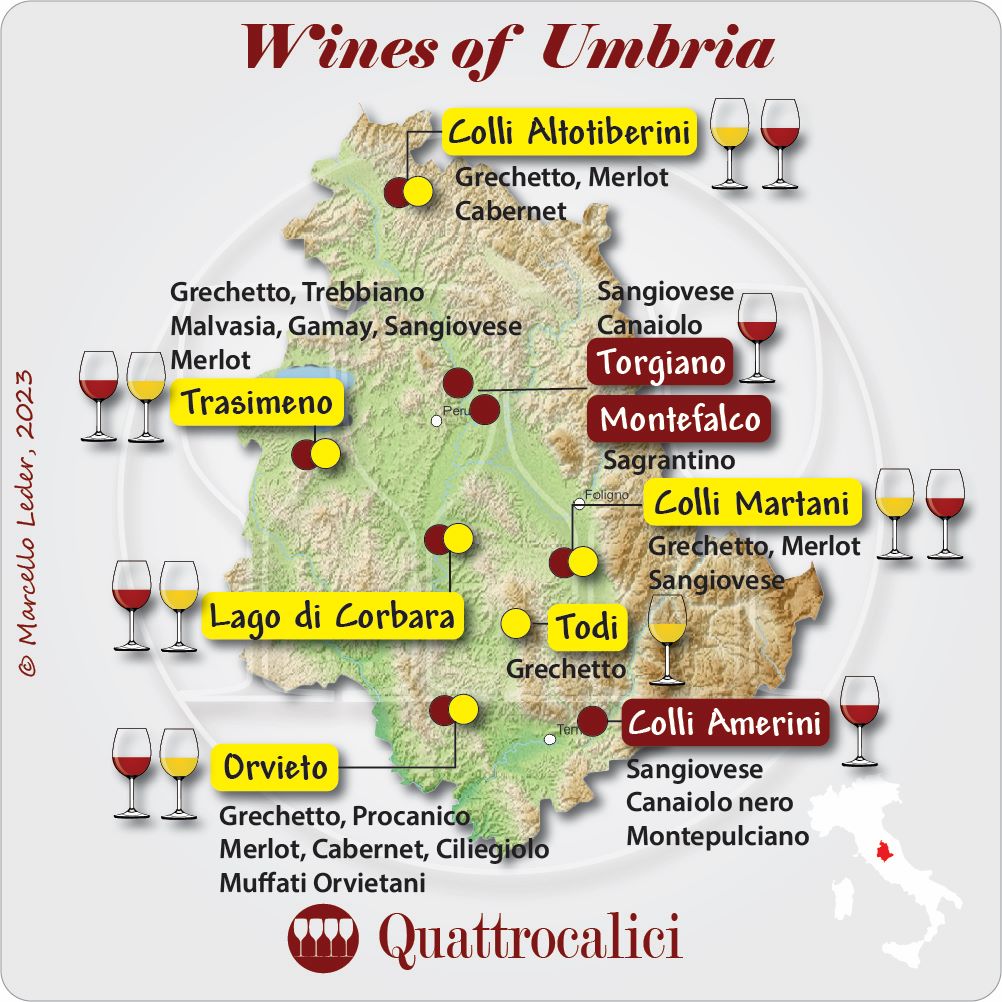
Among the Designations of Origin for wine in Umbria, we highlight the two DOCGs: Torgiano Rosso Riserva DOCG and Montefalco Sagrantino DOCG (the first based on a minimum of 70% Sangiovese, the latter based on the indigenous Sagrantino grape), both in the Perugia area, demonstrating the high-quality level achieved by this small region. Further south, we find the Todi DOC area and the Colli Martani DOC, characterized by the white Grechetto grape. We also remember the Lake Trasimeno area with Colli del Trasimeno DOC, and the Orvieto area, where Rosso Orvietano DOC is present, but it is especially known for Muffati Orvietani wines, based on late (Grechetto, Malvasia) and early (Sauvignon, Chardonnay) white grape varieties. Colli Perugini DOC, Colli Amerini DOC, and Colli Altotiberini DOC are three other significant DOCs in Umbria. In total, in addition to the mentioned DOCGs, Umbria has 13 DOCs and 6 IGTs. The agri-food products are represented with 3 PDOs and one PGI, Prosciutto di Norcia PGI.

Wine areas of Umbria

Although Umbria is a small region, within it, one can distinguish wine-producing areas with distinct and peculiar characteristics.

Torgiano and Torgiano Riserva

Torgiano is located a few kilometers south of Perugia in an area recognized as both DOC and DOCG. Torgiano was the first area in Umbria to achieve these milestones (DOC was recognized in 1968 and DOCG in 1990). Torgiano Rosso Riserva is the only DOCG wine from this area, predominantly made from Sangiovese and Canaiolo Nero grapes. Torgiano’s DOC wines are varied, including white, red, rosé, and sparkling wines. Torgiano white is made with Trebbiano Toscano and Grechetto, alongside varietal wines from Chardonnay, Pinot Grigio, and Riesling Italico. Torgiano red DOC is made with Sangiovese, Canaiolo Nero, and a small part of Trebbiano Toscano. There are also varietal wines of Cabernet Sauvignon and Pinot Noir. The rosé is made with the same blend as Torgiano Rosso.

Montefalco and Sagrantino di Montefalco

The Montefalco area, located about 40 kilometers east of Perugia, shares DOC and DOCG designations with the nearby Torgiano. Wines made exclusively from Sagrantino are awarded the DOCG designation in both dry and sweet (passito) versions. Sagrantino is a robust and powerful wine, with significant tannic strength and considerable organoleptic richness, capable of producing wines appreciated worldwide. Montefalco also produces DOC white and red wines. Montefalco Bianco is made with Grechetto and Trebbiano Toscano, while Montefalco Rosso is made with Sangiovese and Sagrantino grapes and is also available in a riserva type.

Orvieto

Orvieto was once one of the few great names in Italian winemaking, but its fame was more due to the quantities produced and the wine’s diffusion than its quality. In recent years, the area has gradually regained lost ground, and its wines, especially the whites and “Muffati,” sweet wines produced from grapes affected by noble rot, “Botrytis Cinerea,” are known and appreciated everywhere. Procanico is the local name for Trebbiano Toscano, but Verdello, Grechetto, Drupeggio (Canaiolo Bianco), and Malvasia Toscana are also cultivated in the area. Orvieto white wines are also produced in Classico, Superiore, and Classico Superiore versions. Red wines fall under the Rosso Orvietano DOC denomination and are available both as blends and as varietal wines, with Sangiovese, Cabernet Sauvignon, Cabernet Franc, Merlot, Pinot Nero, Ciliegiolo, Canaiolo Nero, and Aleatico.

Colli del Trasimeno

The Colli del Trasimeno area is located west of Perugia, around the municipalities bordering Lake Trasimeno. For white grape varieties, there are Grechetto, Trebbiano Toscano, Malvasia del Chianti, Verdello, and Verdicchio. Grechetto is the area’s only varietal white wine. Among the black grape varieties, there are Sangiovese, Gamay, Ciliegiolo, Cabernet Sauvignon, and Merlot. Gamay, introduced to the Trasimeno area over a century ago, is now so widespread that it is almost considered indigenous. Gamay from Colli del Trasimeno is among the best DOC reds of this area.

Other Production Areas

Other areas of oenological interest in Umbria include the Colli Amerini, with red wines from Sangiovese, Montepulciano, Ciliegiolo, Canaiolo Nero, Barbera, and Merlot. Assisi is particularly known for varietal Grechetto. The Colli Martani produce both white and red wines, but especially Grechetto di Todi. The Lake Corbara area, near Orvieto, produces red wines including Merlot, Sangiovese, Cabernet Sauvignon, and Pinot Nero, also vinified as varietals. Between Perugia and Umbria’s northern border is the DOC Colli Altotiberini, with both white and red wines. South of Perugia is the DOC Colli Perugini, reaching into the province of Terni, again with both white and red wines.

Regional Cuisine of Umbria

The main characteristic of Umbrian cuisine is its simplicity. Dishes revolve around seasonal (mushrooms, wild asparagus) and spontaneous products (the truffle of Norcia, a protagonist of many appetizers) and locally grown vegetables, such as Fagiolina del Lago Trasimeno, Cipolla di Cannara, and Sedano Nero di Trevi. The meats are predominantly sheep, pork, and game, cooked on the spit or processed into cured meats. Bread here knows various regional interpretations, such as pan caciato, pan nociato, pane di Strettura, and pane sciapo di Terni. Umbria also boasts 5 PDO varieties of extra virgin olive oil: Colli Orvietani, Colli Martani, Colli Amerini, Colli di Assisi-Spoleto, and Colli del Trasimeno.

Among the typical first courses of Umbrian cuisine, we remember spaghetti or strangozzi with black truffle, umbrichelli in salsa di Trasimeno, based on perch fillet, shallot, garlic, and chili pepper, spaghetti col rancetto, based on bacon, cherry tomatoes, and fresh pecorino cheese, and pappardelle with hare, with the addition of bacon and cloves. Among the soups, chickpea soup and chickpea and chestnut soup. Among the second courses, in the Terni area, typical is the wild wood pigeon, also called “palomba,” mainly cooked on the spit, in Orvieto, there is the “drunken” chicken, so called because it is cooked in wine. In the Perugia area, the lamb head baked, or the Torello alla Perugina. Norcia is the place for cured meats (from Norcia derives the term “norcino” indicating any producer and seller of cured meats): ranging from the so-called cojoni di mulo, to wild boar sausages, to Prosciutto di Norcia PGI, ending with Ciauscolo, a spreadable salami. However, Norcia is also the city of the Black Truffle, appreciated worldwide along with the white truffles of Città di Castello and Gubbio. Among the cheeses, fresh or aged Pecorino Umbro and fossa cheese are the most famous. The desserts are almost entirely from the oven, based on almonds, spices, and candied fruits, such as the Torcolo di San Costanzo from Perugia, panpepato, ciaramicola (a typical Easter sweet from Perugia), rocciata di Assisi (roccia in the local dialect means round) and many others.

Quattrocalici Wine Guide