
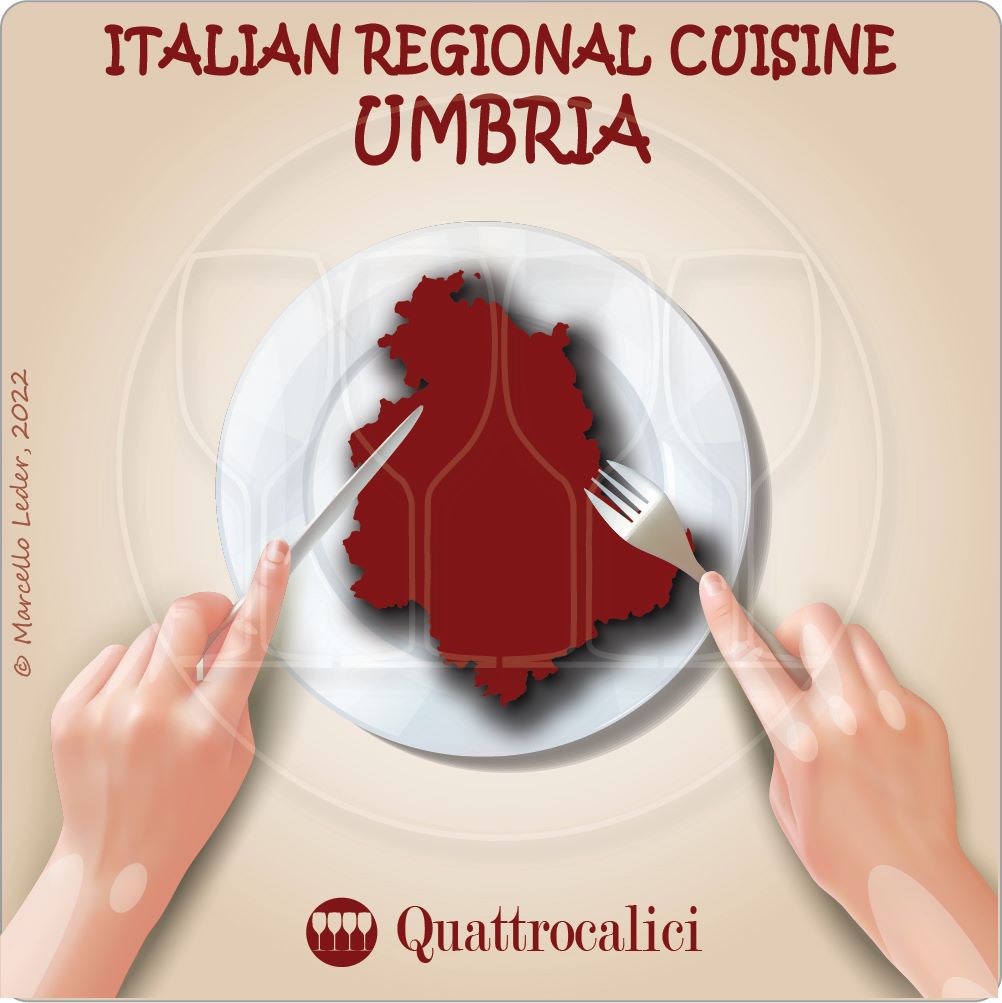
The main feature of Umbrian regional cuisine is its simplicity. Typical dishes are based on seasonal or spontaneous products, such as mushrooms and wild asparagus, or the truffle of Norcia, in addition to legumes and local vegetables, such as Fagiolina del Lago Trasimeno, Cipolla di Cannara, and Sedano Nero di Trevi. The region is widespread with the processing of pork meats and the production of cured meats. Particularly renowned are those from the Norcia area, from which the term “norcino,” meaning butcher, is derived. Famous are the Cojoni di Mulo, Wild Boar Sausages, and Prosciutto di Norcia PGI. Norcia is also the city of Truffles, an emblem of Umbrian gastronomy, especially on the mountainous side to the east of the region and in the middle and high Valnerina. The Black Truffle is appreciated worldwide, along with the White Truffles of Città di Castello and Gubbio. Extra Virgin Olive Oil, present in almost all local recipes, is represented in Umbria by five PDOs. Among cheeses, fresh or aged Pecorino Umbro and various fossa pecorinos are the most famous. Cured meats and cheeses can be paired with both a well-structured white wine, like a Grechetto di Todi, and a medium-bodied red wine, such as a Gamay del Trasimeno or a Rosso di Torgiano. Even bread is presented in local variants, such as Pan Caciato, Pan Nociato, Pane di Strettura, and Pane Sciapo di Terni.
Umbrian Regional Cuisine Appetizers and Wine Pairings
The classic Umbrian Appetizer is a plate of cured meats and cheeses, but a Bruschetta or Crostini, with chicken liver or a truffle-based sauce, or with mayonnaise and mushrooms or tuna, or minced cherry tomatoes, can also be served as an opener. Try pairing with a Grechetto dei Colli Martani.
First Courses of Umbrian Regional Cuisine and Wine Pairings
Among the typical first courses of Umbria, we remember spaghetti or Strangozzi with black truffle, Umbrichelli in Trasimeno sauce, with perch fillet, shallot, garlic, and chili pepper, Spaghetti with rancetto, with bacon, cherry tomatoes, and fresh pecorino. Among the soups, Chickpea Soup and Chickpea and Chestnut Soup. These dishes find their ideal pairings with medium-bodied red wines, such as a Merlot from Colli Martani or Lago di Corbara.
Second Courses of Umbrian Regional Cuisine and Wine Pairings
Among the typical second courses of Umbria, meats are predominantly sheep, pork, and game, cooked on the spit or processed as cured meats. From the Terni area is the wild wood pigeon, also called “Palomba,” stuffed or cooked on the spit, to try with a Sagrantino di Montefalco. In Orvieto, there is the “drunken” chicken, so-called because it is cooked in wine; in Perugia, the baked lamb head, or the Torello alla Perugina, boiled flavored with ham, capers, anchovy fillets, and lemon.
Desserts of Umbrian Regional Cuisine and Wine Pairings
The desserts of Umbria’s tradition are almost entirely from the oven, based on almonds, spices, and candied fruits, such as the Torcolo di San Costanzo, a round cake from Perugia, Panpepato, based on cocoa, hazelnuts, walnuts, almonds, pine nuts, honey, sugar, cinnamon, and pepper. Ciaramicola is the typical Easter sweet from Perugia, whose dough has a purple color obtained by adding Alchermes. It is finally covered with a sweet meringue, sprinkled with silver spheres and colored sugar sticks. Also noteworthy is the Rocciata di Assisi, similar to a round-shaped strudel (roccia in the local dialect means round) and many others. For desserts, a Muffato Orvietano or a Sagrantino di Montefalco passito can be paired.