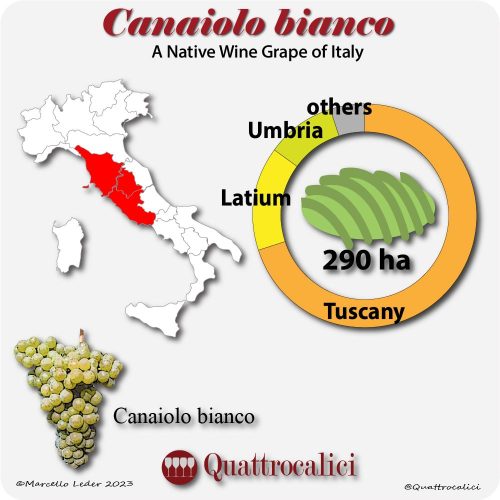


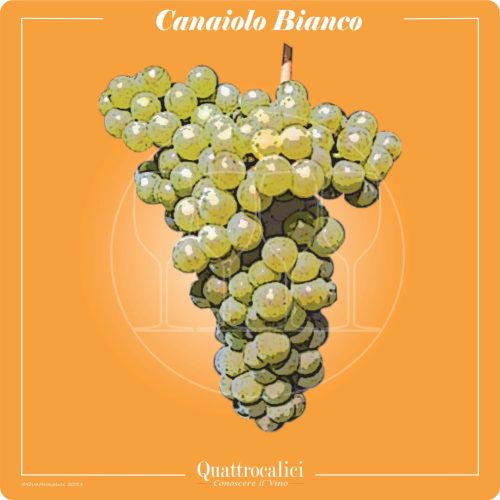
The Canaiolo Bianco grape is a traditional variety from Tuscany, now almost extinct. Despite being included in the regulations of the Carmignano DOC and Valdinievole DOC along with Malvasia Bianca Lunga and Trebbiano Toscano, only a few hectares remain under cultivation, and no new plantings have been reported for at least ten years. The situation is further confused by the fact that in the area, Canaiolo Bianco is often mistaken for Vernaccia di San Gimignano. In the Orvietano area, the Canaiolo Bianco grape is known as Drupeggio. Canaiolo Bianco is allowed in several DOCs, including Orvieto DOC in Umbria, where it is usually blended with Trebbiano, Verdello, Grechetto, and Malvasia Toscana, and in the red and rosé wines of the Barco Reale di Carmignano DOC, where it can be blended with Sangiovese and Cabernet Sauvignon. It is also a permitted variety for use in the production of Vin Santo, thanks to its thick skins that make it particularly suitable for drying.
The first recorded mention of Canaiolo Bianco being used in wine production in Tuscany dates back to 1817. The exact origins of the grape are unknown, but DNA studies in 2011 show that at least six different white grape varieties in Tuscany have been labeled as Canaiolo Bianco. The most important of these is Vernaccia di San Gimignano, widely used in the namesake Denominazione di Origine Controllata e Garantita (DOCG). Other varieties sometimes confused with Canaiolo Bianco include Vermentino and the practically extinct Tuscan variety Zuccaccio. Canaiolo Bianco is a medium to late-ripening variety found almost exclusively in its native land, which corresponds to the central Italian regions of Lazio, Umbria, and Tuscany. It is difficult to estimate the exact number of vineyards, and the 2000 census data reporting 674 hectares likely includes some of the “other” Canaiolo Bianco varieties. In fact, the vast majority of the “true” Canaiolo Bianco (Drupeggio) plantings are in Umbria, where it is included in the blend for Orvieto wines. Here, Drupeggio, along with Grechetto and Malvasia Toscana, makes up 20-30% of the blend, along with Trebbiano (50-65%) and Verdello (15-25%). Outside of Umbria, it is found in the provinces of Florence, Grosseto, and Pistoia, where it can be blended with Malvasia and Trebbiano in various Tuscan DOCs. In the Carmignano region, up to 10% Canaiolo Bianco can be used in the red and rosé wines of the Barco Reale di Carmignano DOC, where it can be blended with Sangiovese, Cabernet Sauvignon, Canaiolo Nero, Trebbiano, and Cabernet Franc.