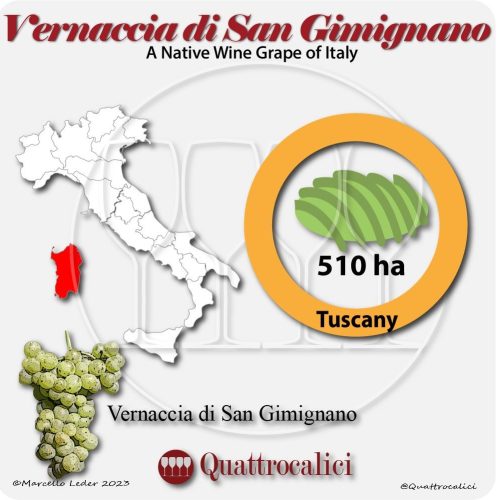


The Vernaccia di San Gimignano is a white grape variety cultivated in Tuscany since ancient times. Its origins remain uncertain, though some suggest it is indigenous to its current main cultivation area, the province of Siena. The first written record dates back to 1276 in the municipal archives of San Gimignano, where the wine was a valuable trade commodity, including by noble families like the Medici. As with other Vernacce, its name might derive from the Latin “ver” (spring) or “vitis vernacula” (local vine), as noted by Lucius Junius Moderatus Columella in De Re Rustica. Alternatively, some suggest a connection to the French variety Grenache or its Catalan synonym Garnacha.
Ampelographic Characteristics
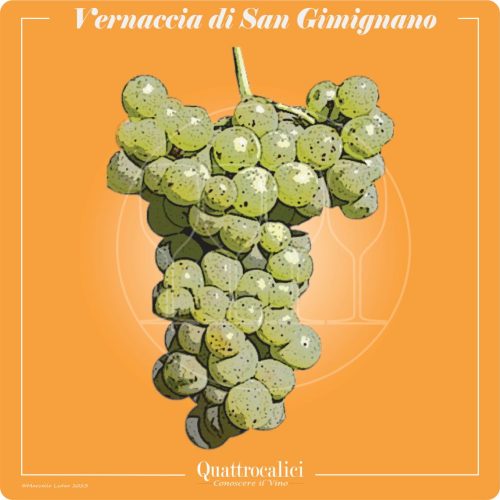
While sharing its name with the Vernaccia di Oristano, the two varieties are ampelographically distinct. The Vernaccia di San Gimignano features large, pyramid-shaped clusters, sometimes with wings, of medium compactness. The berries are medium-sized, round, and heavily pruinose, with thick, amber skins when exposed to sunlight. The vine is consistently productive and thrives in calcareous-clay soils or tuffaceous-siliceous terrains, typically trained in Guyot or arched cordon systems with long pruning.
Resistance and Cultivation
A notable advantage of this variety is its resistance to diseases and pests, making it well-suited to its native environment. This durability, along with its distinct characteristics, contributed to its historical importance in San Gimignano and Tuscany.
Historical Significance and Revival
The wine made from Vernaccia di San Gimignano holds a distinguished place in Italian history, being the first wine to receive DOCG status and among the earliest to achieve DOC recognition. Despite its long-standing significance, the variety faced decline in the 1950s, when more productive varieties like Trebbiano Toscano and Malvasia Bianca gained favor, pushing it toward the brink of extinction.
After years of neglect, the wines of Vernaccia di San Gimignano have regained their former glory, including oak-aged versions that offer distinct aromas and a remarkable structure, ensuring its legacy continues.