

The Vernaccia di Oristano is a white grape variety native to Sardinia, specifically cultivated in the province of Oristano since ancient times. Its exact origins remain unknown; some hypothesize it was introduced during the Roman era, while many consider it a true Sardinian autochthonous variety. The name might derive from the Latin word “ver” (spring) or “vitis vernacula” (local vine), as referenced by Lucius Junius Moderatus Columella in his treatise De Re Rustica. Others suggest a more recent derivation, possibly linked to the French grape Grenache or its Catalan synonym Garnacha. Despite sharing part of its name with varieties like Vernaccia di San Gimignano or Vernaccia di Serrapetrona, it has a completely distinct genetic profile.
Ampelographic Characteristics
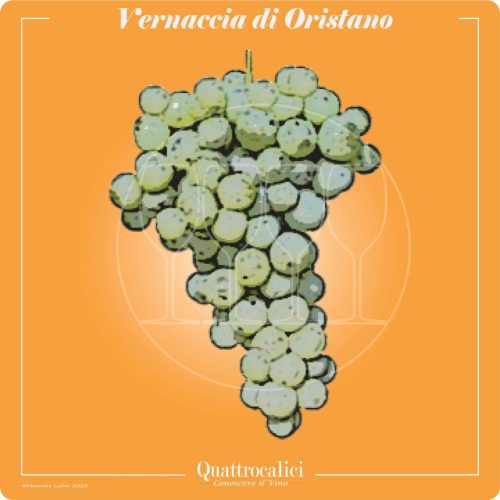
The Vernaccia di Oristano is notable for its medium-sized leaves, which are orbicular or pentagonal and typically trilobate. Its clusters are short, cylindrical-conical, and moderately compact. The berries are small, round, with a thin, delicate, slightly pruinose skin of golden-yellow tending towards green.
Wine Production and Style
In its traditional cultivation area—the Oristano region—this variety is integral to producing the Vernaccia di Oristano DOC. This wine employs a oxidative winemaking method akin to that used for Sherry, utilizing surface yeast film known as “flor.” The DOC designation, established in 1971, permits production exclusively from grapes grown in certain municipalities of the Oristano province.
Decline and Current Status
The cultivation area of the Vernaccia di Oristano has significantly decreased over time. From 1,500 hectares in the 1970s, it declined to 582 hectares in 2000 and further to 435 hectares in 2010, reflecting a continuous reduction in production.
Tasting Profile
The Vernaccia di Oristano DOC produces wines with a rich, robust structure and exceptional softness on the palate. The high alcohol content combines with other extractive elements to deliver a remarkable aromatic persistence. The oxidative characteristics imparted by the aging process evoke Sherry-like notes, contributing to its complex and distinctive sensory profile.
