The Best Tool to Learn about Italian Wine

italian wine regions - quattrocalici

Wine in Liguria

local grapes, wine, and food

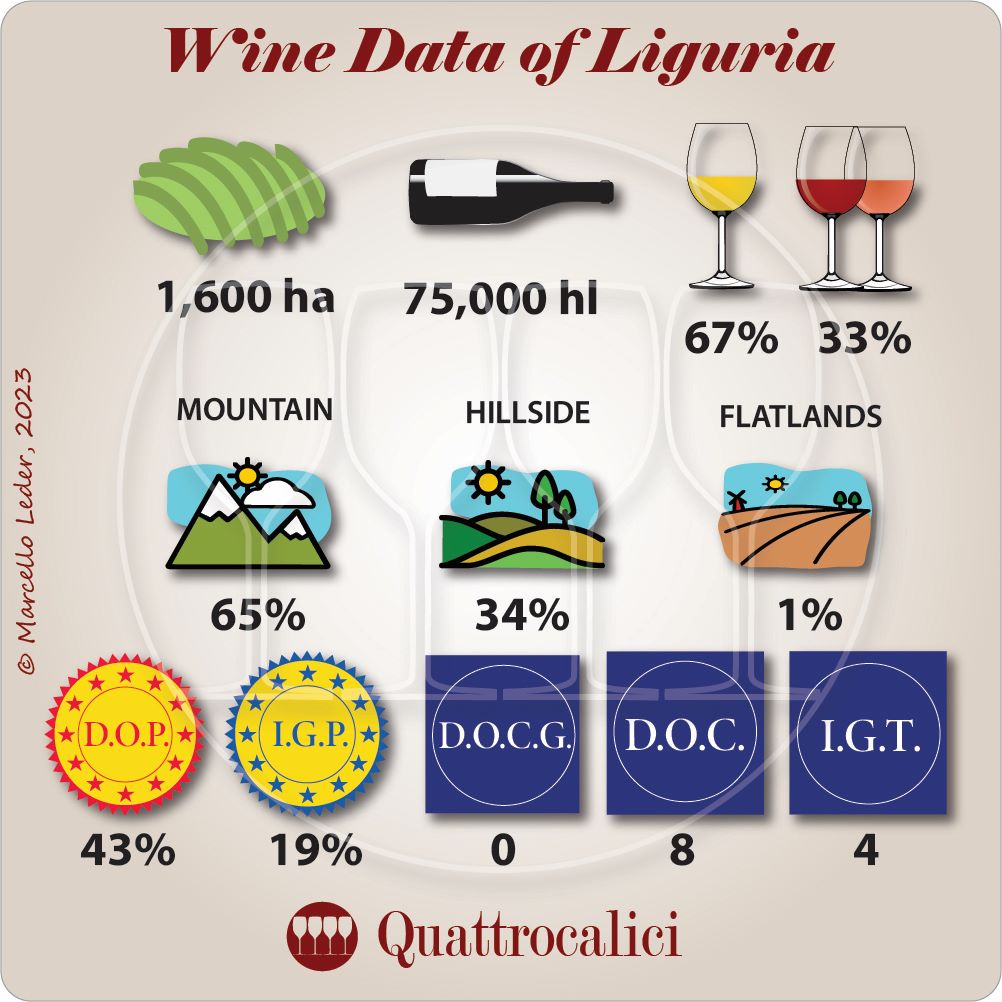
Liguria's wine data

The sea and the landscape have always exerted a very important influence on viticulture and wine production in Liguria. The vineyards, exposed to the sea breeze and often cultivated on steep cliffs that slope down to the sea, produce wines with a unique and distinctive “salinity” that is hard to find in wines produced elsewhere. The terraced and steep slopes of the Ligurian vineyards, often without access roads, as in the area of the “Cinque Terre,” have often led to Ligurian viticulture being described as “heroic.” The harvest, like all operations in the vineyards, is in these cases carried out strictly by hand, and the grapes are transported on the shoulders, not by choice, but out of necessity imposed by the terrain’s configuration. The small quantities of wine that are produced stand out for their originality in the Italian wine scene.

Wine figures of Liguria

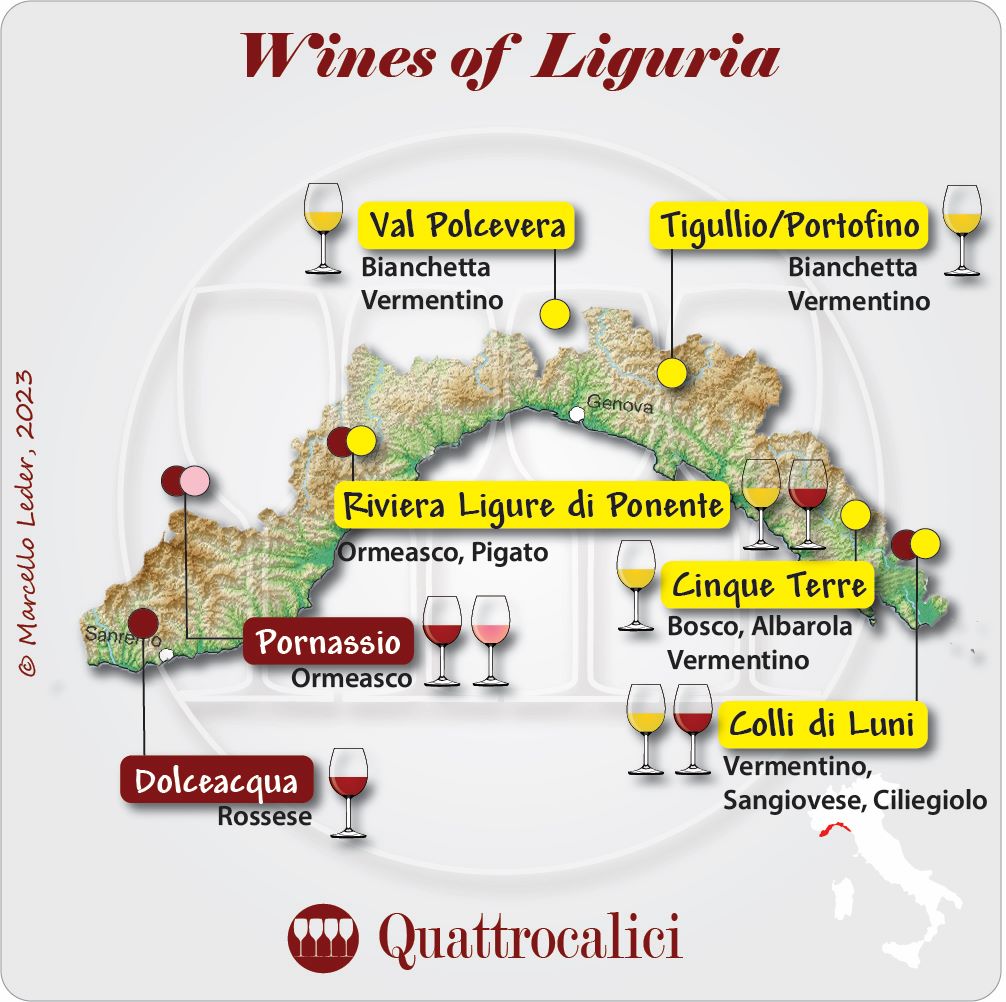
Wines of Liguria

Viticolture in Liguria

Viticulture in Liguria today is deeply intertwined with the region’s unique geography, climate, and historical practices, setting it apart from neighboring Italian regions. The characteristics of Ligurian viticulture are shaped by several factors, including its challenging landscape, the influence of the Mediterranean climate, and the cultivation of indigenous grape varieties. These elements contribute to the distinctive qualities of Ligurian wines and viticultural practices, distinguishing them from those in nearby regions.

Liguria is known for its rugged terrain, with steep hills and narrow valleys that stretch from the coastline into the interior. This topography presents significant challenges for viticulture but also contributes to the unique qualities of Ligurian wines. The vineyards are often terraced to maximize the use of this steep terrain, a practice that requires labor-intensive care and manual harvesting. This contrasts with the flatter, more expansive vineyards found in some neighboring regions, where mechanization is more common.

The Ligurian Sea’s proximity significantly influences the climate, ensuring mild winters and summers that are not excessively hot, with a beneficial sea breeze that helps to moderate temperatures. This maritime influence is crucial for the slow and steady ripening of grapes, allowing for the development of complex flavors and maintaining a balance between sugar and acidity. This contrasts with some inland regions, where the climate can be more continental, with greater temperature extremes that result in different ripening patterns and flavor profiles.

History of Winemaking in Liguria

The history of viticulture in Liguria, is a testament to the region’s enduring connection with wine-making, a tradition that dates back to ancient times and continues to shape its culture, economy, and landscape. From ancient beginnings to its current status as a producer of high-quality, distinctive wines, Liguria’s viticulture heritage is a reflection of its people’s passion for wine-making and their deep respect for the land. As Ligurian wines continue to gain acclaim on the world stage, the region’s viticulture history remains a source of pride and a foundation for future generations of winemakers.

Ancient Beginnings

Viticulture in Liguria has ancient roots, with evidence suggesting that the Etruscans and the Greeks were among the first to cultivate vines in this coastal region. The Greeks, known for their viticulture skills, introduced sophisticated wine-making techniques and grape varieties to the area. Liguria’s strategic location along trade routes made it a crucial point for the exchange of goods, including wine, which was a highly prized commodity in ancient times.

Roman Influence and Medieval Times

The Romans further developed viticulture in Liguria, recognizing the region’s potential due to its favorable climate and hilly terrain. They improved cultivation methods and expanded vineyards, making wine an essential part of daily life and religious ceremonies. During the Middle Ages, monastic orders played a pivotal role in preserving and enhancing viticulture practices amidst political and social upheavals. Monasteries became centers of wine production, where monks meticulously tended to vineyards and perfected wine-making techniques.

Renaissance to Modern Times

The Renaissance period marked a significant advancement in viticulture across Italy, including Liguria. This era saw the refinement of wine-making processes and an increased appreciation for the quality of wine. Ligurian wines began to gain recognition beyond local borders, thanks to the region’s maritime republics, such as Genoa, which facilitated trade with other parts of Europe and the Mediterranean.

In the 19th and early 20th centuries, Liguria, like many other wine-producing regions, faced challenges due to phylloxera infestations and economic difficulties. However, the resilience and dedication of Ligurian winemakers led to the revival of the viticulture sector. They replanted vineyards with phylloxera-resistant rootstocks and focused on quality over quantity, a philosophy that defines Ligurian viticulture today.

Contemporary Ligurian Viticulture

Today, Liguria’s wine industry is characterized by its boutique wineries and focus on indigenous grape varieties, such as Vermentino, Pigato, and Rossese. The region’s challenging topography, with its steep hillsides and terraced vineyards, requires meticulous hand-harvesting, a labor of love that contributes to the distinctiveness of Ligurian wines. The combination of the Mediterranean climate, mineral-rich soils, and traditional wine-making techniques results in wines that are renowned for their crisp acidity, floral aromas, and complex flavors.

Wine in Liguria
Vine cultivation in Cinque Terre area Image: Depositphotos.com

Wine grapes of Liguria

The most widespread grape varieties in Liguria are those with white berries, especially in the central and eastern area of Liguria, while the production of black berry varieties is more concentrated in the western part of the region.

The most important white berry vine in Liguria is Vermentino, known for producing aromatic and fresh wines, ideal for accompanying the typical fish dishes of Ligurian cuisine. Rossese, a black berry vine, is particularly appreciated for its ability to produce wines reminiscent of Nebbiolo, albeit with a low content of coloring substances, resulting in pleasantly fruity and medium-bodied wines.

Among other white grapes cultivated in Liguria, we find Pigato, which shares many characteristics with Vermentino but stands out for its mineral and aromatic herb notes, Bosco, and Albarola, which contribute to the production of complex and structured wines, often also used in the production of the famous Cinque Terre wine.

Regarding black berry grapes, in addition to Rossese, Liguria cultivates Ormeasco, a local synonym for Dolcetto, producing wines with good structure and pleasant fruitiness, and Barbera, a versatile vine capable of adapting to different terroirs and expressing a varied range of organoleptic profiles. Ciliegiolo, widespread in the central and eastern areas of the region, is appreciated for its aromatic and relatively light wines, with cherry notes that justify its name.

This viticultural diversity contributes to the rich Ligurian oenological panorama, offering a variety of wines that reflect the uniqueness of the territory and the close connection between viticulture and the maritime and mountainous landscape of the region.

Wine appellations of Liguria

The Designations of Origin for wine in Liguria, starting from the east, namely the Riviera di Levante, include the Colli di Luni DOC, an area that extends to the province of Massa Carrara in Tuscany. The most widespread white berry grape here is Vermentino, used both pure and for the production of Colli di Luni Bianco, to which Trebbiano Toscano and other white berry grapes are added. The Colli di Luni Rosso type is instead produced with Sangiovese, Canaiolo Nero, Ciliegiolo, Pollera Nera, and Cabernet Sauvignon. Following is the Cinque Terre DOC, named after the five localities overlooking the Ligurian Sea in the eastern part of the region in the province of La Spezia. The landscape of the Cinque Terre is among the most picturesque, with vineyards planted on steep and rugged slopes, on terraces that slope down to the sea. The wines of the Cinque Terre are produced with the grapes of the Bosco, Albarola, and Vermentino vines, from which dry white wines and the rare Sciacchetrà passito, made with overripe grapes left to wither in ventilated places, are obtained. Further west, the DOC areas of Val Polcevera DOC and Golfo del Tigullio or Portofino DOC are distinguished by wines produced with the Bianchetta Genovese grape, the local name for Albarola. The Riviera Ligure di Ponente is instead characterized by the production of red wines, with the grapes of the Rossese, Ormeasco (Dolcetto), and Ciliegiolo vines. Rossese is the absolute protagonist of the wines of the DOC Dolceacqua. With Rossese, fruity red wines with mild tannins are produced, characterized by a light and muted coloration, similar to that of Nebbiolo wines. Ormeasco, on the other hand, is the protagonist of the DOC Pornassio. The same grape also produces Ormeasco Sciac-trà, a light rosé wine not to be confused with the Sciacchetrà of the Cinque Terre. Vermentino and Pigato are genetically related vines and characterize the white wines in the DOC Riviera di Ponente, particularly in the areas between the cities of Savona and Imperia.

Wine areas of Liguria

Liguria, nestled between the sea and mountains in northwest Italy, boasts a unique and diverse wine landscape that captivates tourists and wine enthusiasts from around the globe. The region is celebrated for its aromatic white wines and distinctive reds, thriving in a Mediterranean climate that graces its coastal hills and inland areas.

Cinque Terre

The Cinque Terre, one of Italy’s most picturesque destinations, is not just famous for its breathtaking views but also for the white wine that shares the region’s name. This wine area, challenging to cultivate due to its steep terraces overlooking the sea, produces Cinque Terre DOC, a fresh and mineral white wine that captures the essence of its territory. Another must-try is Sciacchetrà, a golden, aromatic sweet wine, considered a true local treasure.

Riviera Ligure di Ponente

The Riviera Ligure di Ponente extends west from Genoa to the French border. This area is renowned for Pigato, a white wine that best expresses the territory’s character with notes of citrus, aromatic herbs, and a mineral touch. Vermentino and Rossese di Dolceacqua are two other standout wines from this region. Rossese di Dolceacqua, in particular, is a light, fruity red, perfect for pairing with the local seafood cuisine.

Colli di Luni

The Colli di Luni marks the border between Liguria and Tuscany, offering an interesting blend of the wine cultures from both regions. Here, Vermentino finds another excellent expression, with wines ranging from fresh and floral to more structured and complex. The area also produces some reds, including Ciliegiolo and Sangiovese, which show a nice fruity and spicy character.

Golfo del Tigullio

Near Genoa, the Golfo del Tigullio is known for the Portofino DOC, which includes both white and red wines. The whites are primarily made from Vermentino and Bianchetta Genovese grapes, offering fresh and delicate flavors, while the reds often use Dolcetto and Rossese, ideal for accompanying Liguria’s rich seafood and land cuisine.

Val Polcevera

In the Val Polcevera, located in the hinterland of Genoa, the Coronata or Coronata Val Polcevera DOC, a rare and intriguing white wine made mainly from the Bianchetta Genovese grape, is produced. This wine stands out for its freshness and salinity, representing a unique expression of the Ligurian terroir.

Regional Cuisine of Liguria

The Ligurian cuisine has an unbreakable bond with the sea, as evidenced by the numerous recipes dedicated to fish. Among the first courses, we find the Brodetto di pesci di scoglio (rock fish soup), guazzetto di bianchetti (whitebait stew), fish ravioli, and zuppa di cozze alla marinara (mariner’s mussel soup). For the second courses, there’s cappon magro (a rich, layered seafood salad), fish salad, seafood and shellfish combined with vegetables, bianchetti omelette, mackerel in pea sauce, stockfish, and buridda (stewed fish with peas). Bianchetti, which are fished in Liguria from December 1 to April 30, are the fry of some marine fish species, especially sardines and anchovies. They are 3 to 10 mm long and appear as a whitish mass.

In terms of land-based cuisine, first courses include soups and stews rich in vegetables and herbs: minestrone alla genovese (Genoese vegetable soup), soft, fragrant, and enveloping; mesciua, a mix of legumes; and sbira, tripe stew served with broth. The sauces accompanying traditional Ligurian pasta, such as trenette and trofie, include the world-famous Ligurian basil pesto, walnut sauce, meat sauce (tocco), mushroom sauce, and salsa verde. Among the second courses, the unmissable cima genovese (a type of veal “pocket” stuffed mainly with vegetables, pine nuts, and cheese) is served alongside sides like stuffed lettuces, artichoke and mushroom omelette, erbette omelette, fried scorzonera (a wild herb), and zucchini flowers stuffed with potatoes.

Pasta and flours are the basis for many typical Ligurian dishes: chickpea farinata, thin, crispy, with a golden surface, enhanced with rosemary, onions, and sausage, is a calorie-rich dish best enjoyed in the autumn; focaccia is a classic Ligurian specialty, to which ingredients like onions and olives are added, among many others, creating numerous variants. The most famous are Sardenaira, with tomato, olives, and anchovies, and focaccia di Recco, with fresh cheese.

Olive oil and aromatic herbs

The presence of the olive tree in Liguria dates back to 3000 BC. Riviera Ligure DOP olive oil is distinguished by its fruity and delicate taste of ripe olive, almost not bitter at all, with hints of almond and pine nut. It is ideal for mayonnaise and fish-based dishes in general. A characteristic of Ligurian cuisine is the use of highly fragrant aromatic herbs, such as basil, thyme, marjoram, rosemary, sage, and borage, used together with other wild herbs to give each dish a touch of originality.

Quattrocalici Wine Guide