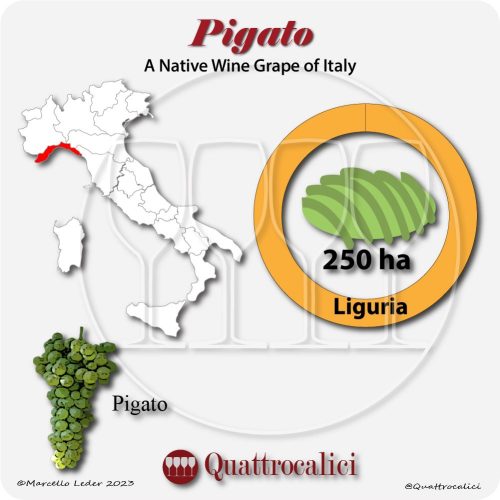


The Pigato is a white grape variety from Liguria, where it is cultivated both along the coast and in the inland valleys, particularly in the geographical area between Albenga and Imperia. Its name comes from the Ligurian dialect “pigau,” meaning spotted, referring to the brown speckles that appear on the mature berries. The Pigato is thought to have distant origins in Thessaly, imported by the Greeks during their colonization of the peninsula, with its appearance in Liguria dating back to the 1600s. Pigato is very similar to Vermentino, probably a spontaneous mutation that has perfectly adapted to the terroir of the Ponente ligure. The main characteristic of Pigato is that its berries take on a deep yellow, almost amber hue when mature, with typical rust-colored spots, while the Vermentino’s skin remains yellow with greenish reflections.
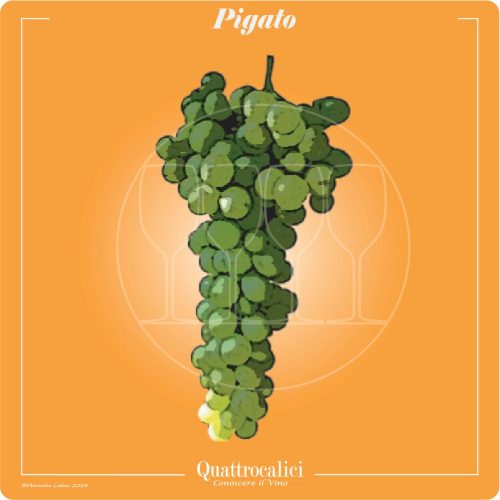
Pigato is highly productive and consistent, but if not pruned with an expanded system, it is prone to flower drop. The variety is fairly resistant to downy mildew (peronospora) and also shows good resistance to powdery mildew (oidio). From an ampelographic perspective, Pigato has medium-sized, pentagonal, five-lobed leaves. The bunch is medium-sized, compact, and sometimes winged, though more often without wings. The berries are medium-sized, elongated spheroids, with a prominent navel and amber-golden color when exposed to the sun, with a medium-thick skin.
Pigato wine is straw yellow in color, with characteristic aromas of Mediterranean scrub, medicinal herbs, white flowers, fruit, and marine hints of iodine. On the palate, it is harmonious and balanced, with moderate acidity, good intensity, and a mineral vein. The finish is pleasantly savory, with a slight almond undertone. Pigato is mainly cultivated in the Riviera Ligure di Ponente and is highly sensitive to the soil where it is grown, resulting in variations in flavor and aroma depending on the terroir. For instance, in the inland area of Ranzo, where the vineyards are at a higher altitude, it produces a delicate, fresh, and elegant wine. In soils rich in limestone, the wine becomes finer, while in red soils rich in iron minerals, it shows a stronger structure and bold flavor.
Pigato has good aging potential, developing tertiary notes of maritime pine and hydrocarbons after a few years of bottle aging. When young, it pairs well with seafood dishes and traditional Ligurian pasta dishes like trenette al pesto. More mature versions find interesting pairings with more structured and complex fish dishes, delicate white meats, and medium-aged cheeses.