


Rossese is a black-skinned grape variety found in Liguria. Its origins are uncertain. It appears to come from southern France, brought to Liguria by the Doria family, and has found its ideal territory in the Dolceacqua area. The name likely refers to the color of its berries. Its nearly exclusive presence in the Riviera di Ponente, near the French border, seems to support this theory. The Rossese di Dolceacqua DOC, the first DOC awarded in Liguria in 1972, is a local oenological excellence, produced only in 11 municipalities of the Riviera di Ponente, situated in the Nervia Valley and Crosia Valley, at altitudes between 300 and 600 meters above sea level. This area is a foothill region with excellent exposures but challenging to cultivate.
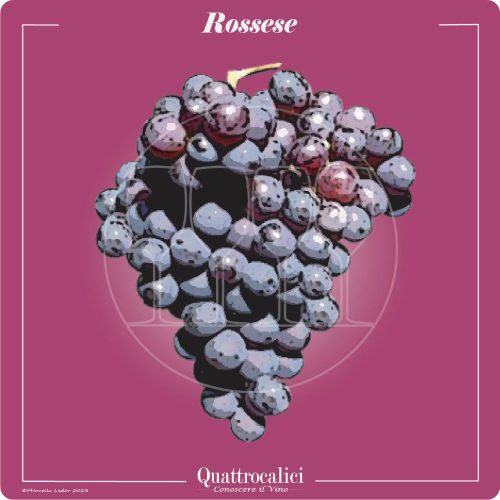
From an ampelographic perspective, Rossese has medium-large, pyramidal, winged, and moderately loose clusters. Its berries are medium to medium-small, elliptical, bluish tending toward black and violet, with a fair amount of pruina and moderately thick skins. The traditional training system for Rossese is the alberello, though in recent years there has been a gradual shift to more modern and rational systems based on the spalliera. The vineyards are located on the hills of the Ligurian Prealps, between 300 and 600 meters above sea level, often in steep positions, making all vineyard operations manual. The challenging morphology of the territory likely explains why the grape variety has always remained confined to this area.
Rossese yields are relatively productive and consistent, but it is susceptible to flower drop and berry shatter. Rossese wines are generally light ruby red, with fruity aromas of marasca cherry and a light structure, with tannins that are not particularly pronounced.
