

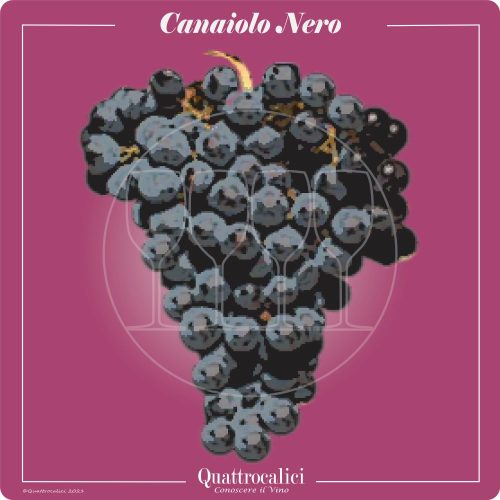
The Canaiolo Nero, also simply known as Canaiolo, is a grape variety widely grown both in the Chianti area and other provinces of Tuscany. Together with Sangiovese and Malvasia, Canaiolo was part of the original Chianti Classico recipe codified in 1872 by Baron Bettino Ricasoli, in the proportions of seven parts Sangiovese, two parts Canaiolo, and one part Malvasia. In the early 1300s, it appeared in Pier de Crescenzi’s “Treatise on Agriculture,” where it was called “Canajuola,” described as “a beautiful grape to preserve.” The name Canaiolo might derive from the Latin dies caniculares, the hottest period of summer (dog days), from late July to late August, when the grapes change color. Some of the synonyms of this grape variety (Canina, Cagnina, Uva dei Cani) might also refer to the dog rose or dog grass, perhaps due to the characteristic bitter note of the wine it produces.
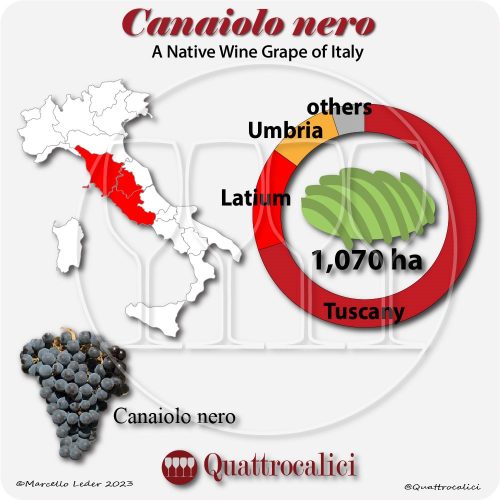
Canaiolo Nero is still widely grown in the Chianti area and other Tuscan provinces and is found to a lesser extent in some neighboring regions such as Marche, Lazio, Umbria, and Liguria. Vinified as a pure variety, Canaiolo produces a wine with an intense ruby red color, elegant, with floral notes and good minerality. On the palate, it is full-bodied, soft, and velvety. Due to its suitability for blending, especially with Sangiovese, it is often found in the DOC and DOCG regulations of many important Tuscan red wines, such as Chianti, Chianti Classico, Vino Nobile di Montepulciano, Torgiano Rosso Riserva, and in the DOCs Carmignano, Colli dell’Etruria Centrale, Montecarlo, Rosso di Montepulciano, San Gimignano.