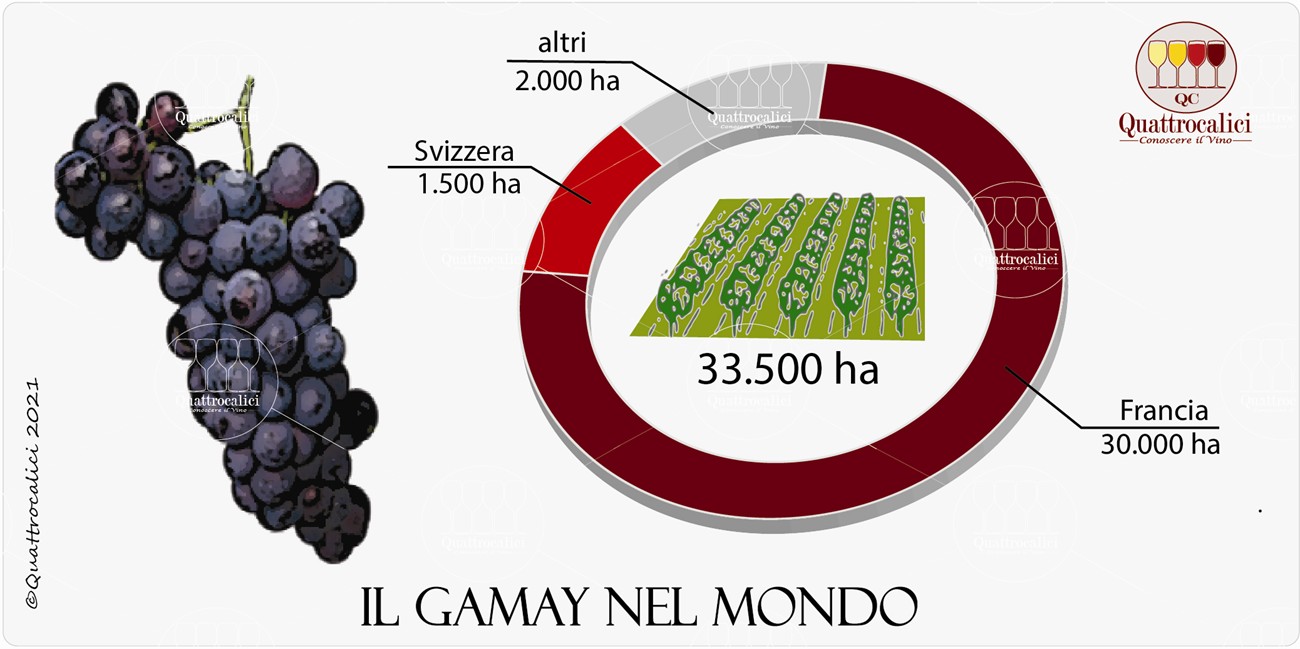



Gamay is a red grape variety primarily known for the production of Beaujolais, a renowned wine from France. Originating from Burgundy, Gamay finds its most famous expression in Beaujolais Nouveau, a young wine celebrated annually in November. However, the spread of Gamay is not limited to France and extends to various regions worldwide.
In France, in addition to Beaujolais, Gamay is also cultivated in the surrounding areas of Burgundy, particularly in the Côte Chalonnaise.
Gamay Worldwide
Outside of France, the grape has found fertile ground in other European wine regions. In Switzerland, Gamay is one of the main grape varieties in the Canton of Geneva, often blended with Pinot Noir to create balanced and aromatic wines.
In the New World, Gamay has seen interesting adoption in Canada, especially in the Ontario region, where the cool climate favors the production of wines similar in style to French Beaujolais. In the United States, the grape is cultivated in limited quantities, primarily in Oregon and California, where some producers are successfully experimenting to create light and aromatic wines.
In Australia and New Zealand, Gamay is a relatively new variety but with growing interest from winemakers looking to diversify their productions. The Yarra Valley region in Australia and Hawke’s Bay in New Zealand are beginning to produce Gamay wines that show considerable promise.
Gamay in Italy
Its presence in Italy, particularly in the Aosta Valley, dates back to the early 1800s. Gamay is spread not only in Piedmont and the Aosta Valley, but also in some areas of Friuli-Venezia Giulia, Umbria, and Tuscany. In France, there are many varieties related to Gamay, some with red pulp (“teinturiers”) producing intensely colored wines used in the past to add color to lighter blends, and some with white pulp (Gamay à jus blanc), whose wines are lighter in color and give rise to the famous Beaujolais Nouveau, which has also spread outside of France.
Agronomic and Enological Characteristics of Gamay
The early ripening of Gamay and the low concentration of extracts in its wines do not make it suitable for aging, except in special cases and in a limited way. Therefore, it is not ideal for blending, as it does not bring any evident improvement to blends except for color. These limitations partially turn into advantages when subjected to carbonic maceration, which enhances its fruity and vinous aromas, resulting in a product characterized by fleeting pleasantness and readiness to drink. Culturally, Gamay is a rather early grape with a tendency to bud and ripen early. For this reason, it is sensitive to spring frosts, despite being a variety well-suited to cold climate areas. Gamay tends towards overproduction, which has probably prevented its spread for quality wines. Therefore, rigorous cultural practices are necessary to obtain premium wines. The best results with Gamay are obtained from granitic or schistose soils, while in limestone-rich soils it produces wines with more intense and less transparent colors, but at the expense of finesse and organoleptic quality.