

The Best Tool to Learn about Italian Wine

italian wine regions - quattrocalici

Wine in Valle d'Aosta

local grapes, wine, and food

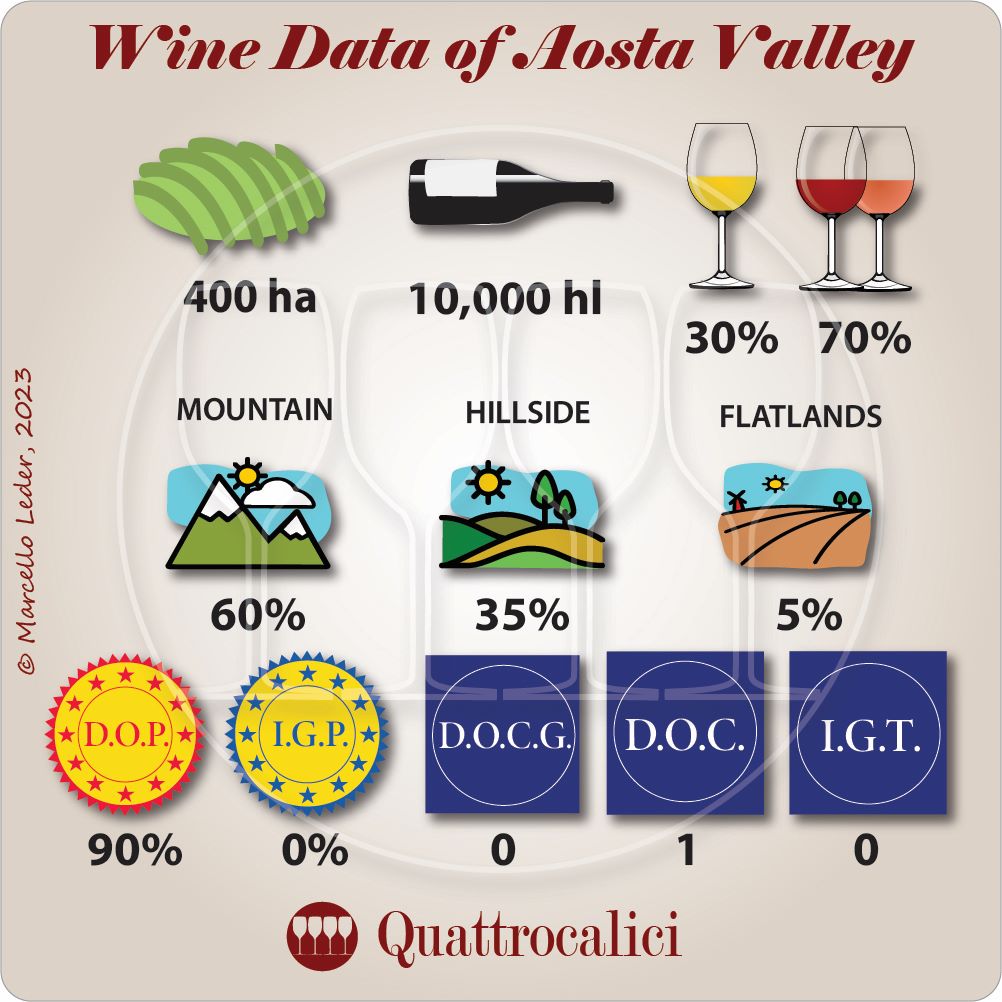
Aosta Valley Wine data

Valle d’Aosta (Aosta Valley), with its approximately 3,000 square kilometers, is a small region, even in terms of wine production. The valley, formed by the Dora Baltea river, stretches from west to east and is surrounded by some of Europe’s highest mountains, including Mont Blanc (4,950 meters). Here, the climate exhibits significant variations depending on altitude, with an elevation difference of over 4,000 meters between the Lower valley area and the highest peaks. The weather is intensely cold during the winter season, subject to frequent spring frosts, and very high temperatures during the summer.

The right orographic side of the Central Valley, known as Envers, faces north and is characterized by the presence of forests. The left orographic side, called Adret, faces south and is cultivated with vineyards and orchards. The vineyard soils are primarily composed of granite in the Morgex area. In Arnad-Montjovet and Donnas, the soil is very thin, often exposing the bedrock, and is predominantly sandy-clay.

The diversification among the various wine-growing areas of the Central Valley is significant, and these areas are generally most suitable for the cultivation of white grape varieties.
Wine figures of Valle d'Aosta

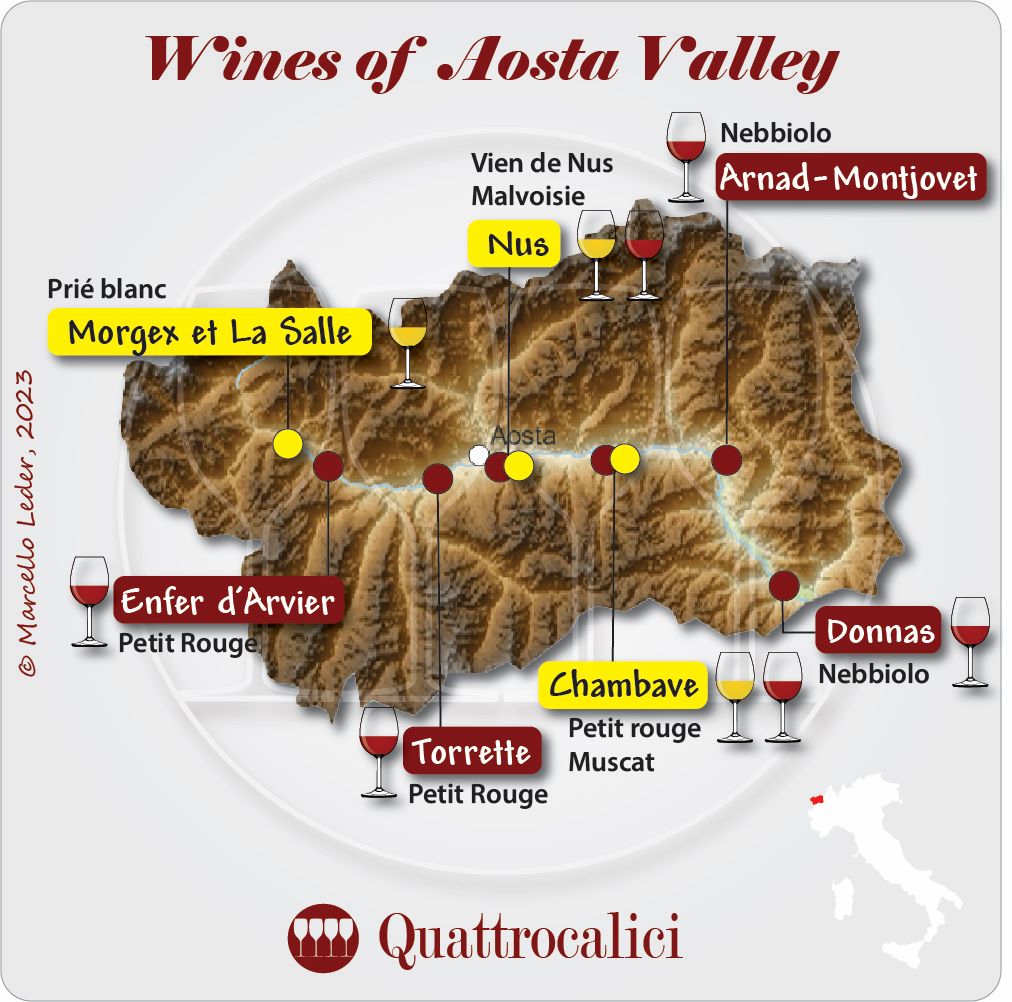
Wines of Aosta Valley

Viticolture in Valle d'Aosta

Valle d’Aosta has a very small vineyard area, approximately 400 hectares, of which 70% is in mountainous regions and the remaining in hilly areas. Viticulture is mainly practiced along the 80 km course of the Dora Baltea river. As often occurs in mountainous areas, such as Valtellina or certain plots in Alto Adige, the vineyards are arranged on terraces supported by stone walls, forming small plots largely sustained by the vines’ own roots. On these steep terraces, where forms of automated pruning or harvesting are not feasible, traditional training systems (such as Pergola and Alberello) prevail over more modern methods.

History of Winemaking in Valle d'Aosta

The history of viticulture in Valle d’Aosta dates back to the Bronze Age, as evidenced by the discovery of grape seeds from that era. However, it was the Romans who first cultivated specialized vineyards for wine production. Amphorae, jugs, and bottles have been found in locales likely used for grape pressing dating back to the 1st century AD. Vine cultivation and winemaking played a significant role in Valle d’Aosta during the Middle Ages and subsequent eras, up until the plagues of the 17th century and the frequent passage of troops, which led to the destruction of agricultural lands.

During the Napoleonic era and throughout the 19th century, the vineyard area reached its peak extent, covering about 3,000 hectares. From the end of the 19th century until the middle of the last century, the area under vine cultivation diminished due to phylloxera, powdery mildew, and downy mildew. The establishment of the École Pratique d’Agriculture in the 1950s, which became the Institut Agricole Régional in 1982, played a significant role in disseminating new cultivation techniques, shifting wine production towards a focus on quality rather than productivity.

In the 1970s, the first Cooperative Wineries were founded, and they still play a vital role in the processing of grapes and the distribution of Valdostan wines. The improvement in wine quality created a virtuous cycle, increasing market appreciation, which in turn boosted demand. This heightened demand encouraged the establishment of new companies and the growth of existing ones, stimulating the development of viticulture.

Today, Valle d’Aosta is home to six cooperative wineries and about forty private wineries, many of which are organized into producers’ associations.

provincia aosta vino
Sarre Castle and vineyards, province of Aosta Image: Depositphotos.com

Wine grapes of Valle d'Aosta

The grape varieties cultivated in Valle d’Aosta are almost all indigenous, largely because these varieties exhibit high vitality even at the high altitudes where nearly all of the region’s vineyards are located, and where other species would not survive or be productive. Among the black grape varieties grown in Valle d’Aosta are Petit Rouge, Prëmetta, and Fumin, while Prié Blanc is notable among the white grape varieties. Additionally, there are Mayolet, Roussin, Vuillermin, and Neyret, but there are at least as many others, showcasing an incredible variety for the region’s mere 400 hectares of vineyards! In the lower areas with a less extreme climate, varieties like Nebbiolo, Freisa, and Moscato Bianco are found.

Wine appellations of Valle d'Aosta

Despite its small size, the Valle d’Aosta region in Italy concentrates its wine appellations into a single DOC, known as Valle d’Aosta DOC or Vallée d’Aoste DOC. Nevertheless, the wine production in Valle d’Aosta is diverse and complex, as evidenced by the seven subzones within the denomination: Arnad-Montjovet, Blanc de Morgex et de La Salle, Chambave, Donnas, Enfer d’Avrier, Nus, and Torrette. Each of these subzones is distinctly characterized by its unique soil and climate conditions.

In addition to the wine appellations, the region also boasts four PDOs (Protected Designation of Origin) related to agricultural products, each highly distinctive and worthy of mention: Fontina DOP and Valle d’Aosta Fromadzo DOP for cheeses, and Valle d’Aosta Jambon de Bosses DOP and Valle d’Aosta Lard d’Arnad DOP for cured meats. These products highlight the rich culinary heritage and the unique agricultural practices of the Valle d’Aosta region.

Wine areas of Valle d'Aosta

Viticulture in Valle d’Aosta is concentrated along the course of the Dora Baltea river. This river originates from the confluence of the Dora di Ferret (coming from the Pré de Bar glacier in Val Ferret) and the Dora di Vény (from the Miage glacier in Val Veny) at Entrèves, and it flows across the entire region for over 90 kilometers. The region’s three viticultural zones – the Alta Valle, Valle Centrale, and Bassa Valle – follow the river’s course.

Alta Valle

The Alta Valle (High Valley) is the first zone encountered when leaving behind the Mont Blanc massif. This area is known for cultivating Prié Blanc, grown at altitudes at the limits of vine survival (1,200 meters above sea level), producing the renowned Blanc de Morgex et de La Salle. The wine is named after the two adjoining municipalities on the river’s banks. Moving downriver, near the village of Avrier, the Petit Rouge black grape variety and other minor indigenous grapes are primarily grown. These grapes blend to create Enfer d’Arvier, the region’s most famous red wine. Viticulture here is possible only on the Adret, the sunnier part facing south on the river’s left orographic side.

Valle Centrale (Media Valle)

Continuing eastward, the river and valley widen, providing vineyards with better exposure on hills at the foot of high mountains. This is the Valle Centrale, (Central Valley) starting with the municipality of Villeneuve and stretching to Montjovet, about 40 km farther east. Viticulture is possible here, partly on plots in the Envers, facing north but located in almost flat areas. This area is home to the region’s most important indigenous grape varieties, including Prëmetta, primarily cultivated in Aymavilles, where the famous “Torrette” red wine is produced. Petit Rouge, Fumin, and Vuillermin, less common, are used in blends, more rarely as varietals. The area of Nus gives its name to the Vien de Nus grape and is famous for Malvoisie Flétri, a rare dessert wine made from Pinot gris grapes. Further east, descending along the river, lies the Chambave area, where the most cultivated varieties are white Muscat, produced both as a dry wine and as an elegant, intense sweet dessert wine (flétri), and Chardonnay, whose natural acidity is heightened by the foothill position of the vineyards, making the wines suitable for prolonged aging in wood.

Bassa Valle

The Central Valley’s natural boundary is at Montjovet, a municipality marking the entrance to the Bassa Valle, (Low Valley) which continues along the river up to the border with Piedmont. Here, the most widespread grape variety is Nebbiolo (locally known as Picoutener or Picotendro), starring in the wine areas of Donnas and Arnad-Montjovet. In these zones, the Nebbiolo expresses unique characteristics shaped by the distinct terroir of the Bassa Valle, contributing to the diversity and richness of Valle d’Aosta’s winemaking heritage.

Regional Cuisine of Valle d'Aosta

Valle d’Aosta’s cuisine retains ancient roots and is thus inextricably linked to local products. It’s a rustic and simple mountain cuisine, largely based on a few local ingredients like cabbage, potatoes, beans, chestnuts, rye, barley, old varieties of corn, apple vinegar, and many local varieties of apples and pears (the most famous being “Martin sec”). Being a mountain cuisine, game, pork (especially cured meats), and cheese play a significant role: the two most famous cheeses are Fontina (at various stages of aging) and Toma. These cheeses still retain the flavors of the high mountain meadows’ herbs, and thus, they exhibit different taste and aromatic nuances depending on the season. Unique to the Valdostan regional cuisine is the almost total absence of wheat and thus pasta, which is replaced by potato-based dishes (e.g., gnocchi), polenta (made from corn as well as rye and buck wheat), and rice (from nearby Piedmont). The use of extra virgin olive oil is also scarce; the most commonly used fats in cooking are butter and lard. There are many influences from French cuisine, particularly similarities with the cuisines of the neighboring transalpine regions (Savoy, Haute-Savoie, and Valais).

Among the first courses, we have Chnéfflenes, small batter dumplings cooked in boiling water and seasoned with fondue, cream and speck, or braised onion; and Chnolles, small cornmeal dumplings, both typical Walser dishes from the upper Lys Valley (Gressoney-Saint-Jean), to be eaten in pork broth.

Pèilà is a soup made from rye and wheat flour, with bread, Fontina cheese, and butter. Seupa à la Vapelenentse is one of the most famous Valdostan dishes, made with bread, cabbage, and Fontina cheese; Seuppa à la Cognèntse, originating from Cogne, is similar but includes rice; Seuppa de l’âno (donkey soup), also called seuppa frèide (“cold soup”), is made with sliced black bread and sweetened red wine; Soça is a bean soup with onion and spices, potatoes, smoked lard, and browned saouceusses; Sorsa is a thick soup prepared with broth, black bread, potatoes, beans, green beans, carrots, pears, and apples.

Among the second courses, notable dishes include Bouilli à la saumure, a boiled salted meat dish found in Valdostan butchers in autumn and winter, served with sausages and potatoes; Carbonade, an ancient typical dish made from salted beef, slowly cooked with garlic and lard, in a white or red wine and spices sauce; Cotoletta di vitello alla valdostana, veal cutlet with Fontina cheese and eggs, fried in butter; Fricandeau, diced veal nut with onion, rosemary, aromatic herbs, and white wine, served with polenta; Involtini di Fénis, veal rolls stuffed with motsetta (similar to bresaola) and Fontina cheese; and many dishes based on melted cheeses, the most famous being Fondue.

Among the desserts, there’s Creinchein, a buttery sweet dessert; Tegole valdostane, almond paste wafers; Torcetti, sweet butter dough biscuits with sugar or honey, typical of Saint-Vincent; Mécoulin, a sweet bread typical of Cogne and Hône; and Crema di Cogne, made with cream, sugar, and chocolate.

Quattrocalici Wine Guide