


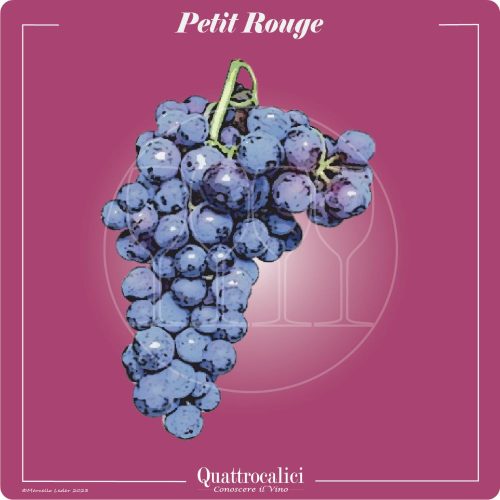
The Petit Rouge is widely considered the finest black grape variety of the Valle d’Aosta and is likely to be a true native of the region. The first evidence of its cultivation dates back to ancient Rome. After the abandonment of the countryside due to barbarian invasions, only a few surviving vines persisted, giving rise to new varieties through repeated reproduction from seeds. This is likely how native varieties like Petit Rouge and Vien de Nus originated. The cultivation area of Petit Rouge stretches from the municipality of Saint Vincent to Avise, at altitudes nearing 800 meters. Like many other Valle d’Aosta grape varieties, it appears to belong to the family of native “Orious” grapes, which itself includes two subfamilies, “Gros Orious” and “Petits Orious,” with Petit Rouge belonging to the latter.
In Valle d’Aosta, there are small productions from historic vineyards of Petit Rouge grown along the Dora Baltea valley. It is one of the preferred grape varieties among Valle d’Aosta winemakers due to its resistance, good yields, and excellent winemaking properties. Also known as “Pitchou Rodzo,” Petit Rouge grapes are distinguished by the very small size of their berries. Petit Rouge produces a wine with a violet-red color, tending towards garnet, and an intense aroma with notes of dog rose, violet, raspberry, and blueberry, evolving over time to bitter almond. Petit Rouge is the base grape used in a wide range of red wines included in the Valle D’Aosta DOC, particularly in the subzones of Enfer d’Arvier and Torrette.
