The Best Tool to Learn about Italian Wine

italian wine regions - quattrocalici

Wine in Piedmont

local grapes, wine, and food

Piedmont Wine Figures

Piedmont is often recognized almost exclusively for its great red wines, but this region also produces excellent white wines and sparkling wines. The role of wine in Piedmont has been fundamental to the development of modern Italian winemaking. It was here that the extraordinary revolution in the wine world began, bringing Italy back to the forefront of high-quality wine production. Piedmontese wines, with few exceptions, are varietal, meaning they are made from a single type of grape. In Piedmont, the first examples of zoning vineyard areas began, applying to Italian wines concepts such as terroir and cru: a specific wine is produced exclusively with grapes from a single vineyard or plot, whose name appears on the label. Currently, the denominations where “vineyard mentions” are present are Barolo DOCG, Barbaresco DOCG, and Dogliani DOCG. The territory of these denominations is divided into zones, and within these, the plots or crus are identified. Locations such as La Morra, Barolo, Serralunga d’Alba, Monforte d’Alba, and Castiglione Falletto are the wine areas for Barolo, while Barbaresco, Treiso, and Neive are for Barbaresco. Bussia, Lazzarito, Cerequio, Rocche, and Brunate are examples of Barolo crus, just as Rabajà, Asili, and Montestefano are for Barbaresco.

Wine figures of Piedmont

wines of Piedmont

Viticolture in Piedmont

Viticulture in Piedmont, one of Italy’s most prestigious and historically rich wine regions, stands as a true pillar of the area’s cultural and economic identity. Located in northwest Italy, surrounded by the Alps on three sides, Piedmont benefits from a unique microclimate that, combined with its varied geography, provides ideal conditions for viticulture.

The region is characterized by a series of hills, rivers, and valleys that create different microclimates, perfect for growing various types of grapes. Piedmont is shielded from major weather disturbances by the embrace of the Alps. This natural barrier, along with breezes from rivers and lakes, contributes to significant temperature variations between day and night, a crucial factor in developing the grapes’ aromas and organoleptic characteristics.

Piedmont is most famous for its red wines, notably Barolo and Barbaresco, both made exclusively from Nebbiolo grapes. These wines are renowned for their complexity, longevity, and depth of aromas, ranging from fruity to floral, to earthy and spicy notes. Other significant red wines include Barbera and Dolcetto, offering more accessible yet equally distinctive styles. Among the white wines, Moscato d’Asti and Arneis are excellent expressions of Piedmont’s terroir, offering sweetness and aromatic freshness, respectively.

History of Winemaking in Piedmont

Piedmont has always been a land of great wines. Viticulture has been present in the region since pre-Roman times, carried out by Celtic-Ligurian populations. Roman domination, starting from the 6th century BC, led to its expansion, which continued into the Middle Ages by various monastic orders. Their work led to the definition of the current wine zones, from Monferrato to Langhe, up to Alto Piemonte. Nebbiolo has been identified as a grape variety since 1200 AD, but it only became well-known from the 19th century, thanks to Cavour and the Marchesi di Barolo. Until the first half of the nineteenth century, Piedmontese wines were predominantly sweet, a tradition due to both commercial and technical reasons. Commercially, since most of the wine was exported via the maritime Republic of Genoa, sweet wines ensured better preservation during long sea journeys. Technically, Nebbiolo, the main Piedmontese grape variety, ripens quite late. The cold of the cellars where fermentations occurred during November and December and the unavailability of selected yeasts halted the fermentation process, leaving a certain amount of residual sugars in the wine.

The protagonist of Piedmontese oenology’s renaissance was Barolo, thanks to the French oenologist Louis Oudart. Giulietta Falletti, Marchesa di Barolo, asked Oudart to improve the Nebbiolo wines produced in her cellar. Oudart understood the potential of Nebbiolo and realized that it could produce an excellent dry wine. Thus, Barolo was born, and thanks to Camillo Benso, Count of Cavour, who decided to convert the cellars of his estate in Grinzane for the production of Barolo, this wine began to gain its national and international fame. By the end of the 19th century, Barbaresco also acquired its own identity, thanks to studies conducted at the School of Oenology in Alba.

These two great wines, and the developments related to them, were destined to mark the history of Piedmontese viticulture to this day.

The years around the end of the 19th century and the post-World War II period saw the devastation of phylloxera, the migration of the agricultural population to the Americas, and two world wars. The development that followed led to a rapid increase in volumes and, consequently, a decline in the quality and prices of Piedmontese wines, culminating in the 1986 methanol wine scandal. However, these episodes marked the beginning of the renaissance of Piedmontese viticulture, with a renewal of the quality and image of the most important wines, starting with Barolo, which gradually moved towards an oenological profile less oriented towards long aging in the cellar. This opened up the quarrel between traditionalist and innovator winemakers, the former anchored to the tradition of long maturation in large barrels, and the latter more inclined to create more immediate wines, thanks also to the contribution of barriques. Barbera, with its denominations of origin, transformed from a traditionally tart and light wine to a product with a harmonious organoleptic profile and good structure, suitable for competing on international markets.

Wine in Piedmnont
Vineyards surrounding Barolo Castle. Image: Depositphotos.com

Wine grapes of Piedmont

The grape varieties cultivated in Piedmont are predominantly black, such as Nebbiolo, which produces Barolo and Barbaresco, among the most famous Italian red wines. Barbera, in its various regional variations, Dolcetto, Croatina, Freisa, Bonarda, Grignolino, Brachetto, and the black Malvasias of Casorzo and Schierano are also significant. Among the white grape varieties, it’s worth mentioning the indigenous Cortese and Erbaluce, Arneis and Moscato Bianco, which finds in the region some of its highest expressions, especially in sparkling forms like Asti DOCG, but also in still wines, like Moscato di Loazzolo DOC.

Wine appellations of Piedmont

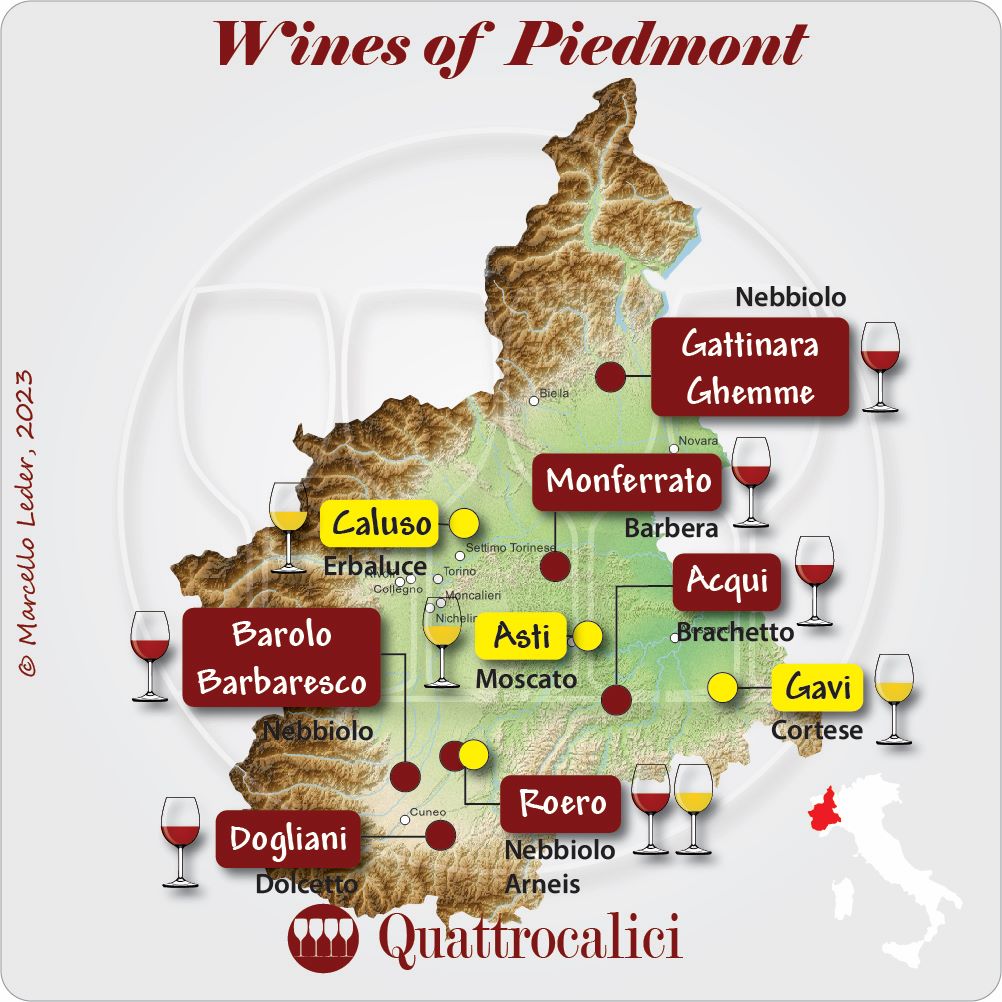
In Piedmont, the Denominations of Origin for wine are geographically divided into eight zones:

1. North of Novara and Vercelli: This area features the Gattinara DOCG and Ghemme DOCG, as well as the Lessona DOC, Bramaterra DOC, Boca DOC, Sizzano DOC, and Fara DOC. The main grape varieties here are Nebbiolo, known in this area as Spanna, Croatina, Barbera, and the white Erbaluce.

2. Bordering Valle d’Aosta: Here, you’ll find the Canavese DOC and Carema DOC, again with Nebbiolo and Erbaluce grape varieties.

3. Near Turin: The Collina Torinese DOC (with Freisa, Barbera, Bonarda, and Dolcetto grapes) and the Erbaluce di Caluso DOCG are located here.

4. The Monferrato area, which spans between Asti, Casale Monferrato, Ovada, and Gavi, includes, among others, the Barbera del Monferrato Superiore DOCG, Brachetto d’Acqui DOCG, Dogliani DOCG, Ovada DOCG, Gavi or Cortese di Gavi DOCG, and Ruchè di Castagnole Monferrato DOCG, featuring grape varieties such as Moscato Bianco, Cortese, Grignolino, the black Malvasias (Malvasia di Casorzo and Malvasia di Schierano), in addition to the other varieties already mentioned.

5. The Asti area, an important sparkling wine zone with Moscato Bianco, which also includes the Loazzolo DOC famous for its sweet Moscato.

6. The Tortonese area, where, besides Cortese and Barbera, the native white Timorasso is highlighted.

7. Left of the Tanaro river: The Roero DOCG with Nebbiolo, Barbera, and the white Arneis.

8. Right of the Tanaro river: The Langhe, with Barolo DOCG, Barbaresco DOCG (Nebbiolo, but also Ruché, Barbera, and Dolcetto), and Dogliani DOCG (Dolcetto).

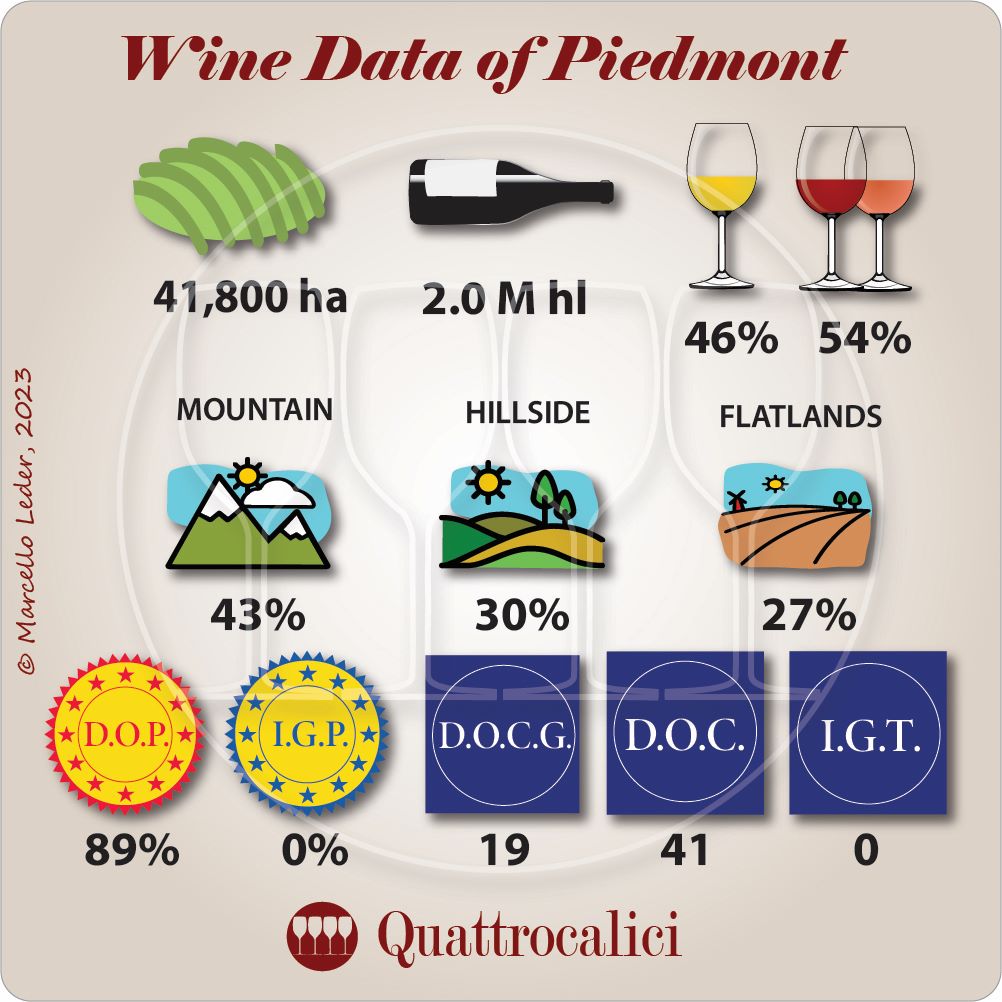
In total, Piedmont boasts 19 DOCG and 41 DOC appellations, with no IGTs. There are also 10 agrifood DOPs, including notable cheeses like Bra DOP and Castelmagno DOP, and 6 agrifood IGPs.

Wine areas of Piedmont

Piedmont is one of Italy’s historic regions for viticulture, one of the first to recover after the deep crisis of the 1980s, and today recognized as the home of some of the country’s most representative oenological excellences. As we have seen, from an enogastronomic point of view, Piedmont can be divided into the following main zones.

Barolo: The production area of Barolo is characterized by five famous locations that also constitute equally important zones: Barolo, Castigione Falletto, La Morra, Serralunga d’Alba, and Monforte d’Alba. Wines from these five locations have different characteristics: the soil of Barolo and La Morra gives the wine a softer, aromatic, decidedly fruity character with faster maturation. In Castiglione Falletto, Serralunga d’Alba, and Monforte d’Alba, the soil is less compact and fertile, producing more robust and intense wines that mature more slowly. These production characteristics are often the subject of discussion among both producers and enthusiasts.

Barbaresco: For years considered the “younger brother” of Barolo, Barbaresco is an extraordinary wine made from Nebbiolo grapes, named after the city where it is produced, not far from Barolo. The fame of Barbaresco is more recent than Barolo, gaining notoriety in the 1960s thanks to Giovanni Gaja and Bruno Giacosa. Barbaresco is generally considered more elegant and refined than Barolo and is produced in the locations of Barbaresco, Treiso, and Neive, each of which, due to the specifics of the area, confers specific characteristics to the wine.

Langhe and Roero: The Langhe are located near the city of Alba, to the right of the Tanaro river, and include the Barolo and Barbaresco zones. Besides Nebbiolo, other grapes such as Dolcetto and Barbera are cultivated here. The most important white grape varieties of the Langhe are Favorita and Arneis, the latter also present in Roero. Roero is located on the left bank of the Tanaro river. Here, the most widespread black grape is Nebbiolo, but the area is also known for a white grape: Arneis. White wines from Arneis are intense and complex on the nose and pleasant on the palate.

Monferrato and Astigiano: These two important wine areas are located in the southeastern part of the region. Here, the most important black grape variety is undoubtedly Barbera. The famous Brachetto d’Acqui is produced both sparkling and sweet sparkling and charms with its pronounced aromatics and pleasantness. Gavi, a white DOCG wine, is produced with Cortese grapes and is characterized by its intensity and harmony. Asti is famous for Moscato Bianco and the sweet sparkling wine named after the city. The success of Asti Spumante is attributed to Carlo Gancia, who decided in 1865 to make sparkling wine from Moscato Bianco. Moscato di Loazzolo is an elegant sweet wine also made with Moscato bianco. In the Asti area, the most important red wine is Barbera, which finds one of its highest expressions here.

Northern Piedmont: The northern area of Piedmont is characterized especially by the production of red wines from Nebbiolo, less known than those of Barolo and Barbaresco, but still of certain charm and interest. Among the most famous areas for these wines are Ghemme and Gattinara and the DOC Carema, in the western part and near the Valle d’Aosta. Erbaluce is a white grape with which dry wines are produced but also extraordinary sweet wines, belonging to the Erbaluce di Caluso DOCG denomination.

Regional Cuisine of Piedmont

Piedmont, a region rich in hills, mountains, and flat lands, reflects the characteristics of its territory through its typical products. From the plains of Vercelli, rice varieties like Carnaroli, Arborio, and Vialone Nano play starring roles in many recipes, while the hills of the Alba area are famous for their white truffles that flavor numerous local dishes. The region is also known for its traditional cheeses such as Castelmagno, which pairs well with a great Barolo; Bra cheese, in its fresher version to be paired with a Roero Arneis, a slightly bitter, dry, and herbaceous white wine, and in its harder, more aged version, which goes well with a Roero DOCG, a red wine made from Nebbiolo grapes. Aged Raschera cheese pairs well with wines from the Langhe, such as Dolcetto or Barbera d’Alba, while the less mature version matches nicely with a Cortese di Gavi. Robiola di Roccaverano cheese can also be paired with regional white wines like Gavi DOCG or young reds like Dogliani DOCG, among many others.

Piedmontese cuisine is renowned for its starters, both hot and cold, including stuffed peppers and onions enjoyed with a Gavi di Gavi white wine, crostini with truffles, salads, and cured meats, Vitello tonnato pairs excellently with a Roero Arneis wine. Famous first courses include Agnolotti del plin, with roast sauce or truffle, best enjoyed with a Grignolino d’Asti, Gnocchi all’ossolana (made with potato and chestnut flour), and various Risottos, such as those made with Barolo, asparagus, finanziera, and many others. Also noteworthy are Tajarin, homemade egg pasta, with truffle or sage and melted butter.

Meat-based main courses are abundant, such as the famous Brasato al Barolo, paired with the region’s most famous wine, and Bollito misto alla piemontese, ideally matched with a Barbera d’Alba. For poultry dishes, there’s Pollo alla babi (grilled chicken) and Pollo alla marengo, enjoyed with a Dolcetto di Ovada. Batsoà, traditional pork or veal trotters common in Canavese, boiled and then breaded and fried, pair well with a Grignolino d’Asti.

There are also many game meat dishes, like the famous Lepre in civet, Pernice al Barolo, and Piccioni saltati alla monferrina, which can be paired with a Nebbiolo di Gattinara. Finanziera, a dish made with offal (brains, liver, sweetbreads), sausage, and diced veal loin, plus broth and porcini mushrooms, Fritto misto, and Bagna caôda, a dip made with anchovies, oil, and garlic for fresh autumn vegetables, go well with a Freisa d’Asti.

Desserts and sweets worthy of mention include marrons glacés, cuneesi al rum, chestnut compote, and bônet, a milk chocolate pudding.

Quattrocalici Wine Guide