


The Best Tool to Learn about Italian Wine

Italy's Native Wine Grapes Guide

Bonarda

Grape's Data Sheet

The Bonarda Wine Grape in Italy

Bonarda - The Grape and the Wines

The Bonarda grape is a black grape variety native to Piedmont. It is often confused with Croatina and Uva Rara because these are also synonyms used for Bonarda outside the region. The first citations of the grape date back to the 1700s in Piedmontese documents. In 1799, Bonarda was described as a grape from the Turin area. Acerbi, in his famous 1825 work “Delle viti italiane,” recorded it as a grape from the Alessandria area. However, the first to differentiate Bonarda from other genetically similar grapes was Rovasenda in 1877. Confusion still exists even within Piedmont. In the Colli Piacentini and Oltrepò Pavese, Bonarda is a synonym for Croatina, while in Novara and Vercelli it is the local name for Uva Rara. However, Bonarda is an indigenous Piedmontese grape that was widespread before the phylloxera outbreak and is now nearing extinction, mostly used in blends with Barbera.

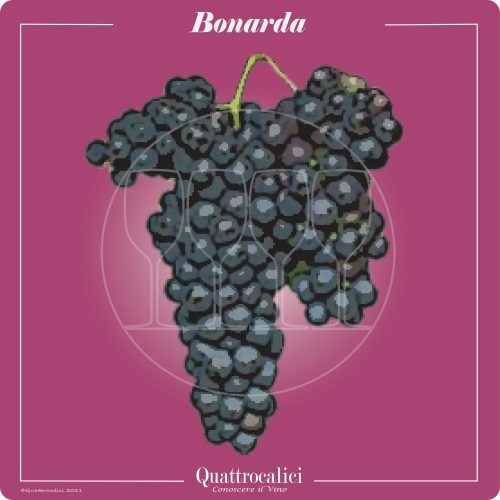
Today, Bonarda is predominantly cultivated in Piedmont, specifically in the Turin area, along the hilly strip from Chieri to Monferrato and in the province of Asti. A few hectares are also cultivated in the Pinerolo area, Val di Susa, and Canavese. Outside of Piedmont, its spread is quite limited, confined to the areas of Piacenza and Pavia. Large plantings of Bonarda are present in Argentina and Brazil, although the hypothesis of the Italian introduction of the grape to South America is still under verification. Ampelographically, Bonarda has medium to large clusters, pyramidal and winged, with medium density. The berries are small, oval, and very pruinose, with almost black-blue colors. Bonarda is a vigorous and fertile grape variety, best trained with the Guyot system although it tolerates short pruning forms. It suffers from downy mildew and frost but has good resistance to powdery mildew, rot, and moths. It can sometimes present issues with berry shatter. It is predominantly cultivated on clayey and less fertile soils.

bonarda a native wine grape of Italy

Bonarda - General Info Table

Bonarda is one of the  Native Grapes with Black berry widespread mainly in Piedmont, officially listed in the “Catalogo nazionale varietà di vite” since 1970. Its surface under vines in Italy is 750 ha.
Berry colorBlack berry
Grape CategoryNative Grapes
Main RegionPiedmont
Surface under Vines in Italy750 ha
Synonym(s)Uva rara
Year of listing1970

Bonarda - Ampelographic Data

Each grape variety is characterized by Ampelographic Descriptors that define the appearance of its main elements. The ampelographic features of the Bonarda grape variety are:
Leaf Features
The leaf of the Bonarda grape variety is medium-sized, wedge-shaped, pentagonal, with no lobes, with five lobes, with three lobes.
Bunch Features
The bunch of the Bonarda grape variety is sparse, medium-sized.
Berry Features
The berries of the Bonarda grape variety are medium-sized, small, of ellipsoidal shape and with Buccia pruinosa and black-bluish colored skin.

Bonarda - Wine Features

The Varietal Wine obtained from each and every Grape Variety, features precisely defined organoleptic characteristics. Referred to Bonarda grapes, they are as follows:
Varietal Wine's features
The wine obtained from Bonarda grapes is ruby red. On the palate the wine is fresh, thin.

Bonarda - Agricultural & Productive Features

Each and every grape variety features very specific agricultural and productive characteristics, such as productivity, yield, ripening time, the ideal type of climate or pruning system, sensitivity to adversities, varying degrees of disease resistance and many others. For the Bonarda grape variety, the main characteristics are:
Preferred pruningshort pruning, combination prumning
Vegetative vigorhigh vigor
Productivityhigh
Training systemGuyot
Sensitivitiesfrost, Peronospora, millerandage
Resistancespowdery mildew

Bonarda - Appellations of Origin

The Quattrocalici Grape Varieties Database collects data on all grape varieties that are explicitly mentioned in at least one Italian PDO (Protected Designation of Origin) or PGI (Protected Geographical Indication) denomination. The Bonarda grape variety is mentioned in the regulations of the following denominations:
DenominationTypeRegion
Albugnano DOCDOCPiedmont
Canavese DOCDOCPiedmont
Colli di Parma DOCDOCEmilia-Romagna
Colli Piacentini DOCDOCEmilia-Romagna
Colli Tortonesi DOCDOCPiedmont
Collina Torinese DOCDOCPiedmont
Monferrato DOCDOCPiedmont
Piemonte DOCDOCPiedmont
Pinerolese DOCDOCPiedmont
Ravenna IGTIGTEmilia-Romagna
Terre di Veleja IGTIGTEmilia-Romagna
Val Tidone IGTIGTEmilia-Romagna