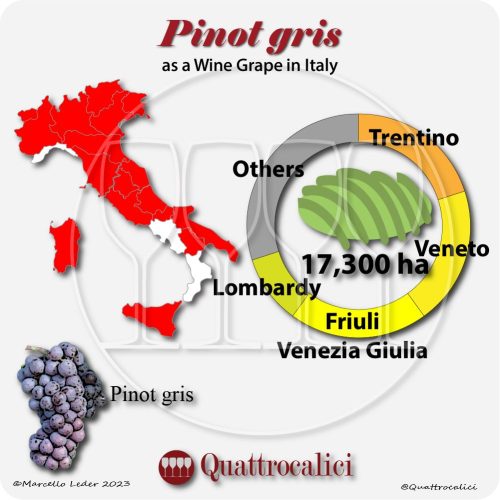


Pinot Grigio originates from Burgundy, where the majority of vineyards are still located, thanks to the particular climatic conditions of the region. However, it has become an international grape variety, reaching Italy, where the cultivation of Pinot Grigio has spread to regions such as Friuli-Venezia Giulia, Lombardy, Veneto, and Trentino-Alto Adige. The origin of the French name “pinot” comes from the word “pin,” meaning “pine.” The shape of its cluster resembles a small pine cone, a characteristic shared by all grape varieties bearing the “pinot” name.
The cultivation of Pinot Grigio is particularly complex and requires specific conditions and careful attention, not only in the vineyard but also in the winery. Pinot Grigio needs a particular habitat, with very cold climates and compatible soils, to support the development of the plant, which is especially difficult to cultivate outside its regions of origin.
In Italy, Pinot Grigio has been a fashionable wine for many years, with commercial success also accompanied by a notable qualitative improvement. Its natural color is coppery, as it is the only gray-skinned grape. Pinot Grigio is often vinified as a white wine, but if left to macerate in contact with the skins, its must takes on a more natural orange hue, as often happens in the Collio region, resulting in wines that are very pleasant, fruity, aromatic, and with good structure. The same practice is common in Alsace. Pinot Grigio also performs well in Germany (known as Ruländer) and Hungary (known as Szürkebarát).
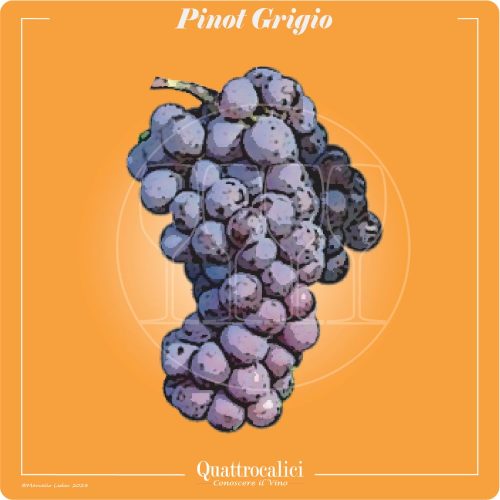
The Pinot Grigio grape variety is distinguished by its small, trilobed or wedge-shaped leaves, a short, cylindrical, and very compact cluster structure. The berries are spherical with a thin, pruinose skin and are pink in color.