


The Trebbiano di Soave grape, also known as Trebbiano di Lugana, has very ancient origins, situated in the area between the provinces of Verona, Brescia, and Mantua—the regions of Soave and Lugana, where it was historically known as Turbiana or Trebbiano Veronese. The Trebbiani family of grape varieties has been known in Italy since Roman times, with the name deriving from “Trebula,” meaning farmhouse. Pliny the Elder described a “Vinum Trebulanum,” which, according to this interpretation, referred to a “country wine” or “homemade wine.” Interestingly, Trebbiano di Soave shares a genetic identity with Verdicchio Bianco, though it differs significantly, particularly in its aromatic profile. Distinguishing the various Trebbiano clones, often named after their areas of origin or primary cultivation zones, can be challenging.
Despite its shared genetic lineage, Trebbiano di Soave has unique characteristics, particularly in its freshness and aromatic expression. Its early ripening, which requires harvest ahead of other varieties in the region, combined with its low productivity, once led to concerns that it might be replaced by Trebbiano Toscano. However, tradition prevailed, and today, Trebbiano di Soave, often blended with Garganega, contributes to some of the most fascinating wine expressions of the Veneto region.
Research into the genetic connection between Trebbiano di Soave, Trebbiano di Lugana, and Verdicchio has also uncovered the historical journey of this variety. Likely originating in Verona, it migrated to the Marche region during the 15th century, following a large migration prompted by a plague epidemic in Veneto. Over time, it adapted to new regions, developing distinct terroir-driven characteristics, giving rise to wines with unique aromatic profiles—from the Verdicchio dei Castelli di Jesi and Verdicchio di Matelica in the Marche to the Trebbiani of Soave and Lugana in Veneto.
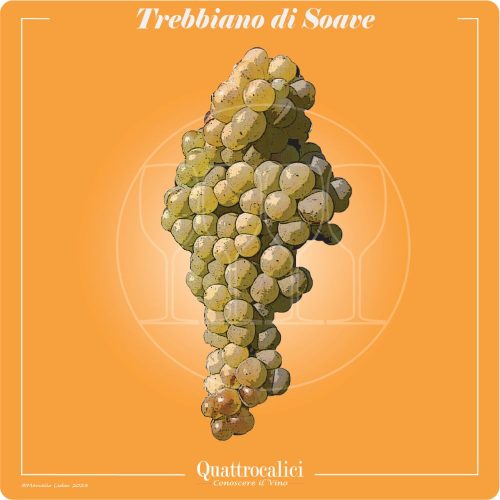
Today, approximately 2,000 hectares of Trebbiano di Soave are cultivated, primarily in Veneto and the Lombard side of Lake Garda. Ampelographically, it features medium-sized clusters with a pyramidal, elongated shape, slightly winged and compact. The berries are medium-sized, spherical, with thick, leathery greenish skins. The variety ripens in mid-October, demonstrating excellent vigor and producing medium-high, consistent yields. It thrives on well-exposed hillsides, as it is susceptible to acid rot, botrytis, and downy mildew.
Trebbiano di Soave can be vinified as a single varietal or in blends, often paired with Garganega. It is a key component in the production of Recioto di Soave, the famous sweet wine of Veneto, and features in numerous appellations. In Lombardy, it appears under the Capriano del Colle DOC, where it can be used in single-varietal wines or blends, and the Garda Colli Mantovani DOC, where it is only used in blends. In Veneto, it plays a vital role in blends, particularly in Recioto, Lessini Durello DOC, Soave DOC, Gambellara DOC, and the Colli Berici area.
