

Primitivo is a black-skinned grape variety widely grown in southern Italy, from Abruzzo to Basilicata, and from Sardinia to Campania. However, Primitivo finds its ideal territory in Puglia, particularly in the Manduria area. In the 1990s, Primitivo was the ninth most planted grape variety in Italy for wine production, with 17,000 hectares (just slightly less than the even more popular Negro Amaro). Primitivo shows a remarkable similarity to Zinfandel from California. DNA tests and extensive historical research have confirmed this common origin. The origins of Primitivo are uncertain, but it is believed that the grape comes from Dalmatia and was brought to Puglia over 2,000 years ago by the ancient Illyrians. Its name undoubtedly comes from the early ripening of the grapes.
In the 1700s, Don Francesco Filippi Indelicati, a priest from Gioia del Colle, noticed that a red-skinned grape variety ripened much earlier than the others, around mid-August. This grape was called “Zagarese” in the local dialect but was renamed “Primitivo”, from the Latin “Primativus,” referring to its early maturation. Primitivo later spread from Gioia del Colle to the present-day provinces of Lecce and Taranto and then to Salento.
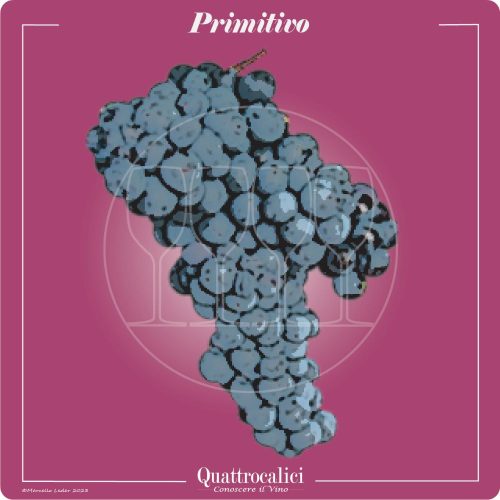
From an agronomic standpoint, Primitivo is a rather demanding grape, due to its sensitivity to both prolonged droughts and excessive humidity. Its dark blue berries, rich in pruina, are medium-sized and packed closely together in a very compact cluster. The humidity trapped between the berries can cause mold to form, so Primitivo requires a dry, warm climate, with intense but short rains that allow the berries to dry quickly and remain healthy. Primitivo is often trained in the “alberello” system, which ensures very low but extremely high-quality yields. This grapevine tends to be very long-lived, and it is possible to find vines over 80 years old, still on their original roots.
The intensity and body of the wines made from Primitivo, along with its high productivity (though not always consistent), meant that in the past it was mostly used as a blending wine. Only in more recent times, by working on reducing yields, returning to traditional training methods (the Pugliese alberello), and using more precise vinification techniques, has Primitivo led to truly remarkable products, rediscovered by the general public. Primitivo produced in this way generally has a deep, intense ruby color, with violet hues that turn to garnet with aging. The aroma is of red fruits like black cherry, blackberries, and plums, with additional floral notes of violet. Aging in wood gives it spicy hints, such as cinnamon, cocoa, black pepper, and licorice. On the palate, it is warm, full, and enveloping, with delicate tannins and good persistence.
