


The Viognier grape variety originates from the Rhône Valley in France, where it was introduced by Emperor Marcus Aurelius Probus, a native of Sirmium (modern Sremska Mitrovica, Serbia), suggesting its Balkan origins. Long forgotten due to its low productivity, Viognier has recently regained prominence as the foundation of the Condrieu white wines (Rhône Valley). These wines are known for their low acidity and remarkable aromatic intensity. Supporting its origins, Viognier is also cultivated on the island of Vis (Dalmatia), where it is called Vugava or Bugava. In Italy, Viognier is increasingly grown in warm regions like Tuscany, Emilia-Romagna, Umbria, and Lazio, often blended with other grape varieties. However, when vinified in purity, it can sometimes deliver exceptional results.
Ampelographic Characteristics
- Leaf: Small to medium, orbicular, with five lobes.
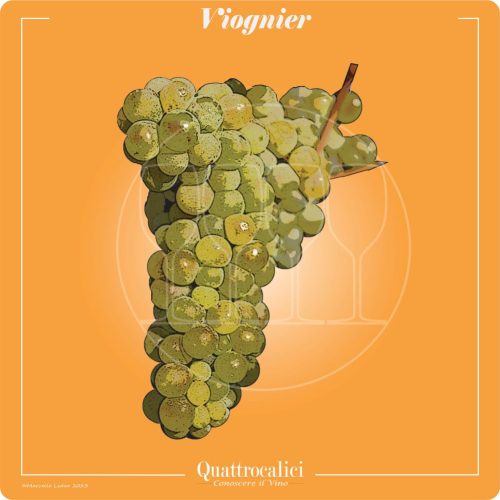
- Cluster: Medium-small, truncated-conical, simple or winged, sometimes compact.
- Berry: Small, spherical or slightly oval, with a thick yellow-amber skin.
Wine Profile
When vinified as a single varietal, Viognier produces wines with:
- Structure: Comparable to the best Chardonnay.
- Freshness: Reminiscent of Sauvignon Blanc.
- Aromas: Tropical notes akin to Gewürztraminer, including peach, apricot, mango, and floral hints of orange blossom and honeysuckle.
Challenges in Cultivation and Winemaking
Viognier only reaches its full aromatic potential when harvested at the ideal maturity. Being a slightly late-ripening grape, there is a risk that over-ripeness can lead to a loss of freshness, with higher sugar content tipping the balance toward alcohol.
Italian Adaptation
In Italy, the warm climate suits Viognier well, allowing it to develop its signature aromatic richness. While primarily used in blends, pure Viognier wines are gaining recognition for their expressiveness and elegance.
